
Most people think weight gain is just about eating too much or not exercising enough. But what if the real issue isn’t your plate-it’s your sleep schedule? If you’ve ever struggled to lose weight despite sticking to a diet, your circadian rhythm might be the hidden culprit. This isn’t theory-it’s biology. Your body runs on a 24-hour internal clock that controls everything from when you feel hungry to how your body burns calories. When that clock gets thrown off, your metabolism doesn’t just slow down-it starts working against you.
Why Your Body Gets Confused at Night
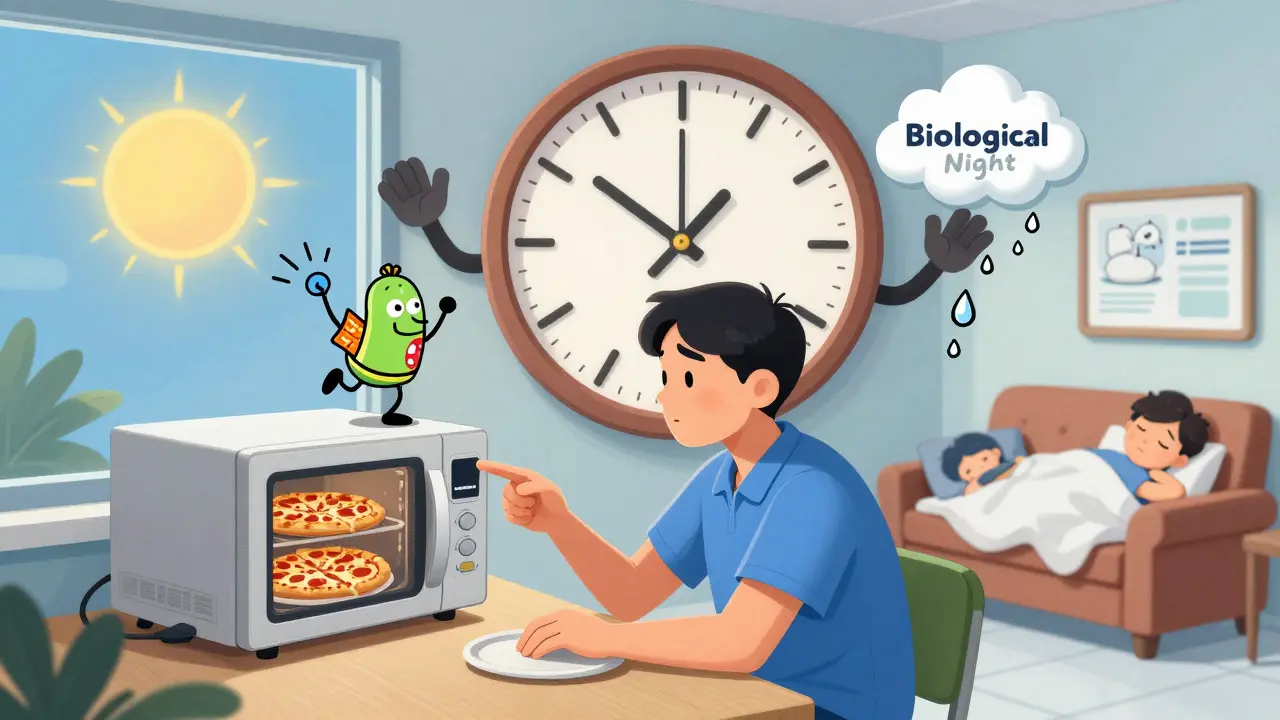
Your circadian rhythm is like a master conductor, syncing up your brain, liver, fat cells, and muscles to match the day-night cycle. When it’s dark, your body releases melatonin to tell you it’s time to sleep. When it’s light, cortisol rises to wake you up. But when you eat at 2 a.m. after a night shift, or scroll through your phone under bright lights past midnight, your body doesn’t know whether it’s day or night. That confusion messes with hormones that control hunger and fat storage.Studies show that eating late at night reduces the thermic effect of food by up to 17%. That means your body burns fewer calories digesting the same meal compared to eating it during daylight hours. Even worse, your insulin sensitivity drops by 20-25% during biological night hours. So when you snack on pizza or chips at 3 a.m., your body doesn’t handle the sugar well-it stores more of it as fat. And you don’t even feel full afterward.
The Numbers Don’t Lie
A 2014 study published in PNAS tracked healthy adults on simulated night shifts. Even when they ate the exact same amount of food as during day shifts, their total daily energy expenditure dropped by 3%-about 55 calories. That might not sound like much, but over a year, that’s the equivalent of gaining nearly 8 pounds just from being awake at the wrong time. Meanwhile, people who sleep less than 6 hours a night consume an extra 250+ calories daily, mostly from sugary, high-carb snacks. That’s a net gain of over 150 calories a day. In a year, that adds up to more than 15 pounds.It’s not just about calories in versus calories out. It’s about when those calories are consumed. Your liver, pancreas, and fat cells have their own internal clocks. When those clocks are out of sync with your sleep schedule, your body stops burning fat efficiently. Mouse studies show that animals with broken clock genes gain 15-20% more weight on the same diet as healthy mice. Humans aren’t mice, but the same genes control our metabolism too.
Shift Workers and the Hidden Epidemic
About 20% of the global workforce works nights, rotating shifts, or irregular hours. In the UK alone, over 3 million people work outside standard business hours. A 2023 Reddit survey of 1,245 shift workers found that 78% gained weight after starting night shifts. One nurse shared: “I gained 35 pounds in my first year. I ate the same food-just at 3 a.m. instead of 7 p.m.”Why? It’s not laziness. It’s biology. Sleep deprivation increases ghrelin-the hunger hormone-by 22%, while lowering leptin, the hormone that tells you you’re full. Brain scans show that when you’re sleep-deprived, your reward centers light up more when you see images of cookies or chips. You’re not weak-you’re wired to crave them.
Even more telling: shift workers gain 2.5 kg more over two years than day workers, even when they eat the same number of calories. That’s the equivalent of eating an extra 300 calories a day without realizing it.
Time-Restricted Eating: A Simple Fix
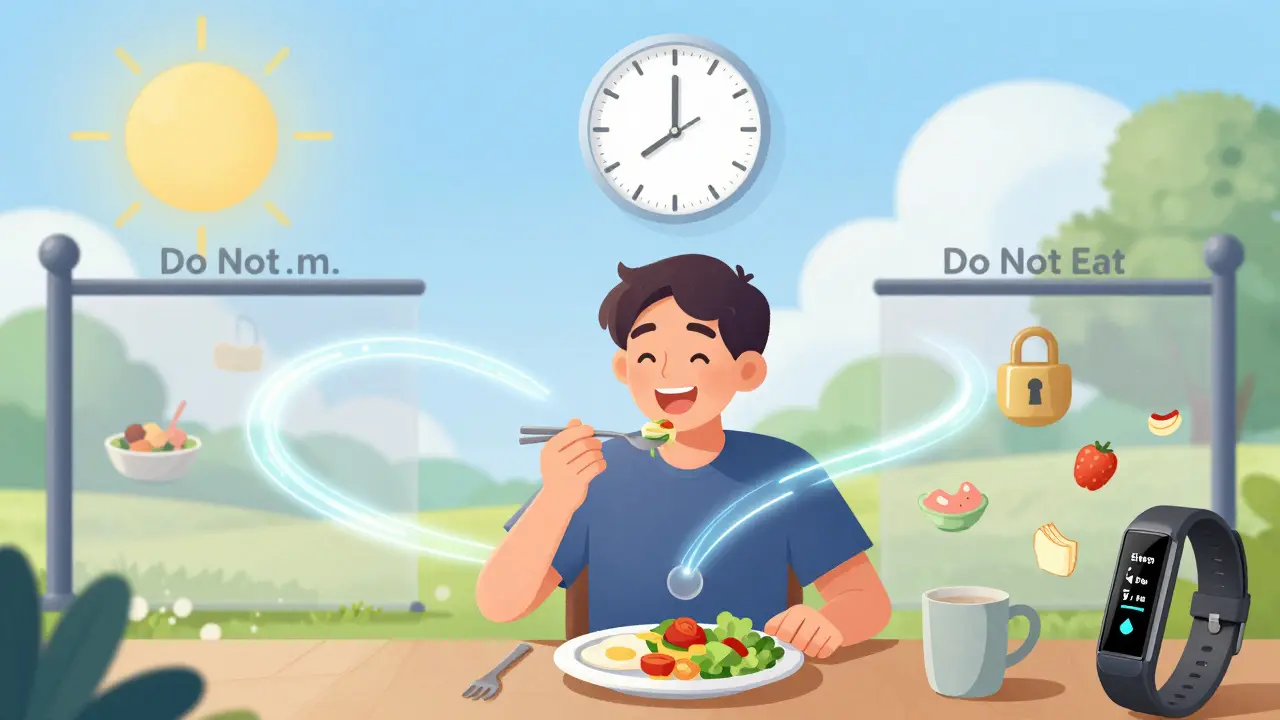
There’s a powerful, science-backed solution: time-restricted eating (TRE). This means limiting your food intake to a 10-hour window-or even 8 hours-during daylight hours. You don’t need to count calories. You just need to stop eating after dinner and wait until morning to eat again.A 2019 study from the Salk Institute found that overweight adults who ate only between 8 a.m. and 6 p.m. lost 3-5% of their body weight in 12 weeks. That’s about 5-8 pounds for someone weighing 160 pounds. Even better, 74% of users on the Zero app reported reduced nighttime cravings after switching to a 10-hour eating window.
Here’s how to start:
- Choose a 10-hour window that fits your schedule-e.g., 7 a.m. to 5 p.m. or 9 a.m. to 7 p.m.
- Stick to it every day, even weekends. Consistency matters more than perfection.
- Stop eating at least 3 hours before bed. This helps your body switch from storage mode to repair mode.
- Gradually shorten your window by 30 minutes every week if you want more results.
People with early chronotypes (morning people) do best with an 8 a.m. to 6 p.m. window. Night owls can try 10 a.m. to 8 p.m. The key is matching your eating window to your natural rhythm, not forcing yourself into someone else’s schedule.
Why This Works Better Than Diets
Traditional diets focus on what you eat. Circadian-based approaches focus on when you eat. That’s why they work better for people who’ve tried everything else. You’re not fighting hunger-you’re aligning your body’s natural rhythm. When your eating window matches your body’s active phase, insulin works better, fat burning increases, and inflammation drops.Unlike calorie counting, TRE doesn’t require willpower. It’s a schedule, not a restriction. And unlike weight-loss drugs, it has no side effects. In fact, people report better sleep, more energy, and fewer cravings within days.
The Bigger Picture
The global market for circadian health tools is expected to hit $2.8 billion by 2030. Hospitals like Kaiser Permanente are already running programs that use light therapy and timed meals to help shift workers lose weight. The FDA now requires drug trials for obesity to consider timing of medication and meals. Even Fitbit’s 2024 sleep score now includes a circadian alignment metric that predicts 18% of weight change.This isn’t a fad. It’s physiology. Your body evolved to eat during daylight and sleep at night. Modern life-late-night screens, 24/7 food access, shift work-has broken that rhythm. And your metabolism is paying the price.
What’s Holding People Back
The biggest obstacle isn’t science-it’s lifestyle. Social dinners, late work hours, and family routines make consistent eating windows hard. A 2021 study found that 68% of people trying TRE struggled with missed meals because of social events. Others give up after a week because hunger feels intense at first.But here’s the truth: that hunger fades. Most people report that intense cravings disappear after 7-10 days. Your body adapts. The real challenge is sticking to it when life gets messy. That’s why consistency-even on weekends-is more important than perfection.
Some experts argue that the 55-calorie daily energy drop from circadian misalignment is too small to matter. But that misses the point. It’s not just about calories. It’s about hormones, insulin, fat storage, and appetite. When you combine all these effects, the impact is massive.
Final Thought: Your Clock Is Always Running
You can’t out-exercise a broken sleep schedule. You can’t out-diet a misaligned metabolism. If you’re tired of cycling through diets that never stick, try fixing your rhythm instead. Eat during daylight. Sleep in darkness. Keep your meals within a tight window. Let your body do what it was designed to do.It’s not about willpower. It’s about working with your biology-not against it.
Can sleeping less really make you gain weight?
Yes. Sleeping less than 6 hours a night increases hunger hormones by 22% and boosts cravings for high-carb snacks by 33%. Even if you don’t eat more, your body becomes less efficient at burning calories. Studies show people who sleep poorly consume an extra 250+ calories daily, leading to weight gain over time.
Does eating at night cause weight gain even if I don’t overeat?
Yes. Your body processes food differently at night. Insulin sensitivity drops by 20-25% during biological night hours, meaning more calories get stored as fat. The thermic effect of food also falls by up to 17%, so you burn fewer calories digesting late-night meals. Even the same meal eaten at 8 p.m. vs. 3 a.m. has different metabolic outcomes.
What’s time-restricted eating, and how does it help?
Time-restricted eating means limiting food intake to a 10-hour (or shorter) window during daylight hours. For example, eating only between 8 a.m. and 6 p.m. Studies show this leads to 3-5% body weight loss in 12 weeks without calorie counting. It works by syncing your eating pattern with your body’s natural metabolic rhythm, improving insulin sensitivity and reducing nighttime cravings.
I work nights. Can I still use circadian rhythm strategies?
Yes. Even if you work nights, you can still align your eating window with your active period. If you sleep during the day, eat your meals during your waking hours-say, 7 p.m. to 5 a.m.-and avoid eating during your sleep window. Keep your light exposure bright during your active time and dark during sleep. Consistency in timing matters more than matching the clock.
How long does it take to see results from fixing my sleep and eating schedule?
Most people notice reduced nighttime hunger and better sleep within 3-5 days. Weight loss typically starts after 2-4 weeks, with noticeable results by week 6-8. The key is consistency-missing a few days won’t ruin progress, but frequent changes will delay results.
Are there any tools or apps that help track circadian rhythm for weight loss?
Yes. Apps like Zero, Sleep Cycle, and Fitbit now include circadian alignment metrics. Fitbit’s 2024 Sleep Score predicts 18% of weight change variability based on sleep timing and light exposure. These tools don’t replace habits-they help you stay consistent by showing how your schedule affects your body.
Jodi Harding
January 18, 2026 AT 18:28Danny Gray
January 19, 2026 AT 07:35Tyler Myers
January 20, 2026 AT 23:20Zoe Brooks
January 22, 2026 AT 19:23Wendy Claughton
January 24, 2026 AT 11:47Stacey Marsengill
January 25, 2026 AT 05:21Aysha Siera
January 25, 2026 AT 14:37Jay Clarke
January 26, 2026 AT 02:55Ryan Otto
January 26, 2026 AT 05:42Praseetha Pn
January 28, 2026 AT 04:16Nishant Sonuley
January 28, 2026 AT 17:23Emma #########
January 29, 2026 AT 23:42Andrew McLarren
January 31, 2026 AT 09:50Naomi Keyes
February 1, 2026 AT 02:18