Medication Food Timing Checker
Check Medication Food Interaction
Enter your medication name to see if it should be taken with food or on an empty stomach.
Have you ever taken a pill with your morning coffee, only to wonder if it even worked? You’re not alone. Millions of people take medications without thinking about what they’re eating-or not eating-at the time. But the truth is, food can make or break how well your medicine works. Sometimes it helps. Other times, it stops the drug from working at all. And in some cases, it can even make you sick.
Why Food Changes How Medicines Work
Your stomach isn’t just a bag that holds food. It’s a chemical factory. When you eat, your body changes the environment inside it. The pH rises from super acidic (around 1-2) to milder (3-5). Digestive juices flow. Bile gets released. Gastric emptying slows down-sometimes for hours. All of this affects how drugs dissolve, absorb, and enter your bloodstream. Take levothyroxine, the common thyroid medication. If you take it with breakfast, your body absorbs 20-50% less of it. That’s not a small drop. It’s enough to throw your TSH levels out of whack, making you feel tired, gain weight, or even need a higher dose just to feel normal. That’s why doctors tell you to take it on an empty stomach, 30 to 60 minutes before eating. On the flip side, some drugs need food to work. Ibuprofen, for example, can cause stomach ulcers if taken alone. But when taken with food, that risk drops by 50-70%. Same with statins like Lipitor. Take them with a meal, and your body absorbs more of the drug. Skip the food, and you might not get the full cholesterol-lowering benefit.Medications That Must Be Taken on an Empty Stomach
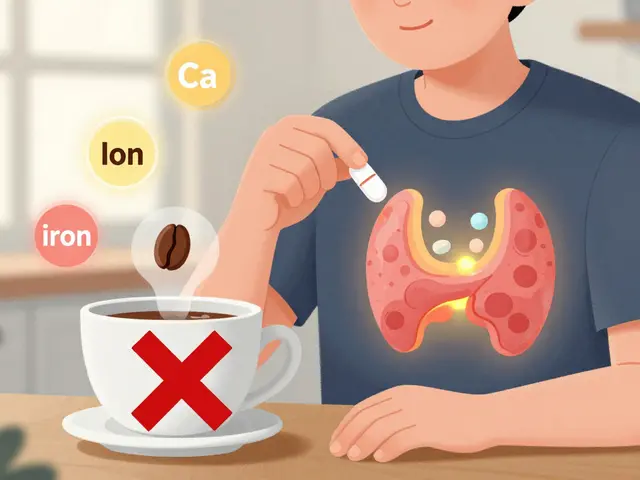
These drugs don’t play nice with food. If you eat around the time you take them, you’re basically wasting your money-or worse, risking your health.- Levothyroxine (Synthroid): Food, coffee, calcium, and iron all block absorption. Best taken first thing in the morning, at least 30 minutes before anything else. Some people even take it at 4 a.m. to avoid interference.
- Alendronate (Fosamax): This osteoporosis drug needs a full glass of water and no food for at least 30 minutes after. Eat too soon, and your body absorbs 60% less. That means your bones don’t get the protection they need.
- Sucralfate (Carafate): This ulcer coating agent only works if it’s on an empty stomach. Food prevents it from sticking to the ulcer site.
- Ampicillin: Food cuts its peak concentration by 35%. Take it 30 minutes before or 2 hours after eating for full effect.
- Zafirlukast (Accolate): A 40% drop in absorption with food. Must be taken 1 hour before or 2 hours after meals.
- Omeprazole (Prilosec) and Esomeprazole (Nexium): These proton pump inhibitors block acid production triggered by food. Take them 30-60 minutes before your first meal. Pantoprazole (Protonix) is the exception-food doesn’t affect it much.
Medications That Need Food to Work Right
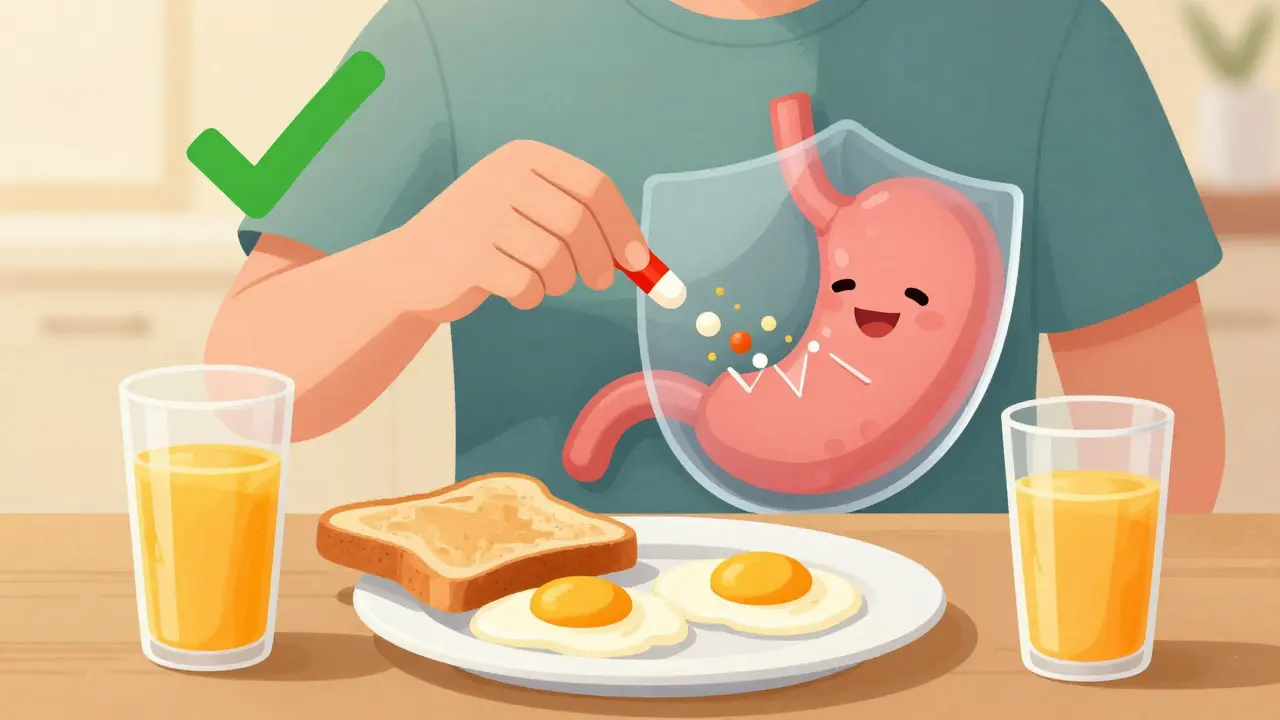
Some pills are like vitamins-they need a meal to be absorbed properly. Taking them on an empty stomach doesn’t just make them less effective. It can make you feel worse.- NSAIDs (ibuprofen, naproxen): These painkillers irritate the stomach lining. Food acts like a buffer. Studies show it cuts ulcer risk by half. If you’ve ever had stomach pain after taking Advil, food timing is likely the fix.
- Aspirin (high-dose): For pain relief, not heart protection, aspirin should be taken with food. It drops gastric irritation from 25% to just 8%.
- Duloxetine (Cymbalta): This antidepressant causes nausea in about half of users on an empty stomach. Take it with food, and nausea drops by 30%.
- Statins (atorvastatin, simvastatin): Food helps your body absorb them better. But here’s the catch: grapefruit juice. Even a single glass can spike statin levels by 300-500%. That raises your risk of muscle damage by 15 times. Avoid it completely.
- Griseofulvin: This antifungal needs fat to work. Take it with a high-fat meal like eggs and bacon, and absorption jumps by 50%.
The Science Behind the Rules
It’s not magic. It’s chemistry and biology. - Calcium and iron in dairy or supplements bind to antibiotics like tetracycline and doxycycline, blocking absorption by 50-75%. Take them 2-3 hours apart. - High-fat meals slow gastric emptying by 90-120 minutes. That delays drugs like levothyroxine, which need fast absorption. A 2021 study in the New England Journal of Medicine showed this delay cuts thyroid hormone effectiveness by 22%. - Acid-labile drugs like penicillin V break down in higher pH levels. Food raises stomach pH, so these drugs degrade faster and don’t work as well. - Bile helps dissolve fat-soluble drugs. No food? Less bile. Less absorption. The FDA now requires drug makers to test new medications with both high-fat and low-fat meals before approval. That’s because 68% of new drugs approved between 2018 and 2022 need specific food instructions. This isn’t a minor detail-it’s a core part of how the drug works.What Happens When You Ignore the Rules
People don’t always follow instructions. And the consequences are real. - A 2022 Express Scripts survey of 10,000 people found 65% took medications without checking food timing. Of those, 41% said their meds didn’t work as well. 29% had worse side effects. - On Reddit, users shared stories like one who took Synthroid with coffee and cream for two years-until their TSH levels went wild. After switching to taking it at 4 a.m. and waiting 90 minutes, their levels stabilized. - For PPIs, taking them with food instead of before it reduces healing rates for esophagitis from 93% to 67% in just eight weeks. - The Institute for Safe Medication Practices estimates 12,000-15,000 medication errors each year are tied to food timing. Thyroid meds make up 22% of those. The cost? Over $290 billion a year in wasted healthcare spending due to non-adherence, according to the American Pharmacists Association. That’s not just money-it’s missed diagnoses, unnecessary hospital visits, and preventable suffering.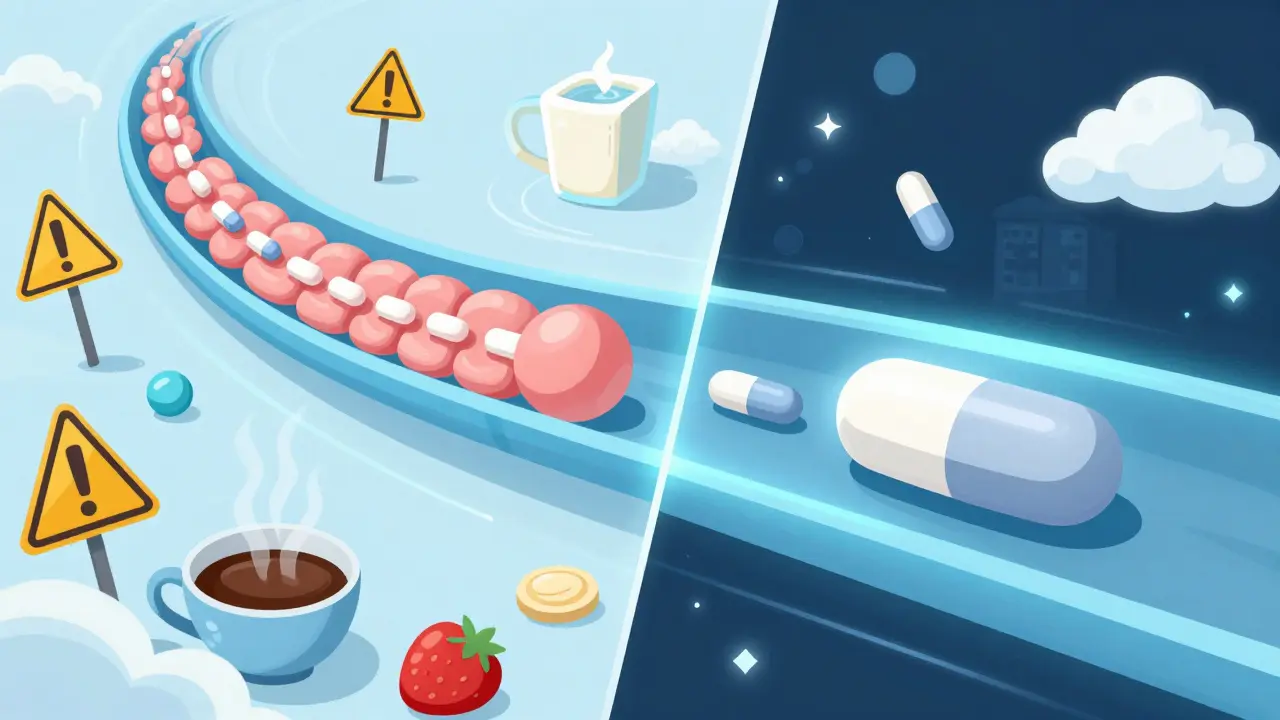
How to Get It Right Every Time
You don’t need to be a pharmacist to get this right. Here’s how to make food timing simple:- Use the 2-1-2 Rule: For empty stomach meds: take them 2 hours after eating, or 1 hour before the next meal. If you’re unsure, wait 2 hours after eating.
- Label your pill organizer: Use sticky notes or color-coded compartments: red for “empty stomach,” green for “with food.” A 2022 study showed this improved adherence by 35%.
- Use a medication app: Apps like Medisafe and GoodRx send alerts: “Take your pill now-wait 30 minutes before eating.” Users who used these saw a 28% drop in errors.
- Ask your pharmacist: Pharmacists give food-timing advice 92% of the time. Doctors? Only 45%. If your prescription label says “take on empty stomach,” ask your pharmacist to explain what that means in real terms.
- Stagger your meds: If you take both types, space them out. Take levothyroxine at 7 a.m., then breakfast at 7:30 a.m., then your ibuprofen with lunch at noon.
What’s Changing in the Future
The good news? Science is catching up. Johnson & Johnson’s new Xarelto Advanced formulation works the same whether you eat or not. It uses a smart coating that protects the drug from stomach pH changes. In trials, it showed only 8% variability in absorption-compared to 35% in the old version. Researchers at the University of Michigan are testing nanoparticle versions of levothyroxine that stick to the gut lining and bypass food interference entirely. Early results show 92% consistent absorption, whether the patient ate or fasted. The FDA is even considering removing food-effect testing for 37% of generic drugs where data shows food doesn’t matter. That could speed up cheaper versions hitting the market. But here’s the catch: these new drugs are still the minority. For now, 75% of the medications you’re likely taking still depend on food timing. So don’t wait for the future. Master the present.Final Checklist: When in Doubt, Ask
Before you swallow your next pill, ask yourself:- Does the label say “take on empty stomach” or “take with food”?
- Do I know what “empty stomach” means? (1 hour before or 2 hours after eating)
- Am I drinking coffee, milk, or grapefruit juice with this? (They interfere with many drugs)
- Have I taken this the same way every day?
Can I take levothyroxine with coffee?
No. Coffee-especially with cream or milk-blocks levothyroxine absorption by up to 50%. Wait at least 30 to 60 minutes after taking it before drinking coffee. Some people take it at 4 a.m. and wait until 5:30 a.m. to have breakfast or coffee to be safe.
Is it okay to take ibuprofen on an empty stomach?
It’s not recommended. Taking ibuprofen without food increases your risk of stomach ulcers by 50-70%. Always take it with a meal or snack. Even a small piece of toast helps buffer the acid and protect your stomach lining.
Why does grapefruit juice affect statins?
Grapefruit juice blocks an enzyme in your gut called CYP3A4, which normally breaks down statins like simvastatin and atorvastatin. When that enzyme is blocked, the drug builds up in your blood-sometimes 300-500% higher than normal. That raises your risk of rhabdomyolysis, a serious muscle breakdown that can damage your kidneys. Avoid grapefruit entirely if you’re on these statins.
What if I forget to take my pill on an empty stomach?
If you realize within 30 minutes of eating, you can still take it and wait 2 hours before your next meal. If it’s been longer than an hour, skip that dose and take your next one at the regular time. Don’t double up. For critical meds like levothyroxine, missing a dose or taking it with food means your thyroid levels may be off for days. Talk to your doctor if this happens often.
Do all antibiotics need to be taken on an empty stomach?
No. Only certain ones. Tetracycline and doxycycline must be taken on an empty stomach because calcium, iron, and dairy bind to them. But amoxicillin and azithromycin are fine with food. Always check the label or ask your pharmacist. Don’t assume all antibiotics work the same way.
Can I use a pill organizer for food-timing meds?
Yes-and you should. Pill organizers labeled with “empty stomach” and “with food” help you avoid mistakes. A 2022 study found using color-coded labels improved correct dosing from 52% to 89%. Just make sure you’re putting the right pills in the right compartments. Some meds need to be taken at specific times, not just with meals.