
What Is Hypoparathyroidism?
Hypoparathyroidism is a rare endocrine disorder where the parathyroid glands don’t make enough parathyroid hormone (PTH). Without enough PTH, your body can’t regulate calcium and phosphate properly. This leads to low calcium in the blood - a condition called hypocalcemia - and high phosphate levels. Symptoms can include tingling in the fingers, muscle cramps, fatigue, dry skin, and even seizures if left untreated. Most cases happen after thyroid or neck surgery, but it can also come from autoimmune disease, genetics, or radiation damage.
Why Calcium and Vitamin D Are Central to Treatment
PTH normally tells your bones to release calcium, your kidneys to hold onto calcium, and your intestines to absorb more of it. When PTH is missing, those signals stop. That’s why treatment focuses on replacing what PTH should be doing: raising calcium and lowering phosphate. The standard approach uses two things: calcium supplements and active vitamin D analogues like calcitriol or alfacalcidol. These aren’t just vitamins - they’re medications that act like PTH in your body.
Regular vitamin D3 (cholecalciferol) won’t work well here. Your kidneys can’t convert it to the active form without PTH. That’s why doctors skip D3 and go straight to calcitriol - it’s already activated. Studies show calcitriol raises calcium levels 2.3 times faster than D3. You’ll typically start with 0.25 to 0.5 micrograms daily, adjusted based on blood tests.
Dosing Calcium Correctly: More Than Just Taking Pills
Calcium supplements are the backbone of treatment, but how you take them matters more than how much. Most patients need 1,000 to 2,000 mg of elemental calcium daily, split into 2-4 doses. Why split? Because your body can only absorb about 500 mg at a time. Taking it all at once means half gets wasted.
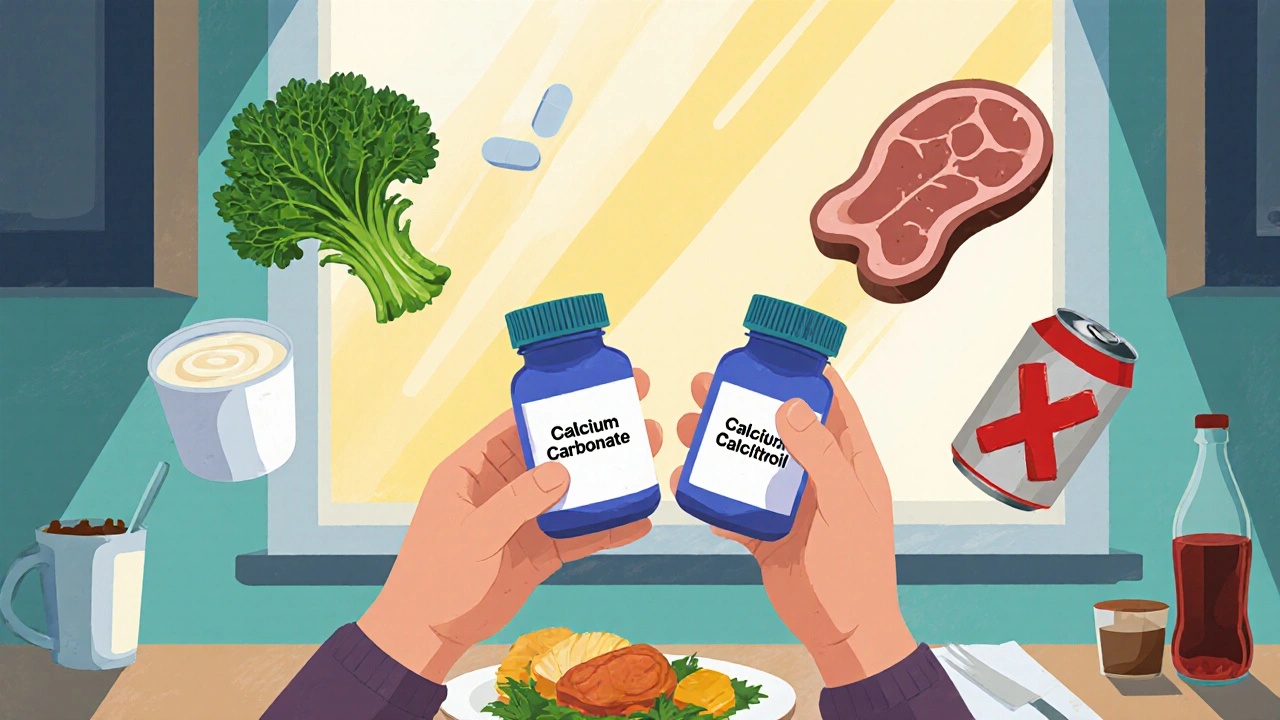
Calcium carbonate is preferred over calcium citrate because it’s cheaper and packs more elemental calcium - 40% vs. 21%. That means you need fewer pills. For example, 1,250 mg of calcium carbonate gives you 500 mg of elemental calcium. Take it with meals. Not only does food help absorption, but calcium also acts as a phosphate binder, helping lower high phosphate levels.
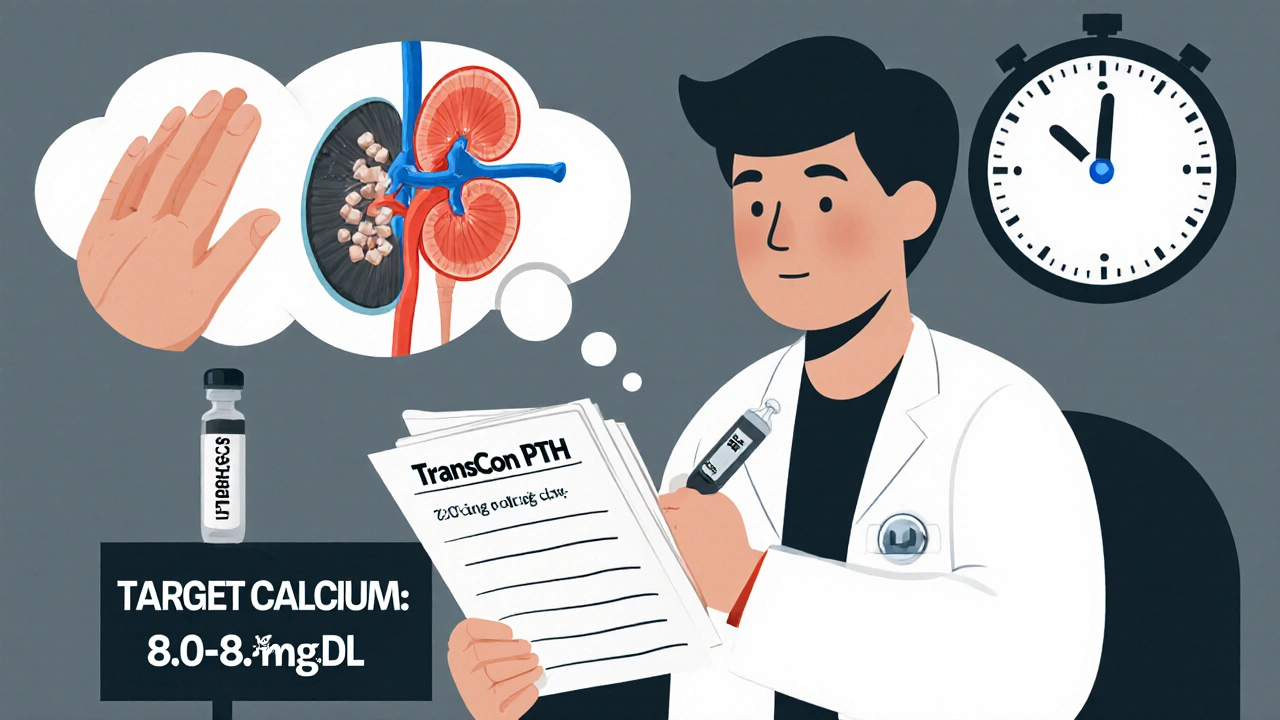
But don’t go overboard. Taking more than 2,000 mg of elemental calcium daily increases heart disease risk by 20-30%, according to the Women’s Health Initiative. Stick to the target range: 2.00-2.25 mmol/L (8.0-8.5 mg/dL) in your blood. Higher than that raises your risk of kidney stones and calcium deposits in your brain.
Monitoring Is Non-Negotiable
This isn’t a set-it-and-forget-it condition. You need regular blood and urine tests. Key numbers to track:
- Serum calcium: Keep it between 2.00-2.25 mmol/L (8.0-8.5 mg/dL)
- 24-hour urinary calcium: Must stay below 250 mg/day (6.25 mmol/day). Above this, you’re at risk for kidney stones - 5 to 7 times more likely.
- Serum phosphate: Target 2.5-4.5 mg/dL
- Magnesium: Below 1.7 mg/dL? You need magnesium supplements. Low magnesium makes calcium treatment less effective, even if your PTH levels were normal.
- 25-hydroxyvitamin D: Aim for 20-30 ng/mL (49.92-74.88 nmol/L). This is why most patients also take 400-800 IU of vitamin D3 daily, even on active vitamin D analogues.
Test every 1-3 months when starting treatment. Once stable, every 3-4 months is enough. Skipping tests is how people end up with kidney damage or brain calcifications.
When Standard Treatment Isn’t Enough
About 25-30% of patients struggle with conventional therapy. If you’re taking more than 2 grams of calcium or 2 micrograms of calcitriol daily and still having symptoms, you’re in the difficult-to-treat group. Signs you might need something else:
- Constant tingling or muscle cramps despite meds
- High urinary calcium despite diet changes
- Needing 6-10 pills a day
- Severe constipation from calcium
Doctors may add a thiazide diuretic like hydrochlorothiazide (12.5-25 mg daily) to reduce calcium in urine. Or switch to a low-sodium diet - less than 2,000 mg of salt per day - to help your kidneys hold onto calcium.
For those who still can’t stabilize, recombinant PTH therapies like Natpara or Forteo are options. These are daily injections that replace the missing hormone. They can cut calcium and vitamin D needs by 30-40%. But they cost around $15,000 a month - versus $100-200 for pills - and require special pharmacy handling and prior authorization. Natpara was pulled from the U.S. market in 2019 over manufacturing issues but returned in 2020 with strict safety rules.
Dietary Adjustments That Actually Help
You can’t just rely on pills. Food plays a big role. Eat calcium-rich foods: milk (300 mg per cup), yogurt, kale (100 mg per cup), broccoli (43 mg per cup), and fortified plant milks. But avoid high-phosphate foods: soda (500 mg per liter), processed meats (150-300 mg per serving), and hard cheeses (500 mg per ounce). Your goal: keep daily phosphorus under 800-1,000 mg.
Some patients find relief by eating smaller, more frequent meals with calcium. Instead of three big doses, try four or five smaller ones. This smooths out calcium levels and reduces the “calcium rollercoaster” - the swings between tingling and fatigue that so many patients describe.
Magnesium: The Overlooked Player
If your magnesium is low, calcium treatment won’t work well. Why? Magnesium is needed for PTH to be released and for cells to respond to it. Even in people without hypoparathyroidism, low magnesium causes low calcium. So if your magnesium is below 1.7 mg/dL, supplement. Magnesium oxide (400-800 mg daily) or magnesium citrate (200-400 mg daily) are common choices. In one Cleveland Clinic study of 78 patients, keeping magnesium above 1.9 mg/dL reduced hypocalcemic episodes by 35%.
What’s Coming Next
Research is moving fast. A new drug called TransCon PTH showed in a 2022 trial that 89% of patients could maintain normal calcium levels with just one injection per day - compared to 3% on placebo. It’s not approved yet, but it could be a game-changer for people tired of multiple pills.
Long-term risks are also being studied. About 15-20% of patients develop early kidney disease after 10 years on conventional therapy. And those who keep calcium above 2.35 mmol/L for years have nearly 3 times higher risk of calcium deposits in the brain. The goal isn’t just to feel better today - it’s to avoid damage tomorrow.
Living With Hypoparathyroidism: Practical Tips
- Take calcium with meals. It boosts absorption and helps bind phosphate.
- Take vitamin D at bedtime. It absorbs better when your stomach is empty.
- Carry emergency calcium. Keep 2-3 calcium tablets (500-1,000 mg total) in your bag. If you feel tingling or muscle spasms, chew them right away.
- Track your symptoms. Use a simple journal: note tingling, cramps, fatigue, and when you took meds. Bring it to every appointment.
- Find a specialist. Most family doctors aren’t trained in this. Work with an endocrinologist - at least in the first year. After that, stable patients can be managed by their GP with endocrine backup.
What Patients Say
A 2021 survey of 412 people with hypoparathyroidism found that 68% struggle to keep calcium levels steady. Half report daily symptoms. Many describe it as a “rollercoaster” - one day fine, the next numb and exhausted. Constipation from calcium pills is common. Others say getting PTH therapy approved takes 30-45 days, leaving them stuck with pills that don’t work well.
But there are wins. People who split their calcium into 4-5 doses report fewer symptoms. Those who track magnesium and vitamin D3 levels feel more in control. And those who learn to recognize early signs - like numbness around the mouth - can act before a full-blown crisis.
jamie sigler
November 29, 2025 AT 13:49Bernie Terrien
December 1, 2025 AT 12:10Tina Dinh
December 2, 2025 AT 23:15Matthew Higgins
December 4, 2025 AT 21:55Mary Kate Powers
December 5, 2025 AT 23:38Sara Shumaker
December 6, 2025 AT 00:18Scott Collard
December 6, 2025 AT 07:13Peter Axelberg
December 7, 2025 AT 21:30Jennifer Wang
December 9, 2025 AT 16:03stephen idiado
December 10, 2025 AT 13:28Subhash Singh
December 11, 2025 AT 05:29Geoff Heredia
December 12, 2025 AT 02:54Andrew Keh
December 13, 2025 AT 15:57Peter Lubem Ause
December 14, 2025 AT 17:47