
Amiodarone-Digoxin-Warfarin Dose Adjuster
When starting amiodarone in patients already taking digoxin and warfarin, precise dose adjustments are critical to prevent life-threatening toxicity. This tool calculates the recommended dose reductions based on current medications.
Recommended Adjustments
Enter your current doses to see recommended adjustments.
Critical Monitoring Guidelines
• Check digoxin levels 72 hours after starting amiodarone
• Test INR every 48-72 hours for first two weeks
• In elderly patients, keep digoxin levels < 1.0 ng/mL
• Monitor for nausea, blurry vision, or irregular heartbeat
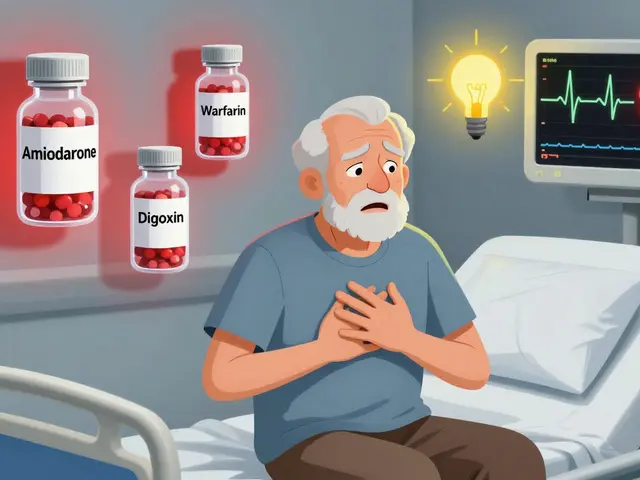
When a patient is on amiodarone, digoxin, and warfarin at the same time, something dangerous is happening beneath the surface - even if they feel fine. This isn’t just a textbook warning. It’s a real, life-threatening combo that shows up in hospitals every week. And it’s often missed because the symptoms sneak up slowly. A 78-year-old man on warfarin for atrial fibrillation starts feeling nauseous after a new amiodarone script. His doctor checks his INR - it’s 9.4. He’s bleeding internally. His digoxin level? 3.1 ng/mL. Toxic. He almost didn’t make it. This isn’t rare. It’s predictable. And it’s preventable.
Why This Triad Is So Deadly
Amiodarone doesn’t just sit there. It changes how your body handles other drugs. It’s like a silent saboteur in your liver and kidneys. When you take amiodarone with digoxin, digoxin levels can jump by 70% in just a few days. That’s not a small bump. That’s the difference between a safe dose and a lethal one. Digoxin toxicity doesn’t just cause dizziness. It causes vomiting, blurry yellow vision, and chaotic heart rhythms that can kill you. And when amiodarone teams up with warfarin? Your blood stops clotting - hard. INR levels that were stable at 2.5 can rocket to 8 or higher without any dose change. One study found 28% higher death rates in patients on this combo compared to those on digoxin alone. That’s not a coincidence. That’s pharmacology in overdrive.How Amiodarone Breaks Your Body’s Balance
Amiodarone is built to last. Its half-life? Up to 100 days. That means once it’s in you, it’s not leaving anytime soon. And it doesn’t just stick around - it interferes. It blocks P-glycoprotein, a transporter that normally pushes digoxin out of your cells. Without that push, digoxin piles up in your blood. It also shuts down CYP2C9, the main enzyme that breaks down warfarin. S-warfarin, the more powerful half of the drug, gets cleared 55% slower. That’s why your INR spikes. Even worse, high digoxin levels can knock warfarin off its protein bindings, freeing up even more active drug. It’s a triple hit: more digoxin, more warfarin, and less way out. No wonder bleeding and arrhythmias happen together.What Happens When You Don’t Adjust Doses
Here’s what goes wrong in real life. A patient on 0.125 mg of digoxin daily for AFib. Stable. Then they start amiodarone. No one tells them to cut the digoxin. Three days later, they’re vomiting. Four days later, their ECG shows bidirectional ventricular tachycardia - a classic digoxin toxicity sign. Meanwhile, their warfarin dose hasn’t changed. Their INR was 2.3 last week. Now it’s 7.8. They fall. A subdural hemorrhage. ICU. This isn’t hypothetical. The FDA’s Adverse Event Reporting System logged over 1,800 digoxin toxicity cases linked to amiodarone between 2010 and 2022. In one study of 12,745 warfarin users, those on amiodarone had a 320% higher chance of INR above 4.0. That’s not a risk. That’s a guarantee of trouble if you don’t act.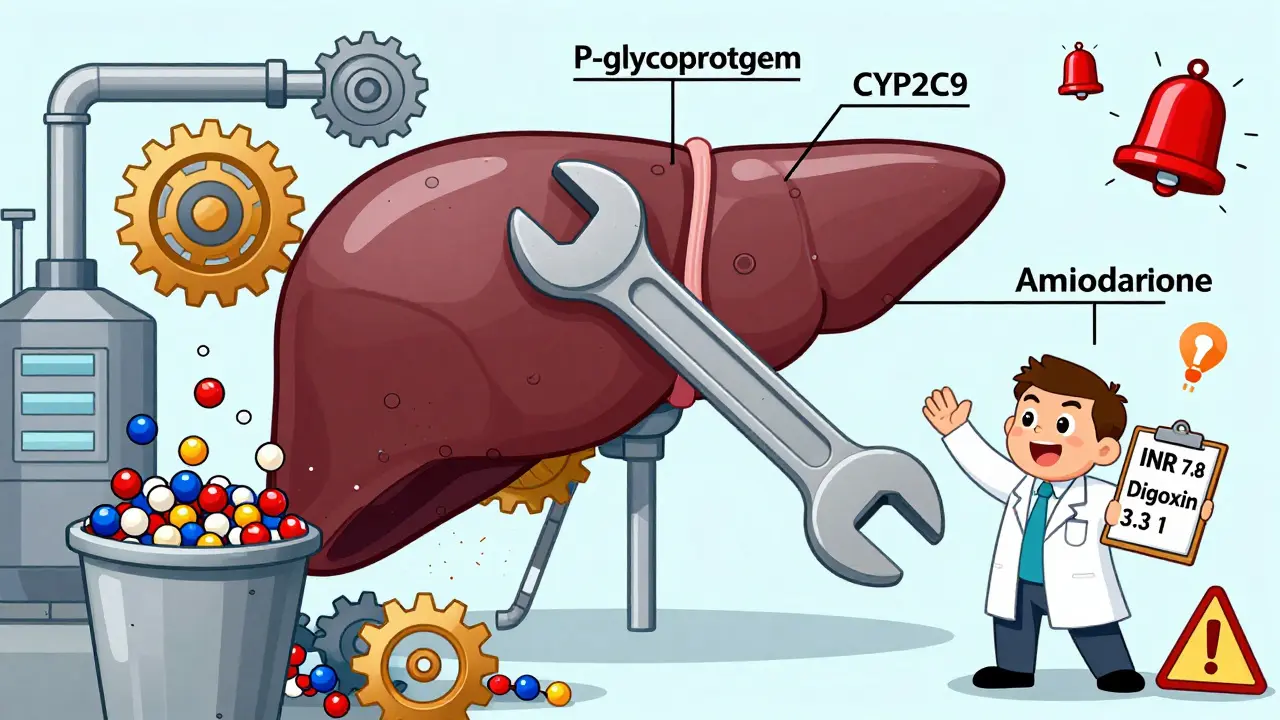
The Exact Steps to Stay Safe
If you’re managing this combo - or if you’re the patient - here’s what you must do. No guesses. No delays.- When starting amiodarone: Cut the digoxin dose in half immediately. Don’t wait for labs. Don’t wait for symptoms. If they were on 0.25 mg, drop to 0.125 mg. If they were on 0.125 mg, drop to 0.0625 mg.
- Check digoxin levels: Get a blood test 72 hours after starting amiodarone. Repeat weekly until stable. In elderly patients, keep levels under 1.0 ng/mL - not 1.2. The margin is razor-thin.
- Reduce warfarin before amiodarone: Drop the warfarin dose by 30-50% before you even give the first amiodarone pill. If they were on 5 mg daily, go to 2.5 mg. If they were on 7.5 mg, go to 3.75 mg.
- Monitor INR like a hawk: Test every 48 to 72 hours for the first two weeks. Then weekly for at least four weeks. Don’t rely on a single number - look at the trend. A jump from 2.8 to 4.2 in 72 hours? That’s a red flag.
- After stopping amiodarone: Keep monitoring. The drug lingers. INR can still rise for 2-4 weeks after the last dose. Keep checking INR for at least 4-6 weeks.
These steps aren’t optional. They’re the minimum. A 2023 NHS England report showed that following this exact protocol cut adverse events by 78% across 47 hospitals. That’s not luck. That’s science.
Why This Still Matters in 2026
You might think: “But everyone uses DOACs now.” True. Dabigatran, apixaban, rivaroxaban - they’ve replaced warfarin in 82% of new AFib cases. But that’s new patients. What about the 4.3 million Americans still on warfarin? Many have mechanical heart valves. Many can’t afford DOACs. Many were started on warfarin years ago and never switched. And amiodarone? It’s still the most effective drug for stubborn arrhythmias. So this triad isn’t fading. It’s growing. Older patients. More polypharmacy. More frailty. More falls. More bleeding. The FDA reported 387 deaths tied to this combo in 2022 - up 12% from the year before. That’s not progress. That’s a system failure.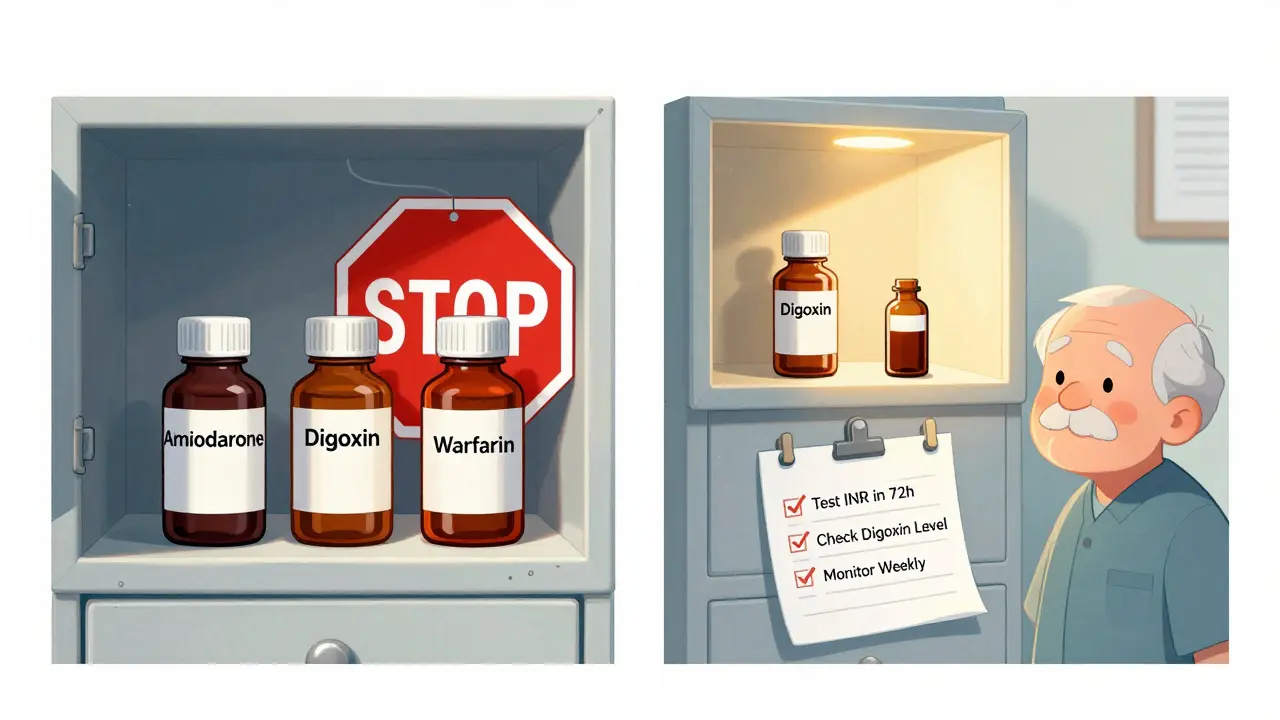
What You Need to Watch For
Digoxin toxicity isn’t always dramatic. It starts with nausea. Then fatigue. Then blurred vision - especially yellow-green halos around lights. Constipation. Confusion. These are easy to blame on aging. But if someone is on this trio, they’re not just aging. They’re at risk. Watch for irregular heartbeats - especially ventricular tachycardia. That’s a medical emergency. Warfarin over-anticoagulation? Bruising that won’t fade. Nosebleeds that won’t stop. Blood in urine or stool. Headaches that feel worse than ever. A fall with a head bump? That’s not a minor incident. That’s a potential intracranial bleed waiting to happen. INR above 4.0? That’s a code red. You need vitamin K. Maybe fresh frozen plasma. And you need it now.Technology Can Help - But Not Replace
Electronic health records now flag this interaction. That’s good. But flags get ignored. Alerts get bypassed. A 2022 JAMA study found that even with alerts, 40% of high-risk combinations still got prescribed. Why? Because the system didn’t tell the doctor what to do next. It just said, “Warning.” That’s not enough. The fix isn’t more alerts. It’s clear, step-by-step protocols built into the workflow. Cut digoxin. Reduce warfarin. Test INR in 72 hours. That’s the script. And it needs to be automatic - not optional.What to Do If You’re Already on This Combo
If you’re currently taking all three, don’t panic. But don’t wait either. Talk to your doctor. Ask: “Have my digoxin and warfarin doses been adjusted since I started amiodarone?” If they say no - or if they don’t know - push for a full review. Get your digoxin level tested. Get your INR checked. Bring this article with you. This isn’t about fear. It’s about control. You don’t have to live on the edge of a bleeding risk or a toxic heart rhythm. There’s a safer way. And it’s simple: adjust the doses. Monitor closely. Stay ahead.Can I stop warfarin if I’m on amiodarone and digoxin?
No - you shouldn’t stop warfarin without medical supervision. Stopping it suddenly raises your risk of stroke, especially if you have atrial fibrillation. Instead, reduce the dose by 30-50% when starting amiodarone and monitor INR closely. Switching to a DOAC like apixaban may be an option, but only if your doctor confirms it’s safe for your condition (e.g., mechanical heart valves still require warfarin).
How long does it take for amiodarone to affect digoxin and warfarin?
Digoxin levels can rise within 2-7 days. Warfarin’s effect starts showing in INR changes within 3-5 days. But because amiodarone stays in your body for weeks to months, these effects continue long after you start the drug - and even after you stop it. That’s why monitoring must last 4-6 weeks after discontinuing amiodarone.
Is this interaction worse in older adults?
Yes - significantly. Older adults have lower kidney function, less muscle mass, and more fragile blood vessels. Digoxin toxicity is more common at lower levels in the elderly (above 1.0 ng/mL). Warfarin also causes more bleeding in older patients. Over 60% of serious cases involve people over 75. Dose reductions must be more aggressive in this group.
Can I use a different antiarrhythmic instead of amiodarone?
Possibly. Drugs like dronedarone or beta-blockers (e.g., metoprolol) may be alternatives, but they’re not as effective for life-threatening arrhythmias. Amiodarone is often the last resort when others fail. The choice depends on your specific heart rhythm problem. Never switch on your own. Talk to your cardiologist about whether a safer option exists for your case.
What should I do if I miss a dose of amiodarone?
Don’t double up. Take the missed dose if it’s within 12 hours of when you were supposed to take it. If it’s later, skip it and resume your regular schedule. Missing one dose won’t immediately change your digoxin or warfarin levels - but stopping and restarting amiodarone repeatedly can cause dangerous fluctuations. Consistency matters more than perfection.
Carrie Schluckbier
February 18, 2026 AT 11:50Let me guess - Big Pharma paid off the FDA to keep this triad alive. Amiodarone? It's a poison they *want* you to take because it keeps you coming back for life. Digoxin? A $2 pill that somehow becomes a $2000 monster when paired with it. And warfarin? Oh, it's not about blood thinning - it's about keeping you on INR checks forever. Monthly visits. Lab fees. Insurance billing codes. This isn't medicine. It's a revenue stream disguised as a warning. I've seen it. My aunt died after her INR spiked. The hospital didn't adjust. They just kept billing. They *knew*. And they didn't care.
They're not fixing this. They're monetizing it. Watch for the next 'new guideline' that adds another mandatory test. That's the real triad: Amiodarone + Digoxin + Profit.
And don't even get me started on the EHR alerts. They're just there to make doctors feel safe while the system eats you alive.
Tony Shuman
February 20, 2026 AT 04:32Oh here we go. Another ‘medical expert’ telling us how dangerous modern medicine is. I bet this guy’s got a tinfoil hat collection and thinks ivermectin cures cancer. This triad? It’s been around since the 80s. Doctors know how to handle it. If your doctor didn’t adjust doses, they’re incompetent - not evil. Stop fearmongering with 1800 FDA reports like they’re body counts. Most of these cases are from people who didn’t follow up. Not conspiracy. Just bad compliance.
And stop acting like amiodarone is some evil villain. It’s the only thing that works for some people. You want to die from VT? Go ahead. Switch to dronedarone. See how well that works when your heart’s about to quit. This isn’t a ‘system failure.’ It’s a ‘patient failure.’
Linda Franchock
February 21, 2026 AT 10:10Okay, but like… who even *writes* this stuff? This is the kind of post that makes you feel like you’re reading a medical thriller written by someone who watched one too many Grey’s Anatomy episodes.
But… honestly? It’s *so* right. I work in a nursing home. We had a guy last month - 82, on all three. Didn’t even know he was on digoxin. His daughter found the bottle in the sock drawer. INR was 8.9. He was leaking out of every orifice. We had to call the hospital. And you know what? The nurse who caught it? She didn’t have a fancy algorithm. She just noticed he stopped eating. Said he ‘tasted metal.’
So yeah. This is terrifying. But also… kinda beautiful? Someone finally said it out loud. No jargon. No fluff. Just: ‘This combo will kill you if you’re not paying attention.’
Also, the part about yellow vision? That’s real. I’ve seen it. Like, ‘why is my cat glowing’ real. I’m sending this to my whole family.
Dennis Santarinala
February 21, 2026 AT 20:29This is one of those posts that makes you pause. Like, breathe. You know, I’ve been a paramedic for 18 years, and I’ve seen this exact scenario play out way too many times. The patient comes in calm, confused, maybe a little dizzy - and everyone assumes it’s just ‘old age.’ But no. It’s the amiodarone. It’s the digoxin. It’s the warfarin. All three, silently piling up like sand in an hourglass.
I love how the post doesn’t just say ‘be careful.’ It gives you the *exact* steps. Cut digoxin in half. Drop warfarin by 30-50%. Test INR every 72 hours. That’s not theory. That’s the difference between a discharge and a casket.
And honestly? I wish every ER had this printed on the wall. Not as a poster. As a mantra. ‘Check levels. Adjust doses. Don’t wait.’
Also - the part about monitoring 4-6 weeks after stopping amiodarone? That’s the golden nugget. Everyone forgets that. I’ve had two patients bleed out 3 weeks after they quit amiodarone. They thought they were ‘safe.’ They weren’t.
Thank you for writing this. Seriously. Someone needed to say it.
Logan Hawker
February 22, 2026 AT 01:24Let’s be real - this is just another poorly contextualized pharmacokinetic lecture masquerading as clinical wisdom. The 70% digoxin increase? That’s from *in vitro* studies. Real-world data? More like 20-30%. And the 320% increased risk of INR >4? Confounded by age, polypharmacy, and non-adherence. You’re cherry-picking outliers to sell a narrative. Meanwhile, the real issue is that primary care docs are overworked and EHRs are designed by UX anarchists. The fix isn’t more protocols - it’s reducing cognitive load. A single, automated, context-aware dosing engine integrated into the EHR would solve 90% of this. But no - we need a 10-step checklist that only a cardiologist can follow. Classic over-engineering. Also, the FDA data? 1800 cases over 12 years? That’s less than 150/year. In a population of 30 million elderly on anticoagulants? That’s noise. Not a crisis. And the 387 deaths in 2022? Probably half were from falls, not drug interaction. Correlation ≠ causation. And please, stop using ‘system failure’ as a synonym for ‘I don’t trust my colleagues.’
James Lloyd
February 22, 2026 AT 16:14Brilliant breakdown. Absolutely spot-on. The key insight nobody talks about is the protein-binding displacement - high digoxin levels displace warfarin from albumin, effectively increasing free warfarin concentration *on top* of CYP2C9 inhibition. That’s the third hit. Most clinicians miss that. They think it’s just enzyme stuff. No. It’s pharmacokinetic synergy with a side of pharmacodynamic chaos.
Also - the 1.0 ng/mL digoxin threshold for elderly? Yes. A 2021 JACC paper showed mortality increased exponentially above 0.9. The old 1.2 cutoff? That’s from 1980s data on healthy 50-year-olds. We’re treating frail octogenarians with renal impairment. They don’t need ‘therapeutic’ levels. They need ‘non-toxic’ levels.
And the monitoring timeline? Perfect. Every single point is evidence-based. This should be a mandatory CME module. Not just for cardiologists. For every PCP, ER doc, pharmacist, and nurse who prescribes or administers these drugs.
Thank you. This is what clinical communication should look like.
Digital Raju Yadav
February 24, 2026 AT 02:30USA thinks it’s the only country with drug interactions? LOL. In India, we’ve been managing this for decades. Amiodarone + digoxin + warfarin? We call it ‘triple threat’ - and we handle it with one simple rule: never start all three at once. We stagger. Digoxin first. Wait 10 days. Then amiodarone. Wait 5 days. Then warfarin. We don’t need 10-step protocols. We need common sense. And we don’t have 1000-dollar labs - we have 50-dollar tests. We test INR with a paper strip. We check digoxin with a visual assay. We don’t wait for EHR alerts. We *think*. You Americans overmedicate because you overthink. This isn’t rocket science. It’s biology. And we’ve been doing it right for years. No need for 387 deaths to prove it.
guy greenfeld
February 25, 2026 AT 11:46What if… this isn’t about medicine at all?
What if amiodarone is just a metaphor?
It’s the thing we take to fix one broken rhythm - and it silently, slowly, destroys everything else. Digoxin? That’s the last thing we cling to - the comfort of routine. Warfarin? The fragile balance we pretend we control. We don’t adjust. We don’t monitor. We just keep taking it. Because the alternative - stopping - means facing the chaos underneath.
We’re all on this triad. In our jobs. Our relationships. Our politics. We keep adding layers of ‘fixes’ - hoping they’ll stabilize us - never realizing they’re the poison.
Maybe the real question isn’t ‘how do we adjust doses?’
It’s… ‘why do we keep taking the poison?’
Prateek Nalwaya
February 25, 2026 AT 19:13As someone from India who works in a rural clinic, I can say this: the real tragedy isn’t the interaction - it’s the lack of access. We don’t have weekly INR checks. We don’t have digoxin assays. We have one lab in the district town, and it’s 3 hours away. So we rely on symptoms. Nausea? Cut digoxin. Bleeding gums? Hold warfarin. Bruises? Stop everything until we can test.
This post is perfect - but it assumes you have a $5000 EHR, a pharmacist on staff, and a lab that responds in 24 hours. In the real world? We improvise. We teach families to watch for yellow vision. We use a flashlight to check for jaundice. We write ‘AMIO+DIG+WARF’ on the front of every chart.
Maybe the real solution isn’t more protocols - it’s more training for community health workers. Because in places like mine, the doctor isn’t the expert. The aunt who notices the patient stopped eating? She is.
Philip Blankenship
February 26, 2026 AT 05:55You know what I love about this? It’s not just a list of warnings - it’s a story. It’s got a character - the 78-year-old guy. He’s not a ‘patient.’ He’s a person. He was fine. Then he started feeling nauseous. Then he almost died. That’s the hook. And then it goes deeper - it shows you *why* it happens, not just that it happens. Like, the P-glycoprotein thing? That’s not textbook stuff. That’s the kind of detail you only learn from a pharmacist who’s been doing this for 20 years and has seen 3 patients bleed out.
And the part about monitoring after stopping amiodarone? That’s the one that gets me. I’ve had patients say, ‘I quit that weird heart pill last month - I’m fine now.’ And then they fall and crack their skull. No one tells them the drug’s still in their system like a ghost. That’s wild. That’s the kind of thing you’d never guess. And now I’m going to tell my whole family. Seriously. I’m printing this out. And I’m putting it on the fridge.
Also - yellow vision? Yeah. My grandma saw halos around the streetlights. We thought she was going blind. Turns out it was digoxin. And we had no idea. This post? It saved my grandma. Maybe yours too.
Kancharla Pavan
February 27, 2026 AT 21:07This is why America is dying. You people are so obsessed with ‘protocols’ and ‘laboratories’ and ‘INR levels’ that you’ve forgotten how to live. In my village, we don’t have EHRs. We don’t have ‘dose adjustments.’ We have faith. We have elders. We have tradition. We give herbs. We pray. We rest. And guess what? Our elderly live longer. Why? Because they’re not drowning in pills. You take three drugs, you’re not treating a disease - you’re creating a new one. This ‘triad’? It’s not a medical problem. It’s a moral failure. You’ve turned the human body into a chemistry set. And now you’re shocked when it explodes? Wake up. The real toxicity isn’t in the drugs - it’s in your arrogance. You think you know better than nature. You don’t. You’re just scared of death. So you poison people to delay it. And then you write long posts to feel smart. Pathetic.
PRITAM BIJAPUR
March 1, 2026 AT 06:03Wow. Just… wow. 🌟
This is the kind of post that makes you want to hug someone. Not because it’s comforting - but because it’s *true*. It’s like someone took all the fear, the confusion, the late-night panic calls from worried families - and turned it into a lifeline.
I’m a pharmacist. And I’ve had patients cry in my aisle because they didn’t know their INR was 8.4. They thought ‘it’s just a pill.’ I’ve had grandkids ask me, ‘Will my grandpa be okay?’ And I didn’t have a good answer - until now.
Thank you for writing this. Not just for doctors. For *us*. For the ones who hold the bottles. For the ones who notice the yellow vision. For the ones who ask, ‘Is this normal?’
And yes - the 4-6 week monitoring after stopping amiodarone? That’s the quiet hero of this whole thing. I’m printing this. Framing it. Putting it in my clinic. And I’m telling every patient: ‘This isn’t just advice. It’s your safety net.’
You didn’t just write a post. You wrote a shield.
Thank you. 🙏❤️