
When you're running a clinical trial, not every side effect needs to be reported right away. But knowing which ones do - and which ones don’t - can mean the difference between protecting patients and drowning in paperwork.
What’s the real difference between serious and non-serious adverse events?
An adverse event (AE) is just any unwanted medical thing that happens to a person during a trial, whether it’s linked to the drug or not. A headache after taking a pill? That’s an AE. A heart attack? Also an AE. But here’s the key: only some AEs are serious.
Serious adverse events (SAEs) aren’t defined by how bad they feel. They’re defined by what they do to the person’s life. The FDA and ICH E2A guidelines lay out six clear outcomes that make an event serious:
- Death
- Life-threatening condition (the person was at immediate risk of dying)
- Hospitalization - or extending an existing hospital stay
- Persistent or significant disability or incapacity
- Congenital anomaly or birth defect
- Any event that requires medical or surgical intervention to prevent one of the above
That’s it. No more, no less.
Now, here’s where people get tripped up: severity ≠ seriousness. A severe headache might be crushing - you can’t work, you can’t sleep, you’re doubled over. But if it goes away in a day with ibuprofen? That’s not serious. It’s just severe. On the flip side, a mild rash that leads to anaphylaxis and ICU admission? That’s serious - even if the rash started as just a little red spot.
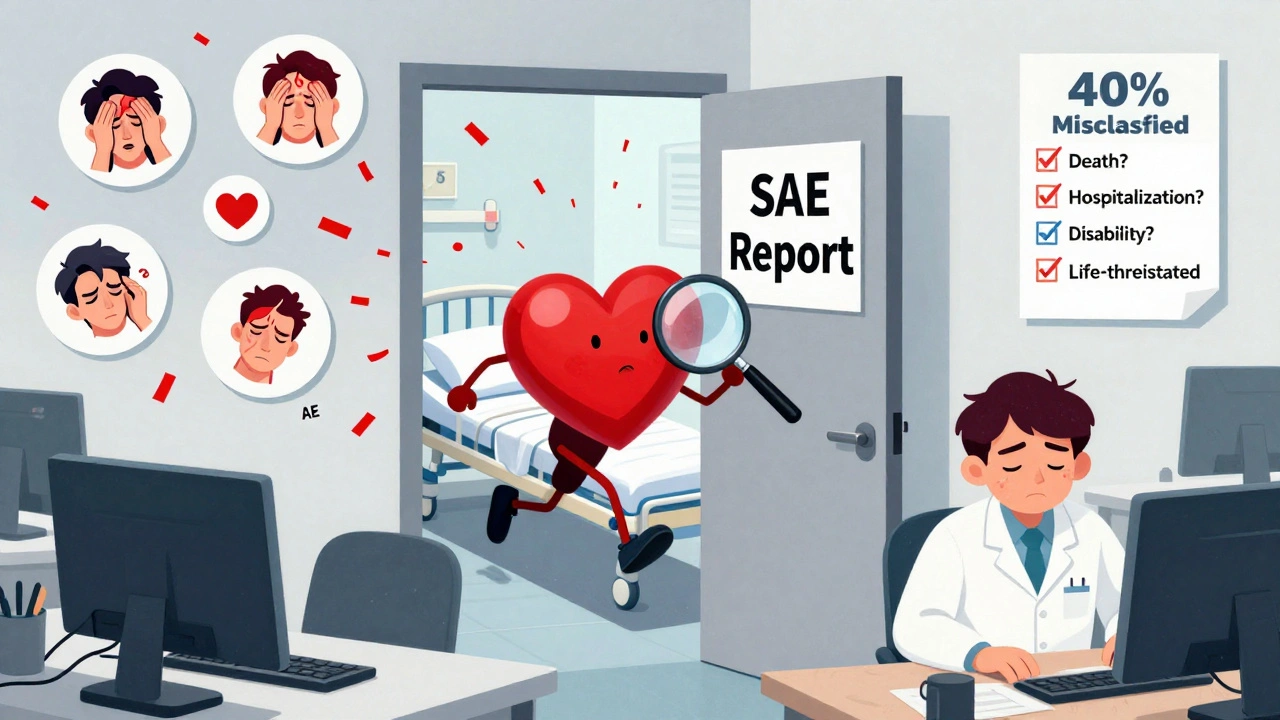
Studies show nearly 40% of reports sent in as serious adverse events don’t actually meet the criteria. That’s not just wasted time - it’s dangerous. When every report looks like a crisis, real crises get lost in the noise.
When do you have to report a serious adverse event?
If it’s serious, you report it fast - no waiting for next week’s meeting.
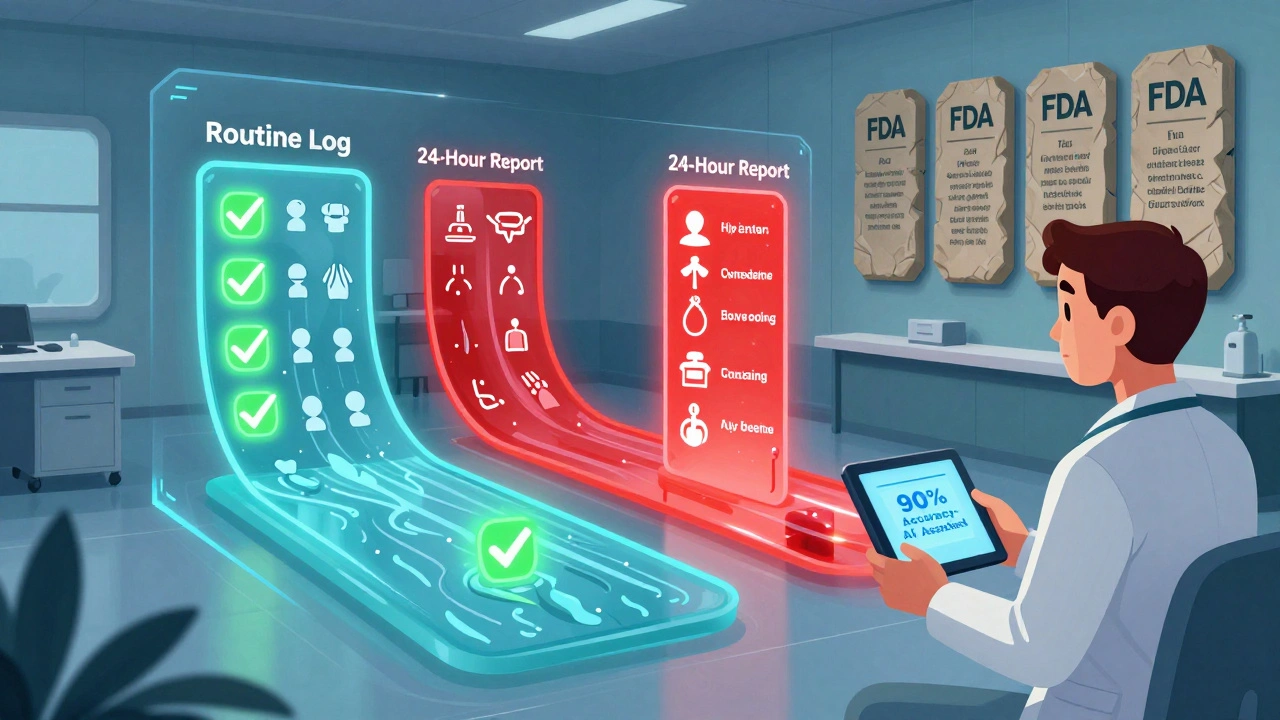
Investigators (doctors running the trial at their site) must tell the sponsor - the company or organization running the trial - within 24 hours of learning about the event. Doesn’t matter if they think it’s related to the drug. Doesn’t matter if the patient had other health problems. If it meets the seriousness criteria, it goes in the queue immediately.
Then, the sponsor has to report it to the FDA:
- Within 7 days for life-threatening events
- Within 15 days for all other serious events
And that’s not all. The Institutional Review Board (IRB) - the group that protects participants - also needs to know. Most IRBs require SAEs to be reported within 7 days. Some require immediate notification, especially if the event could affect other participants in the trial.
Non-serious events? Those go in the regular paperwork. You log them in the Case Report Form (CRF) as they happen. Then you submit them monthly or quarterly, depending on your trial’s safety plan. No rush. No panic. Just accurate records.
Why does this distinction matter so much?
Imagine you’re a safety officer at a pharmaceutical company. Every day, your team gets hundreds of AE reports. Most are colds, bruises, nausea - annoying, but not dangerous. But then one comes in: a patient collapsed after taking the drug. Is it a bad reaction? Or did they just trip on the stairs?
If you don’t have clear rules, you waste hours chasing false alarms. That’s what happens when people confuse severity with seriousness.
The FDA’s Dr. Janet Woodcock said it plainly: the system is overwhelmed by non-serious events reported as serious. That dilutes attention from the real red flags. In 2020, nearly 29% of expedited safety reports submitted to European regulators didn’t even meet the seriousness threshold. That’s 1 in 3 reports that could’ve waited.
At UCSF’s IRB, over 40% of AE reports in 2022 needed clarification because the person submitting them didn’t understand the criteria. Each one delayed review by nearly 10 business days. That means patients might not get safety updates fast enough. Or worse - a real danger goes unnoticed because everyone’s busy sorting out headaches and rashes.
How do you actually decide if an event is serious?
You don’t guess. You use the checklist.
The NIH’s 2018 guidelines offer a simple four-question decision tree:
- Did the event cause death?
- Was it life-threatening?
- Did it require hospitalization or extend an existing stay?
- Did it cause permanent disability or damage?
If the answer to any one of these is yes - it’s serious. Report it now.
And here’s a real-world example that trips up even experienced coordinators:
A patient in a cancer trial gets severe nausea and vomiting. They go to the ER, get IV fluids, and go home the same day. No hospital admission. No life-threatening sign. No permanent damage. So - is it serious?
No. Not under current rules. Emergency room visits alone don’t qualify unless they meet one of the six outcomes. That’s a common misunderstanding. The NIH updated its guidance in September 2023 to make this crystal clear: ER visits only count if they prevent death, hospitalization, or permanent harm.
For non-serious events, severity grading helps. The Common Terminology Criteria for Adverse Events (CTCAE) version 5.0 is used to rate them as mild, moderate, or severe. But again - that’s about how the patient feels, not what the outcome is.
What happens if you get it wrong?
Under-reporting a serious event? That’s a big risk. You could miss a pattern that shows the drug is dangerous. The FDA can shut down a trial. The sponsor could face fines. Lives could be lost.
Over-reporting? That’s a quiet crisis. It wastes staff time, slows down reviews, and desensitizes reviewers. In 2021, the SWOG Cancer Research Network found that over 30% of their SAE reports had to be corrected because they were misclassified. That cost 18.5 full-time hours every week - just fixing mistakes.
And it’s not just paperwork. When sites report too many non-serious events, regulators start to ignore them. That’s how real signals get buried.
That’s why training is mandatory. ICH E6(R2) requires every investigator and coordinator to be trained on seriousness criteria before a trial starts. And 98.7% of top research institutions require annual refreshers. Because this isn’t something you learn once and forget.
What’s changing in 2025?
Technology is stepping in to help. AI tools now correctly classify seriousness in nearly 90% of cases - better than most humans. But they’re not replacing people. They’re helping them.
The FDA is testing natural language processing tools to automatically sort AE reports. Early results show a 47% drop in processing time. That means safety teams can focus on real risks, not sorting through noise.
Also, the ICH is rolling out E2B(R4) by 2025 - a new global standard for electronic safety reporting. That means consistent formats across countries. No more confusion between U.S., EU, and Asia submissions.
The EU’s Clinical Trials Regulation, in effect since 2022, already cut cross-border reporting errors by over 30%. The goal? One clear rulebook for everyone.
And the FDA’s 2023 draft guidance suggests tiered reporting - maybe even faster reporting for the most dangerous events within the serious category. That’s the future: smarter, faster, more precise.
Bottom line: Know the rules. Follow the checklist.
Don’t rely on how bad the symptom feels. Don’t assume ‘severe’ means ‘serious.’
If a patient dies, is hospitalized, or is at risk of permanent harm - report it within 24 hours.
If it’s a headache, a rash, or nausea that goes away - log it. But don’t rush. Save the emergency alerts for emergencies.
Clear rules protect patients. Clear rules protect your team. And clear rules keep the system from breaking under its own weight.
Is a severe headache a serious adverse event?
No. A severe headache is not automatically a serious adverse event. Seriousness is based on outcome, not intensity. If the headache doesn’t lead to hospitalization, death, life-threatening complications, or permanent disability, it’s non-serious - even if it’s the worst headache of the patient’s life. Only report it as serious if it meets one of the six FDA/ICH outcome criteria.
Do I report all adverse events to the IRB?
No. Only serious adverse events typically require immediate reporting to the IRB - usually within 7 days. Non-serious events are usually reported during routine continuing reviews, unless the study protocol says otherwise. Some low-risk trials may not report mild or moderate non-serious events at all. Always check your trial’s specific reporting plan.
What if I’m not sure whether an event is serious?
When in doubt, report it as serious. It’s better to over-report than under-report. But don’t guess forever. Use the four-question checklist: death? life-threatening? hospitalization? permanent disability? If the answer is no to all, it’s non-serious. Consult your sponsor’s safety team or IRB if you’re still uncertain - but don’t delay reporting if the event clearly meets a seriousness criterion.
Can a non-serious event become serious later?
Yes. If a patient initially has a moderate rash that later leads to Stevens-Johnson syndrome requiring ICU admission, the event becomes serious retroactively. You must update the original report with the new information and reclassify it as a serious adverse event. Timely follow-up and monitoring are essential - safety isn’t a one-time snapshot.
Are psychiatric events treated differently?
No. Psychiatric events like severe anxiety or depression are judged by the same six criteria. A patient with severe depression who doesn’t attempt suicide, isn’t hospitalized, and isn’t life-threatening doesn’t qualify as a serious adverse event - even if their symptoms are intense. But if they’re admitted for suicidal ideation or attempt, that’s serious. Outcome matters, not symptom intensity.
Do I need to report an event if the patient already had it before the trial?
Yes, if it worsens or reoccurs during the trial and meets seriousness criteria. For example, if a patient with a history of heart failure has a new hospitalization due to fluid overload after starting the study drug, that’s a new serious event - even if they’ve had heart issues before. The key is whether the event occurred or worsened during the trial period and meets one of the six seriousness outcomes.
Annie Gardiner
December 5, 2025 AT 14:34Okay but what if the headache is so bad the patient throws up for 12 hours straight? Are we really supposed to just say ‘eh, not hospitalization, not death, move on’? That’s not safety, that’s bureaucracy with a side of indifference.
Rashmi Gupta
December 6, 2025 AT 10:15People in India report headaches as SAEs all the time because they know the system will ignore them anyway. Why waste time? Just tag it serious, wait for the sponsor to dismiss it, and get on with your day. It’s the only way to survive clinical trials here.
Andrew Frazier
December 7, 2025 AT 23:54USA got the best rules. If you can’t tell the difference between a migraine and a stroke, maybe you shouldn’t be handling meds. I’ve seen third-world sites report sneezes as SAEs. No wonder the FDA’s drowning in junk. Fix your training, not the guidelines.
Mayur Panchamia
December 8, 2025 AT 01:16HA! You think this is bad? In Mumbai, we used to fax AE forms-yes, FAX-and then wait three weeks for a reply. Now we have AI? Pfft. I’ve seen algorithms misclassify a seizure as ‘mild dizziness’ because the patient said ‘I felt weird.’ You want precision? Train humans first. Then let the bots clean up the mess.
Karen Mitchell
December 9, 2025 AT 10:47This entire system is a moral failure. We are reducing human suffering to a checklist. A patient in excruciating pain, unable to care for their child, is deemed ‘non-serious’ because no hospital bed was occupied? That is not science. That is dehumanization dressed in regulatory language.
Geraldine Trainer-Cooper
December 9, 2025 AT 16:07Nava Jothy
December 10, 2025 AT 03:53Look, I get it. Rules are rules. But when your cousin’s mom gets a rash, goes to the ER, and comes home with a $12,000 bill and PTSD… and you’re told ‘not serious’ because no hospitalization? 😔 That’s not a guideline. That’s a betrayal. 🫠
brenda olvera
December 10, 2025 AT 16:51Just want to say this is the clearest explanation I’ve ever seen on this topic. Thank you for writing this. So many people get this wrong and it’s dangerous. Keep sharing knowledge like this - it saves lives. 🙏
olive ashley
December 11, 2025 AT 21:41AI classifying SAEs? LOL. You really think a bot knows the difference between a ‘bad day’ and a ‘death sentence’? This is all a cover-up. Big Pharma wants fewer reports so they can skip Phase 4. The FDA’s asleep. The IRBs are bribed. And you? You’re just a cog in the machine. Wake up.