
When a doctor prescribes a generic drug, most patients assume it’s just as safe and effective as the brand-name version. After all, the FDA says so. But behind the scenes, many clinicians are starting to ask hard questions-especially when patients report unexpected side effects or when a medication just doesn’t seem to work like it used to.
Why clinicians are worried
Generic drugs make up over 90% of prescriptions in the U.S. They’re cheaper, they’re widely available, and they’re supposed to be identical to brand-name drugs in active ingredients, dosage, and effect. But identical doesn’t always mean the same. The real issue isn’t the active ingredient-it’s everything else.Manufacturing a generic drug isn’t like copying a recipe. It’s a complex, multi-step process that can involve five or more facilities across different countries. One plant makes the active pharmaceutical ingredient (API). Another blends it with fillers. A third applies the coating. A fourth packages it. And only one company’s name ends up on the bottle.
That lack of transparency is what troubles clinicians. When a patient has a bad reaction, it’s nearly impossible to trace whether it came from a bad batch, a faulty coating, or a contaminated ingredient shipped from halfway across the world.
The global manufacturing shift
Since the 1980s, the U.S. has outsourced most of its generic drug production. Today, only 14% of active ingredients are made domestically. Over half come from just two countries: India and China.Why? Cost. Labor is cheaper. Regulations are looser. Profit margins are tighter. But as prices keep dropping-sometimes below $1 per pill-manufacturers cut corners. They use older equipment. They skip maintenance. They reduce quality checks. And when you’re producing millions of pills a month, even small errors add up.
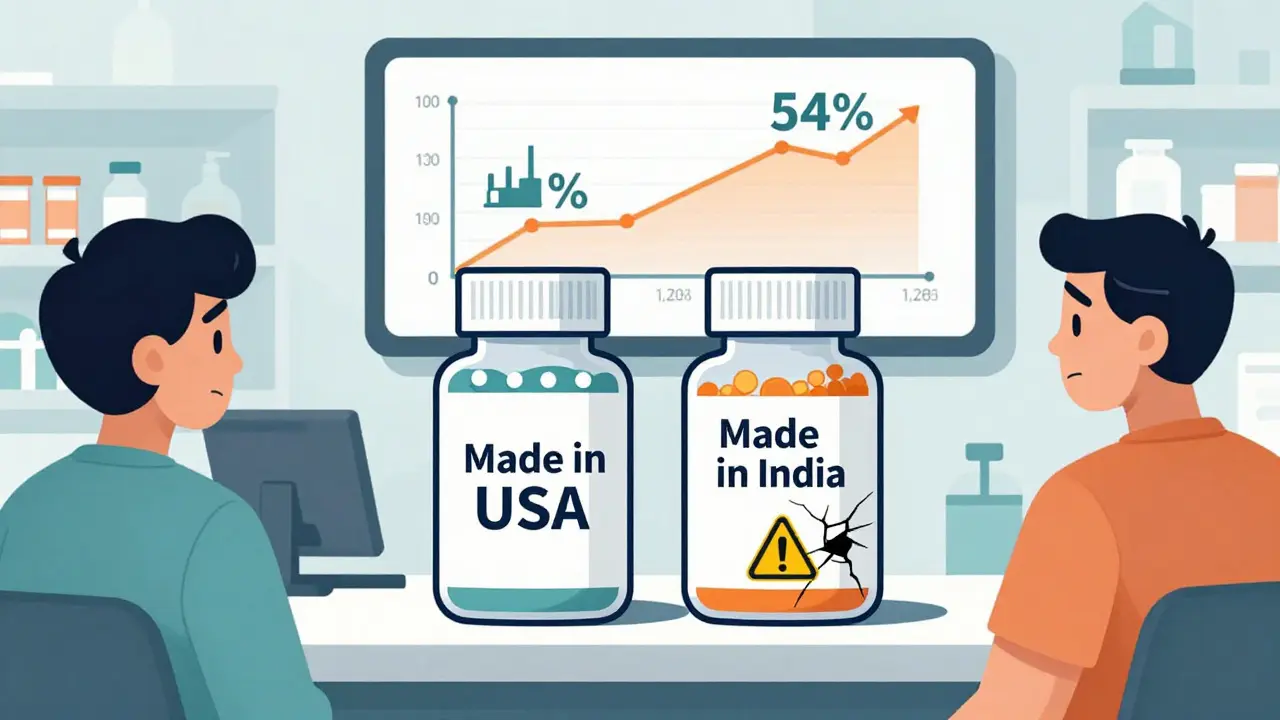
A 2023 study from Ohio State University analyzed over 1.2 million adverse event reports from the FDA. It found that generic drugs made in India were linked to a 54% higher rate of severe side effects-including hospitalizations, disabilities, and deaths-compared to identical drugs made in the U.S. The difference was strongest in older generics, where competition has driven prices down to the bone.
"As drugs get cheaper and cheaper and the competition gets more intense to hold down costs," said Professor Robert S. Gray, one of the study’s authors, "there’s a real risk that operations and supply chain issues can compromise drug quality."
Inspections that don’t inspect
The FDA claims the U.S. drug supply is among the safest in the world. And technically, they’re right-for American-made drugs. But here’s the catch: the agency doesn’t inspect foreign factories the same way.In the U.S., FDA inspectors show up unannounced. They walk through facilities without warning. They check logs, test samples, and interview workers. Overseas? Inspections are scheduled weeks in advance. Manufacturers know exactly when they’re coming. They clean up. They hide problems. They fix what they can for the visit-and then go back to business as usual.
That’s not oversight. That’s theater. And clinicians are seeing the consequences.
Older generics, bigger risks
Not all generics are created equal. Newer ones-those launched in the last five years-tend to be better made. They’re often produced with newer technology. They’re more likely to be made in facilities that meet modern standards.But older generics? Those are the problem.
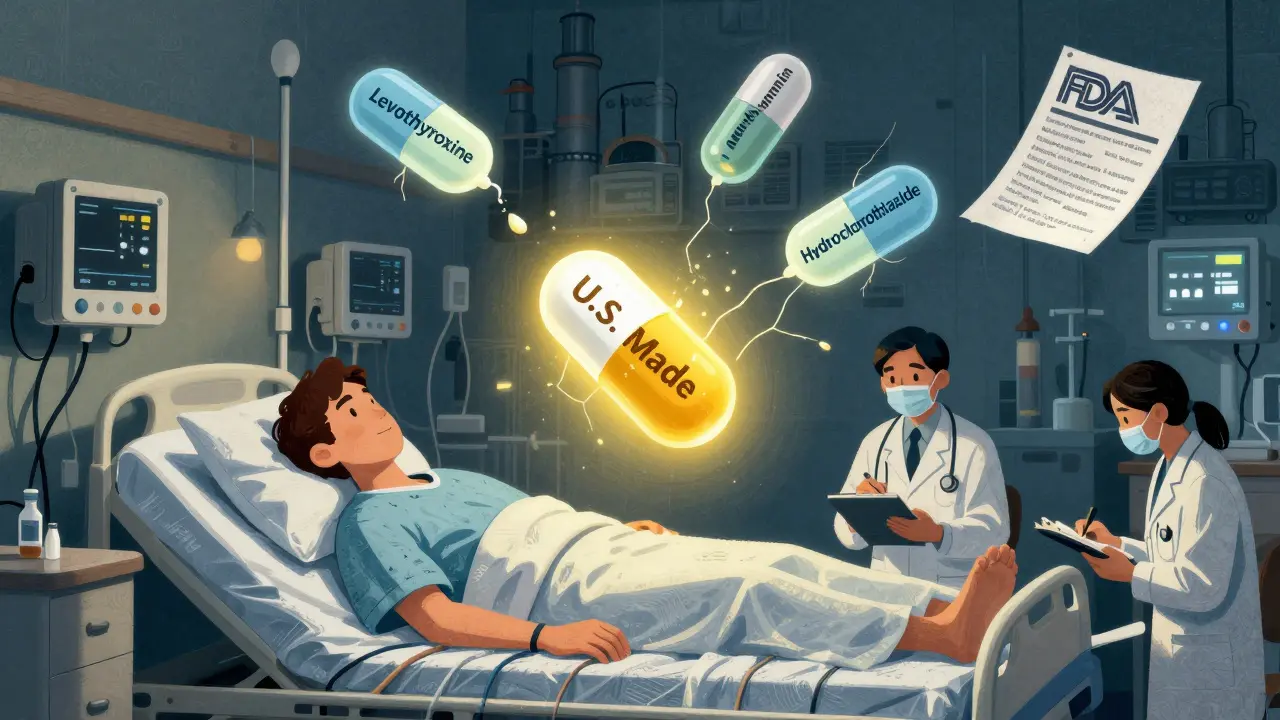
Drugs like levothyroxine, metformin, and hydrochlorothiazide have been around for decades. Their patents expired years ago. There are dozens of manufacturers. Prices have been bid down to pennies. The manufacturers who survive are the ones who can produce them cheapest-not the ones who make them best.
Duke-Margolis Center research shows these older generics are the leading cause of drug shortages. Why? Because the equipment is outdated. The quality systems are weak. And when a single batch fails, there’s no backup. No redundancy. No safety net.
That means patients with heart disease, diabetes, or cancer can suddenly find their meds unavailable. Or worse-they get a new batch that doesn’t work the same way.
What’s being done-and what’s not
The FDA has started pushing for advanced manufacturing technologies: continuous production, real-time monitoring, AI-driven quality control. These systems can catch errors before a single pill is made. They reduce waste. They improve consistency.But here’s the problem: 80% of these advanced systems are already in U.S. facilities. And they’re expensive. A small generic manufacturer in India can’t afford them. So they stick with 20-year-old machines and manual checks.
The FDA has also proposed making the country of manufacture visible on drug labels. That way, prescribers and pharmacists could choose based on quality, not just price. It sounds simple. But the industry resists. Why? Because if patients knew their blood pressure pill came from a factory with a history of violations, they’d ask for something else. And then the cheapest bid wouldn’t win anymore.
What clinicians are doing differently
Some doctors are changing how they prescribe. They’re asking pharmacists: "Where’s this made?" They’re switching brands if a patient reports a change in how the drug feels. They’re keeping detailed notes: "Patient on generic metformin from India-reported nausea and dizziness. Switched to U.S.-made version-symptoms resolved."Pharmacists are starting to track this too. One pharmacy chain in Ohio began recording the manufacturer and country of origin for every generic dispensed. Within six months, they identified a pattern: patients on a certain batch of generic levothyroxine had higher TSH levels. They flagged it. The FDA later confirmed contamination in that batch.
"We used to assume all generics were equal," said a clinical pharmacist in Atlanta. "Now we know that’s not true. We have to treat them like different products."
The real cost of cheap drugs
It’s easy to say generics save money. And they do-billions of dollars a year. But the hidden costs are mounting.Drug shortages delay cancer treatments. Patients miss doses because their medication isn’t available. Emergency rooms see more adverse reactions. Hospitals pay more for backup drugs. Insurance companies pay more for hospitalizations caused by bad generics.
And patients? They lose trust. They wonder: "If my doctor prescribed this, why doesn’t it work like it used to?" They start doubting their treatment. They stop taking their meds. And that’s when real harm happens.
A path forward
There’s no easy fix. But there are clear steps:- Require unannounced inspections globally-not just in the U.S.
- Label the country of manufacture on every generic drug package
- Incentivize domestic production through tax credits and grants for modern facilities
- Prioritize quality over price in government and hospital purchasing
The University of Wisconsin School of Pharmacy put it simply: "If we have more generic manufacturing happening domestically, we would ideally have fewer quality concerns, fewer shortages, and a more stable supply chain."
It’s not about banning generics. It’s about making sure they’re safe. And that starts with transparency, accountability, and a willingness to pay a little more for quality.
Because when a patient’s life depends on a pill, the cheapest option isn’t always the best one.
Are generic drugs always safe?
Generic drugs are required by the FDA to be bioequivalent to brand-name drugs, meaning they deliver the same active ingredient in the same amount and timeframe. But bioequivalence doesn’t guarantee identical performance in every patient. Differences in inactive ingredients, manufacturing processes, and quality control can lead to variations in how the drug is absorbed or tolerated. Clinicians have reported cases where switching to a different generic version caused side effects or reduced effectiveness, especially with older, low-cost drugs made overseas.
Why are generic drugs made overseas?
Most generic drugs are made overseas because labor, materials, and regulatory costs are significantly lower in countries like India and China. After patents expire, multiple manufacturers compete to produce the cheapest version possible. This price pressure leads companies to outsource production to facilities that can meet minimum standards at the lowest cost-even if those facilities use outdated equipment or have weaker quality oversight.
Does the FDA inspect foreign drug factories?
Yes, but not the same way as U.S. factories. The FDA conducts unannounced inspections at domestic facilities to catch real-time issues. For overseas plants, inspections are scheduled in advance, giving manufacturers time to clean up, hide problems, or temporarily improve conditions. This difference in inspection protocols has led experts to question whether overseas facilities are truly held to the same standards.
Should I avoid generic drugs altogether?
No. For most people, generics are safe and effective. But if you’re on a medication for a serious condition-like heart disease, epilepsy, or thyroid disorders-and you notice a change in how you feel after switching generics, talk to your doctor or pharmacist. Ask where it’s made. Consider switching to a brand-name version or a generic from a known U.S.-based manufacturer. Don’t stop taking your medication, but don’t ignore changes either.
How can I find out where my generic drug is made?
Currently, the country of manufacture is not required to appear on the label. But you can ask your pharmacist. Many pharmacies track this information internally, especially if they’ve had issues with certain batches. You can also check the FDA’s Drug Shortages database or use third-party tools like GoodRx, which sometimes list manufacturer details. In the future, labeling requirements may change to make this information more transparent.
Are U.S.-made generics better?
Studies suggest they are. The 2023 Ohio State University analysis found that U.S.-made generics had significantly lower rates of severe adverse events compared to identical drugs made in India. U.S. facilities are more likely to use modern equipment, follow stricter quality controls, and undergo unannounced inspections. While not all U.S.-made generics are perfect, they generally offer more consistent quality and fewer supply chain risks.
Coral Bosley
January 20, 2026 AT 17:44This isn't just about drugs-it's about how we've turned healthcare into a commodity. I've seen patients cry because their thyroid med stopped working after a switch. No one told them the manufacturer changed. No one warned them. And now they're stuck wondering if their body's failing or if the pill is just garbage.
It's not paranoia. It's lived experience.
Steve Hesketh
January 21, 2026 AT 10:00As someone from Nigeria, I see this every day-cheap meds saved lives during the pandemic, but also caused chaos when batches failed. We don't have the luxury of choosing. But if we could, we'd demand transparency. Not because we distrust India or China, but because we deserve to know what’s in the pill we’re swallowing.
Quality isn’t a privilege. It’s a right.
shubham rathee
January 21, 2026 AT 11:00USA is just mad because they lost the monopoly on making pills
India makes 40% of the world's generics and you think we're cutting corners
Try living on $2 a day and still make medicine
The FDA inspects US plants once every 10 years and still misses everything
Stop the fearmongering
And yes I'm Indian and I'm not scared of your bias
MAHENDRA MEGHWAL
January 21, 2026 AT 13:39It is imperative to acknowledge that the global pharmaceutical supply chain operates under stringent regulatory frameworks, even in developing nations. While disparities in inspection protocols exist, the assertion that foreign manufacturing facilities are inherently substandard lacks empirical substantiation across the entirety of the sector. Quality control is not monolithic, nor is it uniformly compromised. A nuanced understanding is required to avoid unwarranted generalizations.
Kevin Narvaes
January 23, 2026 AT 05:00so like... the fda is a joke right
they let chinese factories ship pills with mold in em
and we pay $1 for it
and then we get sick
and then we blame the patient
classic
also why are we still letting corporations run healthcare
someone get me a tinfoil hat
Dee Monroe
January 23, 2026 AT 23:48There's something deeply unsettling about how we've normalized the idea that human health should be subject to the lowest common denominator of cost. We don't buy cheap tires for our cars and expect them to last through a hurricane. We don't use secondhand surgical tools because they're on sale. So why do we accept this for the very things that keep us alive?
It's not just about bioequivalence-it's about dignity. The assumption that a pill is just a pill ignores the fact that it's the difference between life and death for millions.
And when we refuse to pay even a dollar more for safety, we're not saving money-we're betting on other people's suffering to keep our receipts low.
Sangeeta Isaac
January 25, 2026 AT 06:25so i just found out my metformin is from a factory that got a warning letter in 2022
and i’m supposed to be chill about it?
lol
my blood sugar is not a negotiation
also why is the label still blank like some corporate spy movie
next they’ll say the pills are made by elves
send help or at least a label
Alex Carletti Gouvea
January 26, 2026 AT 03:19Let’s be real-America used to make everything. Now we’re begging for pills from countries that can’t even clean their own streets. We outsource our medicine and then act shocked when it breaks. This isn’t about price. It’s about national weakness. We stopped making things because we got lazy. Now we’re paying the price with our health. Time to bring it home. No more excuses.
Melanie Pearson
January 26, 2026 AT 23:30The data is clear: U.S.-manufactured generics have significantly lower adverse event rates. The FDA's failure to enforce unannounced inspections abroad is not negligence-it is complicity. Every delay in labeling is a deliberate act to preserve corporate profit over patient safety. The industry's resistance is not about economics-it is about control. And those who defend this system are not advocates for affordability-they are enablers of systemic harm.
Rod Wheatley
January 27, 2026 AT 19:18Hey-I’m a pharmacist. I’ve been tracking this for years.
One batch of generic levothyroxine from India? TSH levels spiked in 12 patients in two weeks.
We switched them. All fixed.
Now I ask every patient: "Where’s this made?"
And I log it. Every. Single. Time.
It’s not about fear. It’s about responsibility.
And if you’re on a life-saving med? Don’t just take it-know it.
Ask. Track. Advocate.
You’ve got more power than you think.
Jerry Rodrigues
January 28, 2026 AT 21:56It’s complicated. But I think we all just want to know where our medicine comes from. Not because we’re paranoid, but because we care. If a label could say "Made in USA" or "Made in India" without causing panic, wouldn’t that be better than guessing?
Simple transparency. No drama. Just facts.
Uju Megafu
January 30, 2026 AT 12:54Oh my god I knew it. The FDA is a puppet. Big Pharma owns everything. India is being scapegoated because they’re poor and can’t sue back. But guess what? The same companies that outsource to India own the FDA’s budget. This isn’t about quality. It’s about power. And we’re the ones getting poisoned while CEOs buy yachts. Wake up. This is genocide by capitalism.
Jarrod Flesch
January 30, 2026 AT 15:31Been there. My dad’s blood thinner switched generics and he almost had a stroke. Turned out the coating dissolved too fast. He’s fine now, but I still check the manufacturer before every refill. I don’t trust the label, but I trust my pharmacist. And I always say thanks. Those folks are the real heroes.
👍