
Dark patches on your face that won’t go away? You’re not alone. Many people mistake melasma for plain sun spots, but they’re two very different problems - and treating them the same way can make things worse. If you’ve tried fading creams, chemical peels, or even laser treatments without lasting results, it’s likely you’re dealing with the wrong diagnosis or the wrong approach. The key isn’t just using stronger products; it’s understanding what’s really causing your skin to darken and how to stop it for good.
What’s Really Causing Your Dark Patches?
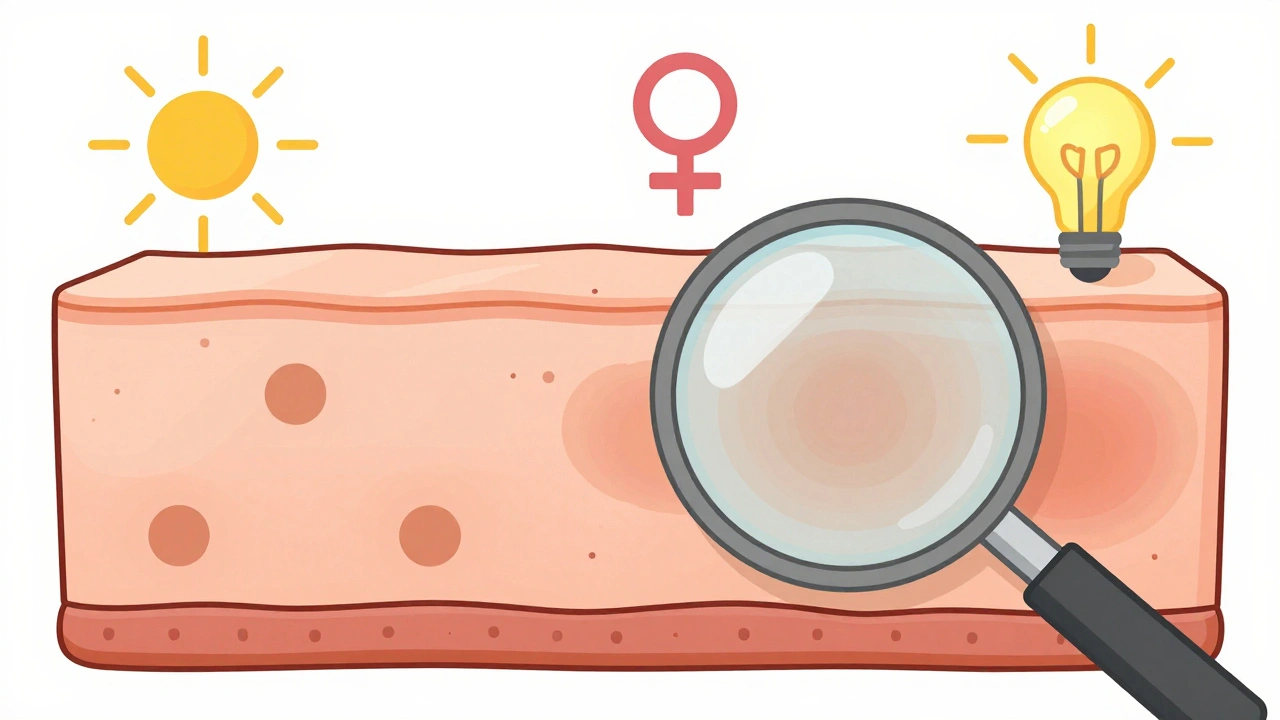
Hyperpigmentation means your skin is making too much melanin - the pigment that gives skin its color. But why? Two of the most common causes are melasma and sun damage, and they look similar but behave completely differently.Sun damage, or solar lentigines, shows up as small, defined brown spots on your face, hands, and shoulders. These are the classic “age spots” you see on people who’ve spent years in the sun. They’re caused by UV rays directly triggering melanocytes - the pigment-producing cells - to overproduce melanin in specific spots. Around 90% of fair-skinned people over 60 have them. The good news? These spots respond well to light-based treatments like IPL and usually fade in 1-2 sessions.
Melasma is different. It shows up as large, irregular, symmetrical patches - usually on the cheeks, forehead, upper lip, or nose. It’s not just from the sun. Hormones play a huge role. About 60-70% of cases happen in women during pregnancy, while on birth control, or during menopause. It’s also far more common in people with medium to dark skin tones (Fitzpatrick types III-VI). In fact, Black, Asian, and Hispanic populations are 3-5 times more likely to develop melasma than Caucasians.
What makes melasma tricky is that it’s triggered not just by UV light, but also by visible light (like from screens or fluorescent bulbs) and even heat. A study in the PMC review found that visible light contributes to 25-30% of melasma cases. That’s why regular sunscreen isn’t enough. You need something that blocks visible light too.
Why Sunscreen Alone Isn’t Enough - And What to Use Instead
Most people think SPF 30 or 50 is enough. It’s not - especially if you have melasma. Standard chemical sunscreens only protect against UVB and UVA rays. But melasma needs protection from visible light and infrared radiation too.Dermatologists now recommend mineral sunscreens with zinc oxide and iron oxides. Iron oxides are the secret ingredient. They block visible light, which regular sunscreens don’t. Harvard Health quotes Dr. Kourosh: “The sun is stronger than any medicine I can give you.” That means even if you’re indoors near a window, visible light can still trigger melasma.
Use at least SPF 50+, and apply a full quarter-teaspoon just to your face. Reapply every two hours if you’re outside. Skip the spray sunscreens - they rarely give full coverage. And yes, you need to wear it every day, even when it’s cloudy. Studies show 95% of melasma patients see recurrence within six months if they stop sun protection.
Topical Treatments That Actually Work
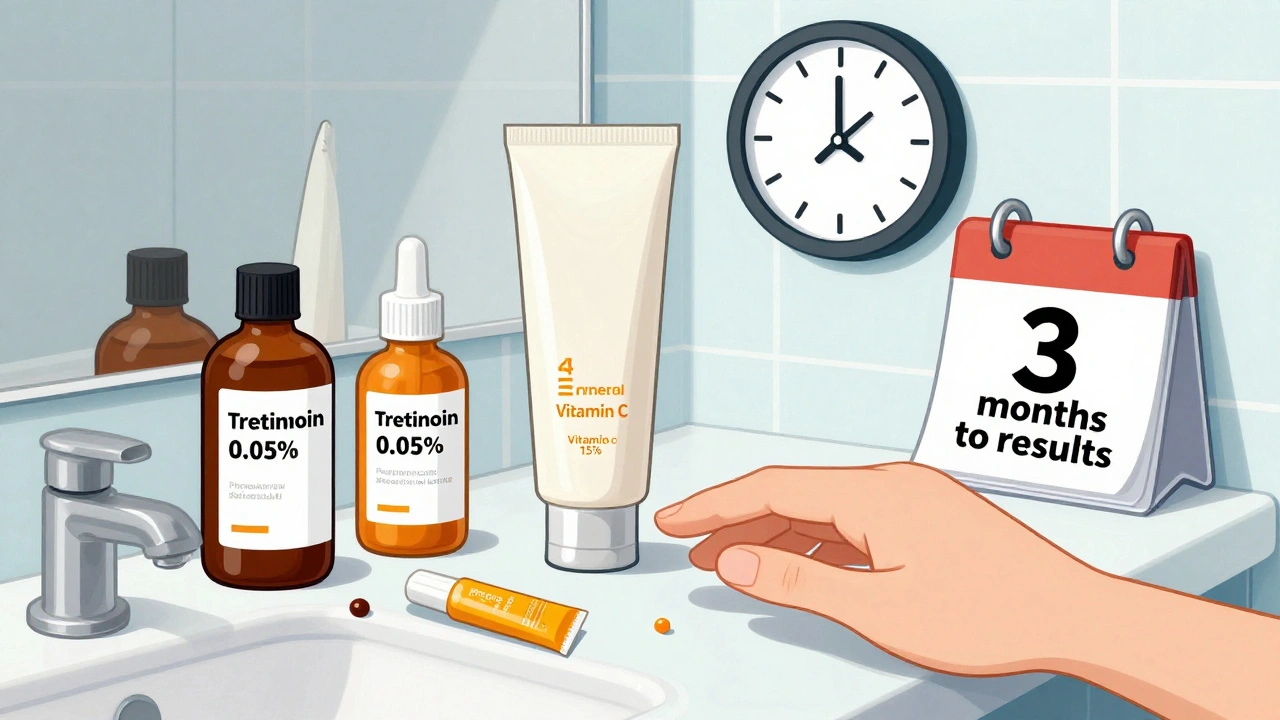
There’s no magic cream, but there are proven combinations that work when used correctly.Hydroquinone (4%) is still the gold standard. It blocks the enzyme tyrosinase, which your skin uses to make melanin. It’s effective - especially when used in a triple combination with tretinoin and a corticosteroid. That combo improves melasma by 50-70% in 12 weeks. But don’t use it longer than 3 months. Beyond that, you risk exogenous ochronosis - a rare but serious condition where skin turns a permanent brownish-gray.
Tretinoin (0.025%-0.1%) doesn’t lighten pigment directly. Instead, it speeds up skin cell turnover. Think of it like a gentle exfoliator that pushes out the dark cells faster. Used nightly, it helps other ingredients penetrate better and reduces the time it takes to see results.
Vitamin C (10-20% L-ascorbic acid) is a powerful antioxidant. It doesn’t just block melanin production - it also neutralizes free radicals caused by UV and visible light. It’s safe for long-term use and works well in the morning under sunscreen. Look for stable formulations in dark, airless bottles.
For those who can’t use hydroquinone (due to regulations in the EU or Japan, or skin sensitivity), alternatives like tranexamic acid (5%) and kojic acid are gaining traction. Tranexamic acid, originally used to reduce bleeding, was found to reduce melasma by 45% in clinical trials with almost no side effects. Niacinamide (5%) also helps by blocking pigment transfer to skin cells.
Why Lasers Can Make Melasma Worse
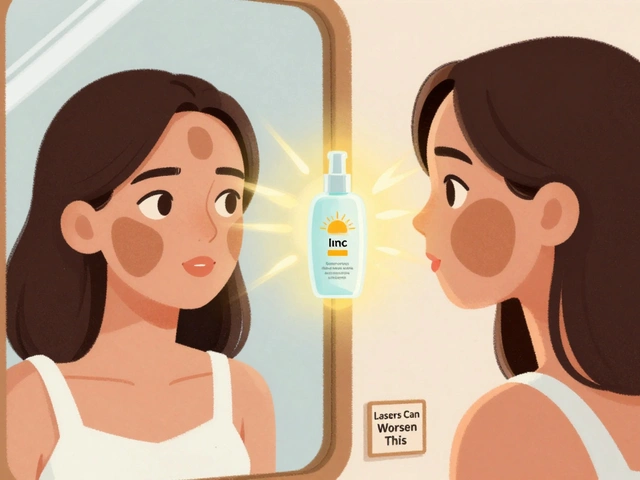
Laser treatments like IPL or Q-switched lasers work great on sun spots - they zap the pigment and the skin sheds it in a few days. But for melasma? They’re risky.Lasers generate heat. And heat triggers melanocytes to go into overdrive. Studies show 30-40% of melasma patients get worse after IPL. That’s why dermatologists wait. Before any laser treatment, they’ll have you use topical agents for 8-12 weeks to “rest” the melanocytes. This reduces recurrence from 60% down to 25%.
Even chemical peels can backfire if used too aggressively on darker skin. Post-inflammatory hyperpigmentation (PIH) - dark spots left behind after inflammation - is common in Fitzpatrick IV-VI skin types. PIH looks like melasma but appears after acne, cuts, or burns. It doesn’t respond to lasers and often needs different treatments.
The Real Problem: Adherence
You can have the best prescription in the world, but if you don’t use it right, it won’t work.Here’s what most patients get wrong:
- Skipping sunscreen or not reapplying
- Using too little product (most people use half the recommended amount)
- Stopping treatment as soon as skin looks better - not realizing melasma needs lifelong maintenance
- Trying OTC creams first for months before seeing a dermatologist
Advanced Skin MD found that 70% of patients don’t protect their skin properly. And only 35% stick with their topical regimen for the full 3-6 months needed to see results. That’s why so many think “nothing works.”
Start slow. If you’re using hydroquinone and tretinoin, begin every other night to avoid irritation. Use a gentle moisturizer. Build up over 4-6 weeks. And remember - improvement takes time. You won’t see changes in a week. It usually takes 8-12 weeks. Patience is part of the treatment.
What’s Next for Hyperpigmentation Treatment?
The field is changing fast. The FDA is considering reclassifying hydroquinone as an over-the-counter drug with strict safety labels - which could make it easier to access but also risk misuse. New agents like cysteamine cream (10%) are showing 60% improvement in melasma after 16 weeks with minimal irritation.Researchers are also looking at genetic testing to predict who responds best to which treatment. Within five years, your dermatologist might test your skin’s genetic profile to choose the right combo for you.
For now, the most effective strategy is simple: protect your skin from all light (UV, visible, infrared), use proven topicals consistently, and avoid anything that heats up your skin. Melasma isn’t curable - but it’s manageable. Sun damage is easier to fix. The difference is knowing which one you have - and treating it accordingly.
What to Do Today
If you’re dealing with dark patches:- Stop using random OTC creams. They rarely help melasma.
- Get a proper diagnosis from a dermatologist. Don’t assume it’s just sun damage.
- Switch to a mineral sunscreen with zinc oxide and iron oxides. Apply a quarter-teaspoon daily.
- Ask about triple-combination therapy: hydroquinone, tretinoin, and a corticosteroid.
- Don’t rush into lasers. Let your skin calm down first.
Hyperpigmentation isn’t vanity. It affects confidence, mental health, and quality of life. But it’s not hopeless. With the right plan - and consistency - you can get your skin back under control.
Shelby Ume
December 12, 2025 AT 16:49Wow, this is one of the most thorough breakdowns I’ve read on melasma vs. sun damage. I’ve been using a chemical sunscreen for years and still got patches - turns out I needed iron oxides. I switched to a mineral SPF 50+ with iron oxide last month, and my upper lip darkening has already lightened. No magic, just science. Thanks for the clarity.
Also, the part about visible light from screens? Mind blown. I work 10 hours a day in front of a monitor. Guess I’m wearing sunscreen indoors now, even if I’m ‘just scrolling’.
And yes - 3 months max on hydroquinone. I learned that the hard way after my skin turned grayish. Never again.
John Fred
December 13, 2025 AT 12:45YO. THIS. RIGHT. HERE. 🙌
SPF 50+ with iron oxides = non-negotiable. I used to think ‘I’m indoors’ meant I was safe. Nope. My melasma got worse after Zoom calls. Now I wear sunscreen like it’s my job. And yes, quarter-teaspoon. No excuses.
Triple combo (HQ + tretinoin + steroid) changed my life. Took 10 weeks, but my cheeks finally look even. Lasers? Nope. Heat = bad. Learned that after a $2k disaster.
Also - vitamin C in the AM? YES. My skin glows. No filter. 🌞
Harriet Wollaston
December 14, 2025 AT 08:37I just want to say thank you for writing this. I’ve felt so alone with this. My mom had melasma, I thought it was just ‘my skin type’ - turns out it’s hormones + sun + stress. I’m 34, never had acne, but now I have these patches on my cheeks like I’m in my 50s.
I started the triple combo last week and I’m terrified I’ll mess it up. But reading this made me feel like maybe - just maybe - I can get my skin back. I’m not giving up. Not anymore.
Also, please know you’re not just helping people with their skin. You’re helping them feel seen.
Lauren Scrima
December 15, 2025 AT 19:53So… you’re telling me I’ve been wasting $200/month on ‘brightening’ serums that don’t block visible light? 🤦♀️
And I thought ‘SPF 50’ meant ‘I’m covered’. Nope. I used half the amount. Reapplied once a day. And blamed my skin for being ‘too sensitive’. Oops.
Also - hydroquinone for 3 months max? Why didn’t anyone tell me this before I ruined my skin? I’m not mad… just deeply embarrassed.
Also - no lasers. Got it. I’m putting my money into sunscreen now. And a measuring spoon. 😅
nina nakamura
December 16, 2025 AT 05:10Hamza Laassili
December 16, 2025 AT 06:23ok so i read this whole thing and like… why is everyone so obsessed with sunscreen? i mean yeah i wear it but like… i live in america. we got AC. we got windows. we got shade. why do i need to wear it indoors? i dont go to the beach every day. also hydroquinone? sounds like poison. i used a cream from walmart and it worked fine. why complicate stuff? also why is everyone so serious about this? its just skin. breathe.
also i think lasers are fine. i know a guy who did it and he looks great now. no one told him not to. so why are you all scared?
Constantine Vigderman
December 17, 2025 AT 22:43Guys. I was skeptical. I thought this was just another ‘skinfluencer’ post. But I tried the iron oxide sunscreen - the one with zinc oxide and the dark tint? I wore it for 3 weeks. No reapplication. Just once in the morning. And guess what? My melasma didn’t get worse. That’s huge.
And I started using vitamin C in the AM - it stings a little, but my skin feels alive. Like it’s breathing again.
Also - I’m 42, and I finally feel like I’m not fighting a losing battle. This isn’t vanity. It’s self-respect. Keep going. You’re not alone. 💪✨
Jamie Clark
December 18, 2025 AT 13:50You’re all missing the systemic issue. This isn’t about sunscreen or hydroquinone. It’s about capitalism turning a biological condition into a product market. Dermatologists profit from your insecurity. They sell you creams, then lasers, then more creams. They don’t want you cured - they want you dependent.
And yet you all cling to these ‘solutions’ like religious relics. You’ve been conditioned to believe your worth is tied to your skin tone. That’s the real disease. Not melasma. The belief that you need fixing.
Stop buying. Start questioning. The skin will heal when the mind does.
Webster Bull
December 19, 2025 AT 23:51Just wanted to say - this post saved me. I was about to book a laser appointment. Read this. Cancelled. Switched to mineral SPF. Started the triple combo. Took 2 months. My skin isn’t perfect… but it’s not dark anymore. I can go outside without feeling like I’m hiding.
And yeah - I used too little product. I’m not proud. But I’m learning. Small steps. Consistency. Not perfection.
Thanks for the real talk. No fluff. Just facts. That’s rare.
Bruno Janssen
December 20, 2025 AT 22:11...
I read this. I didn’t comment before. I don’t know why I’m commenting now.
I’ve had melasma for 8 years. I stopped using anything. I just… live with it. I don’t talk about it. I don’t look in mirrors much.
I didn’t think anyone understood. I didn’t think anyone else felt this quiet shame.
Thank you.
...
I’ll try the sunscreen tomorrow.
I’m scared.