
Getting the right dose of medicine for your child isn’t just important-it can be life-saving. A teaspoon of liquid medicine might seem simple, but if you’re using a kitchen spoon instead of the right tool, you could be giving your child too much-or too little. Studies show that 7 in 10 parents make at least one dosing mistake with liquid medications, and many of those errors happen at home. The difference between 0.5 mL and 5 mL? That’s a tenfold error. For a child, that can mean the difference between treatment and emergency care.
Why Using Kitchen Spoons Is Dangerous
You might think a regular teaspoon is close enough. It’s not. A standard kitchen teaspoon holds anywhere from 3.9 to 7.3 milliliters (mL), depending on how full it is and the shape of the spoon. But the medical standard for a teaspoon is exactly 5 mL. That’s a 20% to 200% variation. For a child weighing 10 kilograms, a dose of amoxicillin might be 2.5 mL. If you use a kitchen spoon that holds 7 mL, you’re giving almost three times the right amount. That’s not a typo. That’s a real risk. The Centers for Disease Control and Prevention (CDC) made this clear in their PROTECT initiative: never use kitchen utensils to measure children’s medicine. Even if you’ve done it before without problems, you’re playing with fire. The same goes for tablespoons. They’re even more unpredictable. One parent in Sydney told me they used a tablespoon for their toddler’s fever medicine-because it was the only thing handy. The child ended up in the ER with vomiting and drowsiness. The dose was double what it should have been.Use Only the Tool That Comes With the Medicine
When you pick up a prescription for liquid medicine, there’s almost always a dosing tool inside the box. It might be a plastic syringe, a dropper, or a small cup. That tool is calibrated for that specific medicine. It’s not a suggestion-it’s part of the safety system. The CDC and the American Academy of Pediatrics (AAP) both say: use only the measuring device that comes with the medication. Don’t swap it out for a different syringe or a cup you found in the drawer. Even if the new tool looks similar, the markings might be off. A syringe from another bottle might be labeled in teaspoons instead of mL. That’s a trap. Some pharmacies still print instructions like “give 1 tsp” on the label. That’s outdated and dangerous. Ask the pharmacist to rewrite it in mL. If they don’t, write it yourself on the bottle with a permanent marker. Always double-check the concentration. Amoxicillin might be 250 mg per 5 mL, or 400 mg per 5 mL. The dose changes completely based on that number.Oral Syringes Are the Gold Standard
For doses under 5 mL, an oral syringe is the most accurate tool you can use. Studies show oral syringes are 94% accurate. Dosing cups? Only 76%. For small doses like 1.5 mL or 2.5 mL, cups are especially bad-error rates jump to nearly 70%. That’s because it’s hard to see the line clearly, and liquid sticks to the sides. Oral syringes come in different sizes: 1 mL, 3 mL, 5 mL, 10 mL. Use the smallest one that fits your dose. A 10 mL syringe for a 2 mL dose is like using a measuring jug to pour a shot of whiskey-you can’t be precise. Hold the syringe vertically when you draw up the medicine. Look at the plunger at eye level. The liquid forms a curve called a meniscus. Read the measurement at the bottom of that curve. Some syringes have color-coded tips. For example, red might mean fever medicine, blue for antibiotics. These aren’t gimmicks-they’re safety features. A 2022 study found color-coded syringes reduced dosing errors by 61%. If your pharmacy doesn’t give you one, ask for it. Or buy one at a pharmacy. They cost less than $5.Never Mix Up mg and mL
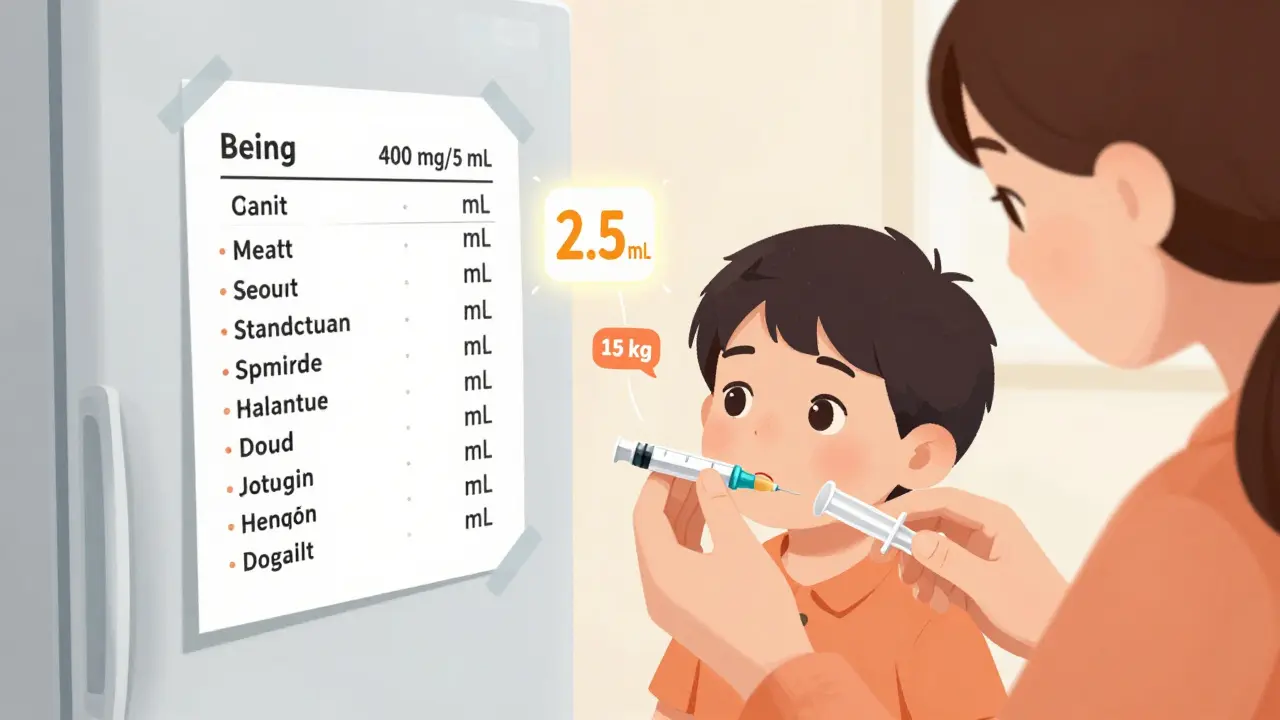
This is one of the most common-and deadly-mistakes. Medication labels list two numbers: the strength (mg) and the volume (mL). For example: “Amoxicillin 400 mg per 5 mL.” That means every 5 mL of liquid contains 400 mg of medicine. Parents often confuse the two. They see “400 mg” and think that’s the dose. But the doctor prescribed “15 mg per kg.” So if your child weighs 15 kg, the dose is 225 mg. Now you have to figure out how many mL that is. Here’s how:- Weight: 15 kg
- Dose: 15 mg/kg
- Total dose: 15 × 15 = 225 mg
- Concentration: 400 mg per 5 mL
- So: 225 mg ÷ 400 mg = 0.5625
- 0.5625 × 5 mL = 2.8 mL
Weight Matters-Convert Pounds to Kilograms
Children’s doses are almost always based on weight-not age. That’s why your doctor asks for your child’s weight. If your scale only shows pounds, you need to convert. One kilogram equals 2.2 pounds. So a 22-pound child is 10 kg (22 ÷ 2.2 = 10). A 44-pound child is 20 kg. If you’re unsure, write it down: Weight in pounds ÷ 2.2 = Weight in kilograms. Keep this number handy. Many parents write it on the medicine bottle or stick it on the fridge. If your child’s weight changes by more than 2 kg, check the dose again. Growth spurts happen fast.What to Do When Your Child Spits Out the Medicine
About 68% of parents report their child spits out or refuses liquid medicine. It’s frustrating. But don’t give more to make up for it. That’s how overdoses happen. Instead, try these tricks:- Use the syringe to place the medicine on the inside of the cheek, not the front of the tongue. Kids can’t spit it out as easily.
- Give a small amount at a time-0.5 mL at a time-and pause between each.
- Let your child suck the medicine off the syringe instead of pushing the plunger.
- Mix it with a small spoonful of applesauce, yogurt, or juice (only if the medicine allows it-check the label or ask your pharmacist).
Shake It Before You Use It
Many liquid medications are suspensions-meaning the medicine floats in liquid. If you don’t shake it, the medicine settles at the bottom. One study found that parents who didn’t shake their child’s antibiotic suspension gave doses that were 30% to 50% too low. Shake the bottle hard for 10 seconds before each dose. Even if it looks mixed, shake it anyway. Don’t skip this step. It’s not optional.
Keep a Dosing Chart
Create a simple chart for your child’s most-used medicines. Write down:- Medicine name
- Concentration (e.g., 250 mg/5 mL)
- Dose per kg
- Weight in kg
- Volume per dose in mL
- How often to give it
What to Do If You Make a Mistake
If you accidentally give the wrong dose, don’t panic. But don’t wait either.- If you gave too much: Call your doctor or poison control immediately. In Australia, call 13 11 26.
- If you gave too little: Don’t double the next dose. Just give the right amount at the next scheduled time.
- If you’re unsure: Call your pharmacist. They’re trained for this. They won’t judge you.
What’s Changing in 2026
The system is getting better. The FDA now requires that all new pediatric liquid medications come with a dosing syringe marked in mL only. By 2026, 95% of these medicines will follow this standard. Pharmacies are starting to hand out color-coded syringes automatically. Apps like MedSafety use your phone’s camera to show you exactly how much to draw up. But the biggest change? Awareness. More parents now know that teaspoons are unsafe. More doctors are writing “2.5 mL” instead of “½ tsp.” It’s not perfect yet-but it’s getting safer.Can I use a regular spoon if I don’t have a syringe?
No. Kitchen spoons vary too much in size and can give you 20% to 200% more or less than the right dose. Always use the measuring tool that came with the medicine. If you lost it, ask your pharmacy for a new one-they usually give them out for free.
Why do some labels still say ‘teaspoon’ instead of ‘mL’?
Some older prescriptions and over-the-counter medicines still use outdated terms. The CDC and AAP have banned this practice since 2015, but not all manufacturers have updated their labels yet. Always ask your pharmacist to rewrite the instructions in mL. Write it on the bottle yourself if needed.
How do I know if my child’s dose is based on weight?
If the dose is written as ‘mg/kg’ or ‘milligrams per kilogram,’ it’s weight-based. Most antibiotics, pain relievers, and fever reducers for children are. Age-based doses are usually only for very simple medicines like infant acetaminophen, and even then, weight is preferred. Always confirm with your doctor or pharmacist.
Is it safe to mix medicine with food or drink?
It’s safe for some medicines, but not all. Check the label or ask your pharmacist. Medicines like amoxicillin can be mixed with a small amount of applesauce or juice. But others, like certain antibiotics or thyroid meds, must be taken on an empty stomach. Never mix into a full bottle-your child might not finish it, and you won’t know how much they got.
What should I do if my child vomits right after taking the medicine?
If your child vomits within 15 minutes of taking the dose, it’s likely the medicine didn’t get absorbed. Call your doctor before giving another dose. If it’s been more than 30 minutes, the medicine has probably been absorbed, and you shouldn’t repeat the dose. Never guess-always check with a professional.
Marian Gilan
January 27, 2026 AT 15:59Conor Murphy
January 28, 2026 AT 01:55Conor Flannelly
January 29, 2026 AT 12:33Patrick Merrell
January 30, 2026 AT 00:23Aishah Bango
January 30, 2026 AT 12:47Simran Kaur
January 31, 2026 AT 09:40Neil Thorogood
February 1, 2026 AT 09:18Jessica Knuteson
February 3, 2026 AT 06:46Robin Van Emous
February 4, 2026 AT 12:08Angie Thompson
February 5, 2026 AT 22:00rasna saha
February 5, 2026 AT 23:56