
When your blood sugar climbs above 180 mg/dL, your body is sending alarms you might not even notice-until it’s too late. Hyperglycemia isn’t just a number on a glucose meter. It’s a slow-burning fire that, if ignored, can lead to coma, hospitalization, or even death. For people with diabetes, understanding the signs and knowing exactly what to do when blood sugar spikes isn’t optional-it’s life-saving.
What Exactly Is Hyperglycemia?
Hyperglycemia means your blood glucose (sugar) is too high. This happens when your body either doesn’t make enough insulin or can’t use it properly. In type 1 diabetes, the pancreas stops producing insulin. In type 2, your cells stop responding to it. Either way, glucose piles up in your bloodstream instead of feeding your muscles, brain, and organs. The result? Energy starvation at the cellular level-even though there’s plenty of sugar in your blood.
Doctors classify hyperglycemia in tiers:
- Mild: 180-250 mg/dL
- Moderate: 251-300 mg/dL
- Severe: Over 300 mg/dL
- Emergency: Above 600 mg/dL
At 600 mg/dL, you’re not just feeling off-you’re in danger of hyperosmolar hyperglycemic state (HHS) or diabetic ketoacidosis (DKA), two life-threatening conditions that demand immediate medical help.
Early Warning Signs You Can’t Afford to Ignore
Most people don’t realize they’re in the early stages of hyperglycemia until their blood sugar hits 300 mg/dL or higher. That’s too late. The real clues show up much earlier.
Here’s what to watch for:
- Excessive thirst: Drinking more than 4 liters of water a day isn’t normal. If you’re constantly reaching for the fridge or bathroom, your body is trying to flush out sugar.
- Frequent urination: Going more than 2.5 liters a day? That’s your kidneys working overtime to remove glucose. It’s not just inconvenient-it’s a red flag.
- Blurred vision: High sugar pulls fluid from your lenses. Vision gets fuzzy. It’s temporary, but if it keeps coming back, don’t brush it off.
- Unexplained fatigue: You’re not tired from work. You’re tired because your cells aren’t getting the fuel they need, even though there’s sugar everywhere.
- Headaches and trouble focusing: A 2021 JAMA study found nearly half of type 2 patients with blood sugar over 250 mg/dL reported brain fog. It’s not stress-it’s glucose toxicity.
These aren’t "just a bad day." They’re your body’s way of saying, "Something’s wrong. Fix it now."
The Hidden Symptoms That Lead to Crisis
When blood sugar climbs above 250 mg/dL, things get dangerous fast. You might think you’re just "feeling under the weather," but your body is slipping into emergency mode.
- Weight loss: Losing more than 5% of your body weight in a few months without trying? Your body is breaking down fat and muscle because it can’t use glucose. That’s a major red flag.
- Slow-healing cuts: High sugar damages blood vessels and weakens your immune system. A small scrape that won’t heal? That’s hyperglycemia at work.
- Recurrent infections: Yeast infections, urinary tract infections, or skin boils that keep coming back? Sugar feeds fungi and bacteria. It’s not coincidence-it’s cause.
At this point, you’re no longer just uncomfortable-you’re at risk of DKA or HHS. And these aren’t the same thing.
DKA vs. HHS: Two Different Emergencies
When blood sugar surges past 250 mg/dL, your body might start burning fat for fuel. That produces ketones-acidic chemicals that poison your blood. That’s diabetic ketoacidosis (DKA).
DKA hits mostly type 1 diabetics. It comes on fast-within 24 to 48 hours. Symptoms include:
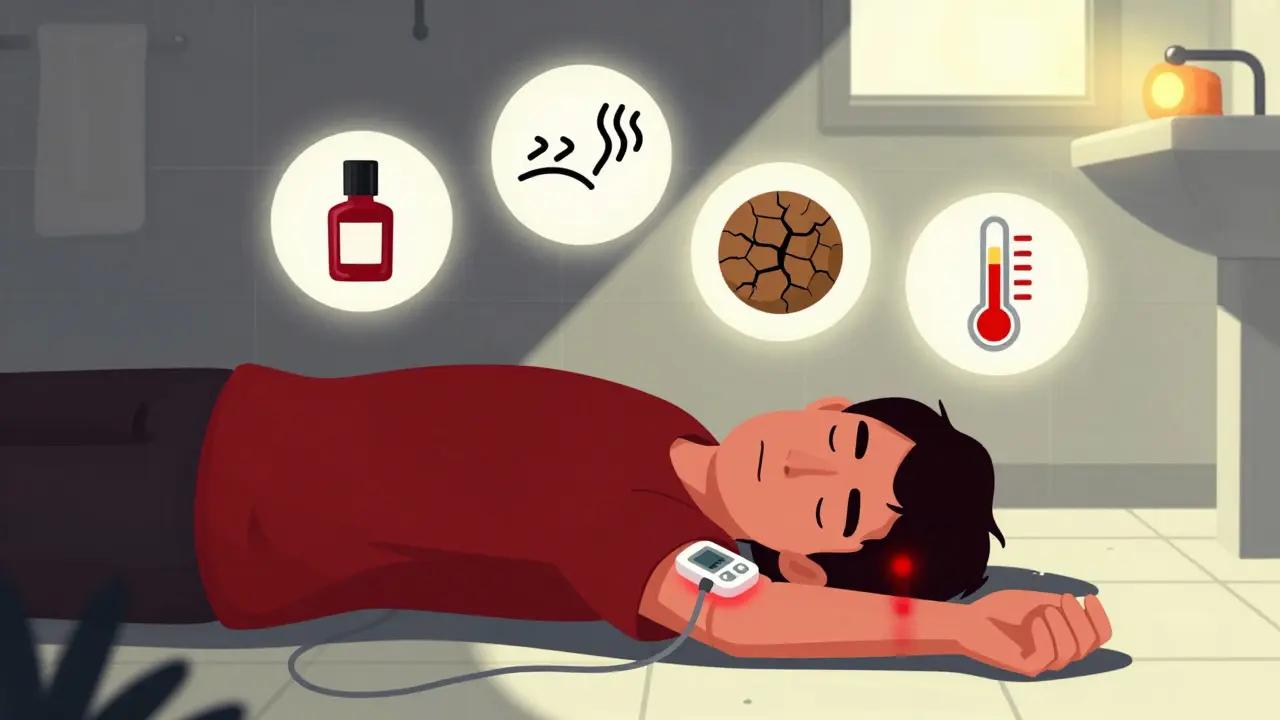
- Fruity-smelling breath (like nail polish remover)
- Deep, rapid breathing (Kussmaul respirations)
- Stomach pain, nausea, vomiting
- Confusion or drowsiness
DKA is dangerous. It kills 2-5% of adults who don’t get help in time.
Then there’s HHS-hyperosmolar hyperglycemic state. This is the silent killer. It mostly affects type 2 diabetics, especially older adults. It builds over days or weeks. You don’t get ketones. Instead, your blood becomes thick, syrupy, and super-concentrated.
HHS symptoms:
- Extreme dehydration (you may lose 8-12 liters of fluid)
- Severe confusion, dizziness, or weakness
- Loss of consciousness
- High fever (in some cases)
HHS has a 15-20% death rate-far worse than DKA. And it’s often missed because people think they’re just "getting old" or "dehydrated from the heat."

What to Do When Blood Sugar Hits 240 mg/dL or Higher
If your meter reads 240 mg/dL or more, don’t wait. Don’t hope it’ll go down on its own. Act.
Here’s your step-by-step plan:
- Check for ketones. Use a urine test strip or a blood ketone meter. If ketones are moderate or high (above 1.5 mmol/L), you’re at risk of DKA.
- Take your fast-acting insulin. Use your correction dose-usually 0.1 units per kilogram of body weight. Don’t skip this. Insulin is the only thing that brings sugar down.
- Drink water. Sip 8-16 ounces of sugar-free fluid every hour. Dehydration makes everything worse.
- Test again in 2-3 hours. If your sugar hasn’t dropped by at least 30-50 mg/dL, call your doctor. If it’s still rising, go to the ER.
- Never exercise. Working out when ketones are present can make DKA worse. Rest. Hydrate. Treat.
And here’s what not to do:
- Don’t drink sugary drinks to "fix" it.
- Don’t wait to see if it "goes away."
- Don’t take extra insulin without knowing your correction factor-you could overdose.
Why People Miss the Signs (And What You Can Learn From Them)
A 2023 survey of over 2,800 people with diabetes found that 67% didn’t notice symptoms until their blood sugar was over 300 mg/dL. Why? They blamed fatigue on work. Blamed thirst on the weather. Thought blurry vision was just aging.
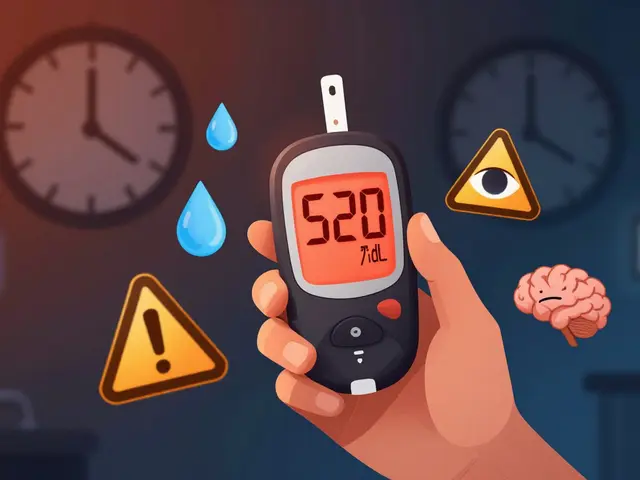
On Reddit’s r/diabetes community, one user wrote: "I thought my headache was from stress. By the time I checked my glucose, it was 520. I passed out in the bathroom."
Another common mistake? Insulin stacking. People take a correction dose, then wait 30 minutes and take another because it hasn’t dropped yet. But insulin takes 1-2 hours to peak. Taking more too soon leads to dangerous lows later.
And then there’s the dawn phenomenon-your blood sugar spikes between 4 and 8 a.m. because of hormones. It’s not laziness. It’s biology. Many people don’t realize their morning high isn’t from eating too much-it’s from their body’s natural rhythm.
How Technology Is Changing the Game
Continuous glucose monitors (CGMs) are no longer luxury tools-they’re lifesavers. A 2023 Dexcom study showed CGM users reduced severe hyperglycemia episodes by 57%. Why? Because they get alerts before symptoms appear.
The FDA approved Dexcom G7’s "Glucose Guardian" in January 2024. It predicts high blood sugar 30 minutes before it happens. That’s not science fiction-it’s real, and it’s available now.
But tech alone won’t fix this. You still need to know how to respond. A CGM won’t inject insulin for you. It won’t tell you to drink water. It won’t stop you from ignoring the alarm.
When to Go to the ER
Call 911 or go to the emergency room if:
- Your blood sugar is above 600 mg/dL
- You have ketones and vomiting
- You’re confused, drowsy, or can’t stay awake
- Your breathing is fast and deep
- You have chest pain or severe abdominal pain
Don’t drive yourself. Don’t wait until morning. HHS and DKA can kill in hours.
Prevention Is the Real Cure
The best way to avoid hyperglycemia emergencies is to catch them early. Here’s how:
- Test your blood sugar at least twice a day-more if you’re sick or stressed.
- Know your insulin-to-carb ratio and correction factor. Write them down. Use them every time.
- Keep sugar-free fluids on hand. Always.
- Check your insulin pump or injection site weekly. A blocked cannula or bad injection can cause sudden spikes.
- Get educated. Programs like the CDC’s Diabetes Self-Management Education cut ER visits by 42%.
And if you’re worried about cost-Medicare now covers CGMs. Many private insurers do too. The $1,200 annual price tag is real, but it’s cheaper than an ER trip.
What’s Next for Hyperglycemia Care?
In 2025, new guidelines will relax blood sugar targets for seniors over 65. Fasting levels under 180 mg/dL will be considered safe-because the risks of low blood sugar in older adults can be just as deadly as high sugar.
But the biggest shift? AI. The NIH just launched a $150 million initiative to use wearable sensors and machine learning to predict hyperglycemia before it happens. Imagine your smartwatch alerting you: "Your sugar will spike in 20 minutes. Take insulin now."
This isn’t a future fantasy. It’s here. And it’s changing outcomes.
What is the first sign of high blood sugar?
The earliest signs are increased thirst and frequent urination. These happen because your kidneys are trying to flush out excess glucose. Many people ignore these symptoms, thinking they’re just drinking more water or have a urinary infection. But if you’re drinking more than 4 liters of fluid a day and still thirsty, it’s likely hyperglycemia.
Can stress cause high blood sugar?
Yes. Stress triggers the release of cortisol and adrenaline, which signal your liver to pump out more glucose. This is why blood sugar often spikes during illness, job loss, arguments, or even sleep deprivation. Emotional stress accounts for 11% of hyperglycemia episodes, according to Kaiser Permanente’s 2023 data.
Is it safe to exercise when blood sugar is high?
Only if ketones are absent. If your blood sugar is above 250 mg/dL and you have moderate or high ketones, exercise can make DKA worse by increasing fat breakdown and ketone production. Wait until your sugar drops below 250 and ketones are gone before moving.
Why does high blood sugar cause blurred vision?
High glucose pulls fluid out of the lenses of your eyes, changing their shape. This makes focusing difficult. Vision usually returns to normal once blood sugar stabilizes. But if it keeps happening, it can damage the retina over time-leading to diabetic retinopathy.
How long does it take to bring down high blood sugar?
With fast-acting insulin, blood sugar typically starts dropping within 15-30 minutes. The biggest drop happens in 1-2 hours. But if you’re severely dehydrated or have HHS, it can take 12-24 hours to stabilize-even with IV fluids and insulin. Don’t expect quick fixes in emergencies.
Can non-diabetics have hyperglycemia?
Yes. Severe illness, steroid medications, pancreatitis, or Cushing’s syndrome can cause temporary hyperglycemia in people without diabetes. It’s less common, but it happens. If someone without diabetes has a blood sugar above 200 mg/dL, they need medical evaluation.
tatiana verdesoto
March 3, 2026 AT 10:45Just wanted to say this post saved my life last year. I thought my constant thirst and fatigue were just "getting older"-turns out my BG was hitting 480. I didn’t even know ketones were a thing until I read this. Now I check my CGM every 20 mins when I feel off. You’re not alone. We got this.
RacRac Rachel
March 4, 2026 AT 16:08Thank you for writing this. 🙏 I’ve been using the Dexcom G7 since January and the predictive alerts? Game. Changer. I caught a spike at 245 before I even felt dizzy. No more panic midnight glucose checks. Also-hydration is non-negotiable. Water > soda. Always.
Jane Ryan Ryder
March 5, 2026 AT 06:09Ugh. Another sugar sermon. People are lazy. Stop blaming biology and start eating less carbs. I’ve been keto for 7 years and my BG never spikes. Problem solved. No need for fancy gadgets.
John Cyrus
March 7, 2026 AT 00:54Anyone who thinks insulin stacking is dangerous clearly doesn't understand pharmacokinetics. You take insulin when you need it. Period. If you're scared of lows then don't be diabetic. Simple. Also DKA is for people who don't check their pumps. You're not special. Just irresponsible.
Diane Croft
March 8, 2026 AT 19:03This is so important. I used to ignore my symptoms until I ended up in the ER. Now I keep sugar-free electrolytes in my bag, car, and purse. One little habit changed everything. You don’t need to be perfect-just consistent. Small steps save lives.
Tobias Mösl
March 10, 2026 AT 18:46Let me guess-this was written by Big Pharma. CGMs? $1200 a year? Medicare covers it? Sure. But who really profits? The labs. The insulin manufacturers. The tech companies. And you? You're just another data point. They want you dependent. Watched. Monitored. And scared. The real cure? Stop treating diabetes like a disease and start treating it like a metabolic choice. But no one wants to hear that.
Ethan Zeeb
March 11, 2026 AT 08:30I appreciate the info but let’s be real-most people with diabetes don’t have access to CGMs or insulin pumps. I’m on Medicaid. My meter costs $50 a month. I can’t afford test strips. So your "life-saving" advice? It’s a luxury. Stop preaching to the privileged.
Darren Torpey
March 12, 2026 AT 07:32Man, this hits different. I used to think hyperglycemia was just "feeling blah." Then I had a 600 mg/dL episode and woke up in the ER with IV fluids and a nurse saying, "You’re lucky you’re alive." I didn’t even know my own body could shut down like that. Now I carry glucose tabs AND water. I check my levels like I check my phone. It’s not OCD-it’s survival. And yeah, the dawn phenomenon? Real. I set an alarm for 3 a.m. to drink water. Sounds nuts? It saved me.
Lebogang kekana
March 14, 2026 AT 02:29I'm from South Africa and we don't have access to half of what you're talking about. But I do know this: if your foot won't heal, if your vision blurs, if you're always thirsty-you need to act. No device needed. Just awareness. I teach this to my community. No fancy tech. Just truth. Your body talks. You just gotta listen.
Jessica Chaloux
March 15, 2026 AT 15:13OMG YES. I ignored my blurry vision for 3 months. Thought it was just screen fatigue. Then I checked my BG-410. I cried. I was so scared. Now I have my CGM on my wrist 24/7. And I drink water like it’s my job. 🥲💧
Mariah Carle
March 17, 2026 AT 06:13It’s fascinating how the body communicates when we stop ignoring it. Hyperglycemia isn’t just a medical condition-it’s a metaphysical signal. A disruption in the flow. A reminder that we’re not separate from our biology. We are the sugar. We are the insulin. We are the balance. And when we forget that… we suffer.
Raman Kapri
March 17, 2026 AT 08:48The premise of this article is fundamentally flawed. Hyperglycemia is not a disease. It is a symptom of systemic insulin resistance caused by processed foods, sedentary lifestyles, and poor public health policy. Blaming individuals for not checking their glucose levels ignores the structural failures of the food industry and healthcare system. Technology may help, but it does not address root causes. This is performative medicine.