
Pharmacists don’t just fill prescriptions-they make critical decisions every day that affect patient safety. One of the most complex parts of that job? Understanding generics. With over 90% of prescriptions filled with generic drugs in the U.S., and new ones approved at a record pace, staying up to date isn’t optional. It’s a daily necessity.
Why Generics Knowledge Is Non-Negotiable
Generic drugs aren’t cheap copies. They’re FDA-approved versions of brand-name medications that must match in strength, purity, identity, and quality. But here’s the catch: not all generics are created equal in practice. Two generics of the same drug can behave differently in the body. That’s why pharmacists need to know the therapeutic equivalence ratings in the FDA’s Orange Book.
Every month, the FDA updates its Orange Book with over 1,200 therapeutic equivalence codes. A rating of “A” means the generic is interchangeable with the brand. An “AB” rating? That’s a subcategory indicating bioequivalence within 80-125% of the original. Miss a change in rating, and you could accidentally switch a patient from a stable generic to one that doesn’t work the same-especially dangerous with narrow therapeutic index drugs like levothyroxine or warfarin.
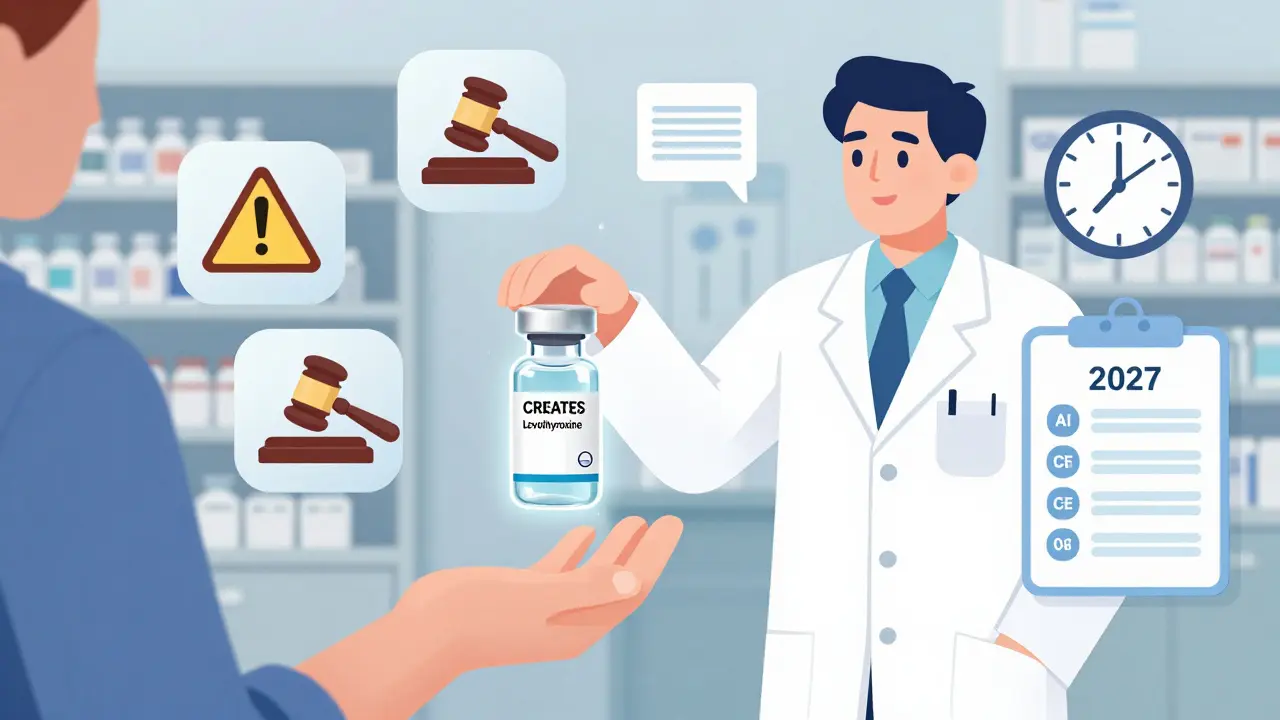
It’s not theoretical. A 2021 ACPE report found that 42.7% of all pharmacy malpractice claims involved errors related to generic substitution. One pharmacist in Illinois swapped a patient’s levothyroxine brand for a different generic because they didn’t know the new product had a different bioequivalence rating. The patient ended up in the ER with atrial fibrillation. That mistake could’ve been prevented with just one updated CE module.
What’s Required by Law
All 50 states require pharmacists to complete continuing education (CE) to renew their license. Most require between 15 and 30 hours every two years. But here’s where it gets messy: each state has its own rules.
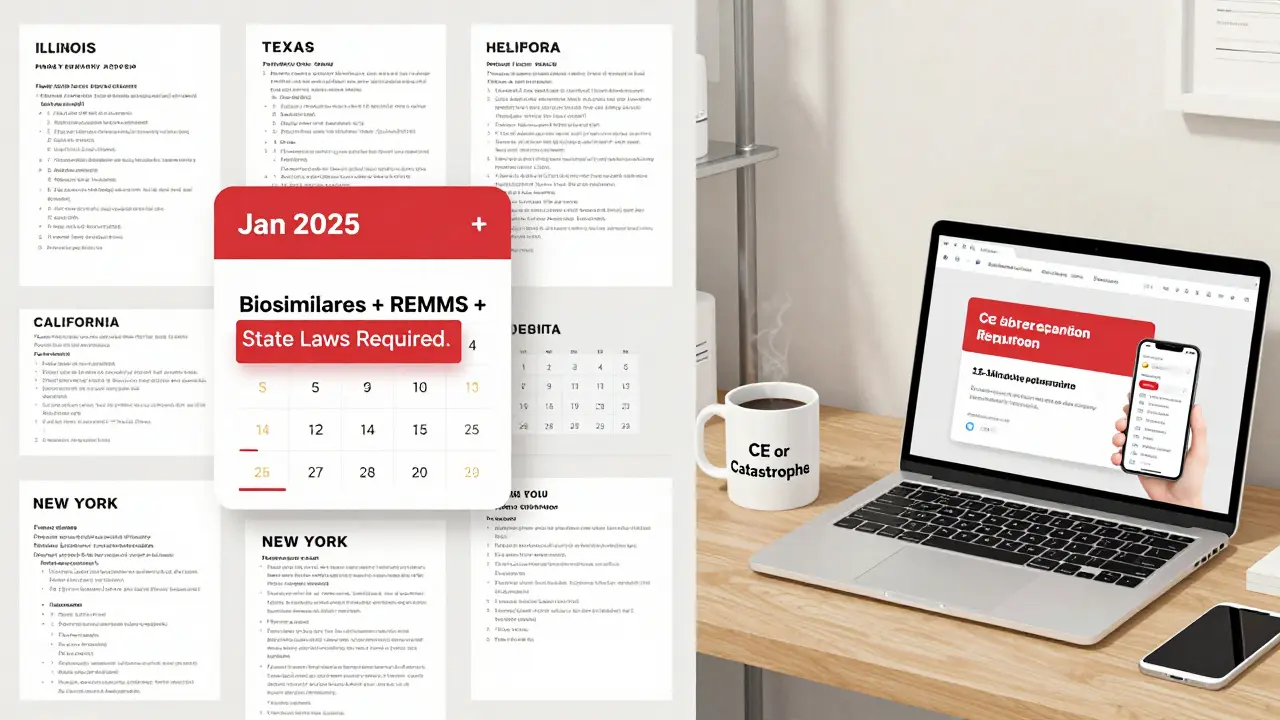
In Illinois, pharmacists need 30 hours every two years, including 1 hour on sexual harassment prevention, 1 hour on implicit bias, and-starting January 2025-1 hour on cultural competency. Texas doesn’t require those extra topics, but it does have strict rules about substituting narrow therapeutic index drugs. California requires you to keep CE records for two years. New York wants you to submit certificates with your renewal. If you’re licensed in multiple states, you’re juggling different deadlines, different topics, and different proof requirements.
And it’s not just about hours. The Accreditation Council for Pharmacy Education (ACPE) requires all CE to be accredited-either by ACPE itself or your state board. Unaccredited courses? They don’t count. You can’t just watch a YouTube video and call it training. You need structured, verified learning.
How to Choose the Right CE
Not all CE is created equal. There are three main types:
- Knowledge-based: Lectures, readings, videos. Good for basics, but forgettable.
- Application-based: Case studies, real-world scenarios. You’re asked to make decisions, not just absorb facts.
- Certificate programs: Longer, hands-on programs with assessments and practice components.
Here’s what the data shows: pharmacists who take application-based courses report 4.7 out of 5 satisfaction ratings. Knowledge-based courses? Only 3.2. Why? Because you remember what you *do*, not what you *hear*.
Look for modules that walk you through real cases: a patient on levothyroxine with a new generic, a biosimilar being introduced in a hospital formulary, a patient whose insurance switches them to a cheaper generic without warning. These aren’t hypotheticals-they happen every day.
Providers like Pharmacist’s Letter and PocketPrep offer free, ACPE-accredited modules focused on generics. PocketPrep alone had over 45,000 users in 2023, with 32% growth in generics-specific content. That’s not a fluke. Pharmacists are voting with their clicks.
The Hidden Gaps in Today’s CE
Most pharmacists spend just 5.2 hours a year on generics-specific education. That’s less than one full workday. But the landscape changes faster than ever.
In 2023, the FDA approved 983 new generic drugs-up 17% from the year before. New biosimilars are entering the market for rheumatoid arthritis, cancer, and diabetes. Each one has its own interchangeability rules, REMS programs, and labeling requirements. A 2023 ASHP survey found that 78% of hospital pharmacists felt unprepared to handle biosimilar substitutions.
And then there’s the CREATES Act. It was meant to stop brand-name companies from blocking generic manufacturers from buying samples. But it’s added a whole new layer of legal complexity. Pharmacists need to understand how patent litigation, drug sampling rules, and state substitution laws interact. Most CE modules still treat this as a footnote.
Worse, many courses are generic-literally. They use the same case studies year after year. A Texas pharmacist told Pharmacy Times in 2023: “I took the same CE on generic substitution three years in a row. Nothing changed. But my state’s law did.”
What’s Changing in 2025
ACPE just announced new standards taking effect January 1, 2025. All generics-related CE must now include:
- Biosimilar interchangeability rules
- FDA Risk Evaluation and Mitigation Strategies (REMS)
- State-specific substitution laws
This is a big deal. It means CE providers can’t just recycle old content anymore. They’ll have to update modules, add new case studies, and focus on real-time decision-making. It’s a step toward relevance.
Meanwhile, the National Association of Boards of Pharmacy (NABP) is pushing for 80% alignment in CE requirements across states by 2025. That could mean less confusion for pharmacists who work in multiple states. But until then, you still need to check your state’s rules every year.
How to Stay Ahead Without Burning Out
You don’t need to read every FDA update. But you do need a system.
Start with this:
- Set a calendar reminder: every quarter, check the FDA Orange Book updates.
- Subscribe to one reliable source: Pharmacist’s Letter, ASHP’s Daily News, or the FDA’s Drug Shortages page.
- Choose one application-based CE module per year focused on generics. Don’t just check the box-apply it.
- Ask your pharmacy manager if your department runs monthly case reviews. If not, suggest it.
Pharmacists who complete at least 5 hours of generics-specific CE per year make 37% fewer substitution errors, according to APhA data. That’s not a small margin. That’s patient safety.
What’s Next for Generics Education
The future is personalization. AI-powered platforms are already learning which pharmacists struggle with biosimilars, which ones confuse therapeutic equivalence codes, and which ones need reminders about state laws. By 2027, over a third of CE will be delivered through adaptive platforms that tailor content to your gaps.
Early pilots at CVS Health show that just-in-time learning-pushing a 5-minute module to a pharmacist’s phone right before they’re about to dispense a new generic-reduced errors by 28%. Imagine getting a quick alert: “This generic has a new AB2 rating. Check your state’s substitution rules.” That’s the future. And it’s coming fast.
For now, the best tool you have is your own curiosity. Don’t wait for CE to come to you. Seek it out. Ask questions. Talk to colleagues. Read the FDA’s guidance. The generics landscape won’t slow down. You shouldn’t either.
What is the FDA Orange Book and why does it matter for pharmacists?
The FDA Orange Book is a public database that lists approved drug products with therapeutic equivalence evaluations. It assigns ratings like "A" or "AB" to generics, indicating whether they’re interchangeable with brand-name drugs. Pharmacists must check this daily because even small changes in rating can affect substitution decisions-especially for drugs with narrow therapeutic indexes like levothyroxine or warfarin. Monthly updates mean staying current isn’t optional.
Do all states require the same continuing education for generics?
No. While all 50 states require pharmacists to complete CE for license renewal, the topics, hours, and deadlines vary. For example, Illinois requires 30 hours every two years plus mandatory training on sexual harassment and bias. Texas has unique rules for substituting narrow therapeutic index drugs. California requires record-keeping for two years, while New York requires submitting certificates with renewal. Pharmacists licensed in multiple states must track each state’s requirements separately.
Are free CE courses worth taking for generics?
Yes-if they’re ACPE-accredited. Providers like Pharmacist’s Letter and PocketPrep offer free, high-quality modules that cover therapeutic equivalence, biosimilars, and state laws. These are not just cheap alternatives-they’re designed by experts and tested for clinical relevance. Many pharmacists report these as the most practical CE they’ve ever taken. Just make sure the course has an ACPE accreditation number before you complete it.
What’s the difference between a generic and a biosimilar?
Generics are chemically identical copies of small-molecule drugs, like metformin or lisinopril. Biosimilars are copies of complex biologic drugs, like insulin or Humira, made from living cells. They’re not exact copies-small differences are allowed as long as they don’t affect safety or effectiveness. Interchangeability rules for biosimilars are stricter, and many states require prescriber consent before substitution. This is why new CE standards now require specific training on biosimilars.
How can I tell if a CE course is truly application-based?
Look for case studies, decision points, and feedback. A true application-based course will ask you to choose between substitution options, explain your reasoning, and then show you the clinical outcome. If the course just shows you slides with bullet points and ends with a multiple-choice quiz, it’s likely knowledge-based. Application-based courses typically have higher satisfaction ratings-4.7 out of 5 on platforms like CE21-and are proven to reduce real-world errors.

Denise Jordan
March 11, 2026 AT 20:03Look, I get it. But honestly, how many of us are actually reading these updates? I took the same CE on generics in 2021, 2022, and 2023. Same case study. Same slides. They just changed the font.
Meanwhile, my pharmacy just switched to a new generic for levothyroxine because the rep said it was "the same thing." No one checked the Orange Book. No one cared. We’re all just going through the motions.
Bridgette Pulliam
March 12, 2026 AT 03:37As someone who’s been in this field for 22 years, I’ve seen this cycle repeat. Every time there’s a new FDA update, there’s a flurry of panic-then silence. We need to stop treating CE like a checkbox and start treating it like a lifeline.
I started doing 15 minutes of Orange Book review every Monday morning. Not because I have to. Because I want to. My patients notice. One man told me last month, "You’re the only one who ever explained why my med feels different." That’s worth more than any credit hour.
Kenneth Zieden-Weber
March 13, 2026 AT 15:19Love this. But let’s be real-most CE providers are just repackaging the same junk. I’ve taken 12 modules this year. Only two actually changed my practice. The rest? Just fancy PDFs with quiz questions that don’t reflect real life.
That said, PocketPrep’s biosimilar module last month? Game changer. I walked into work and caught a substitution error before it happened. Saved a guy from a possible hospitalization. That’s the kind of stuff we need more of.
Alexander Erb
March 15, 2026 AT 08:38Yessss! 🙌 I’ve been doing the daily 5-minute PocketPrep drills since January. It’s like a caffeine hit for my brain. Last week I caught a swap on a new generic warfarin because the rating changed from AB1 to AB2. My pharmacist buddy was about to fill it-until I stopped him. He said, "How’d you know?" I said, "I didn’t. I just checked."
It’s not hard. It’s just consistent. And yeah, I use emojis. Deal with it 😎
Donnie DeMarco
March 15, 2026 AT 19:23Bro. I just took a CE on generics and it was like 45 minutes of someone reading the FDA website out loud. I swear I saw the same slide from 2020. Like, did they even update the examples? I’m not even mad. I’m just… disappointed.
Meanwhile, I’m out here Googling "AB rating levothyroxine" at 2 a.m. because I don’t trust the system. We need better tools. Not more hours. Better content.
Chris Bird
March 16, 2026 AT 18:03Let’s cut the crap. The FDA doesn’t care. The states don’t care. The CE companies? They’re just selling courses. You think this is about patient safety? Nah. It’s about money. CE is a $2 billion industry. Pharmacists are the suckers who keep paying.
And don’t get me started on biosimilars. Half the people in my pharmacy don’t even know what a biosimilar is. We’re one bad substitution away from a mass casualty event. And no one’s doing anything.
Adam Kleinberg
March 18, 2026 AT 10:23Did you know that 70% of CE providers are owned by big pharma? They’re not teaching you safety-they’re teaching you loyalty. That "free" PocketPrep module? Sponsored by a company that makes the exact generics they’re telling you to avoid.
They want you to trust the Orange Book. But what if the Orange Book is manipulated? What if the bioequivalence thresholds are rigged? Who audits the auditors?
Don’t be fooled. This isn’t education. It’s control.
David L. Thomas
March 20, 2026 AT 08:37From a clinical pharmacology standpoint, the real gap isn’t CE-it’s implementation. We’ve got the data. We’ve got the guidelines. But the system doesn’t incentivize vigilance.
Pharmacies are still paid per script, not per outcome. So why spend 20 minutes checking an AB rating when you can fill 10 scripts in that time? The CE is there. The knowledge is there. The infrastructure? Not so much.
We need a CPOE alert system tied directly to the Orange Book. Real-time. Automatic. Not another webinar.
Mike Winter
March 21, 2026 AT 03:49It’s fascinating how we’ve turned what should be a professional duty into a bureaucratic burden. The fact that we need state-by-state compliance checks for something as fundamental as drug substitution speaks volumes about the fragmentation of our healthcare system.
I’ve been tracking this since 2018. The number of states requiring bias training has tripled. Yet none require a competency exam on therapeutic equivalence. We prioritize optics over outcomes. It’s tragic.
Randall Walker
March 21, 2026 AT 12:39Oh wow. Another article telling us we’re not doing enough. How about this: instead of telling us to "check the Orange Book" every quarter, maybe the FDA should just email us when something changes?
And while they’re at it-send a damn text. I’ll get it. I’ll read it. I’ll act on it. But I won’t log into some portal, click through 12 ads, and take a quiz about a drug I haven’t touched in six months.
Just… make it easy.
Tom Bolt
March 21, 2026 AT 21:48One pharmacist in Illinois. One patient in the ER. One mistake. And now we’re all being lectured like we’re children who forgot to brush our teeth.
Do you know how many people have died because of this? We don’t even track it. We don’t even name them. We just say "42.7% of malpractice claims" and move on.
That’s not data. That’s a funeral. And we’re all invited.
Miranda Varn-Harper
March 23, 2026 AT 02:33While I appreciate the thoroughness of this post, I must emphasize: the notion that "generics are not cheap copies" is a marketing narrative, not a clinical truth. The FDA’s bioequivalence criteria allow for up to a 25% variation in absorption. That is not equivalence. That is risk.
And let us not forget: the CREATES Act was passed under political pressure, not scientific consensus. We are being sold a false sense of security. This is not progress. It is peril dressed in regulatory language.
Gene Forte
March 23, 2026 AT 04:47You know what’s beautiful? The fact that we still have a chance to get this right.
It’s not about hours. It’s not about certificates. It’s about showing up. Every day. With curiosity. With humility. With the courage to say, "I don’t know-let me check."
That one pharmacist in Illinois? She could’ve been you. Or me. But she didn’t check. And now she has to live with that.
Don’t wait for the system to fix itself. Fix yourself first. One patient. One drug. One decision at a time.
We’re not just filling prescriptions. We’re holding lives in our hands. And that’s a gift. Even on the slow days.