
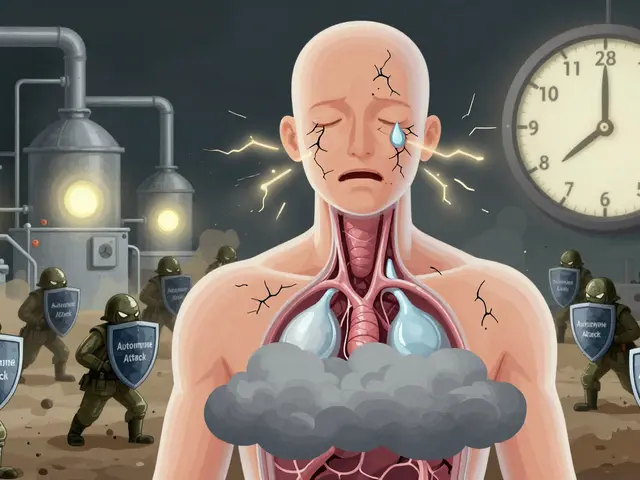
Sjögren’s Syndrome isn’t just about being thirsty or having gritty eyes. It’s when your immune system turns on the very glands that keep you moist-your tear ducts, saliva glands, and more. Imagine your body’s natural lubricants suddenly shutting down, one by one. That’s what happens in Sjögren’s. It’s not aging. It’s not dehydration. It’s an autoimmune attack.
It Starts with Dryness-But It Doesn’t Stop There
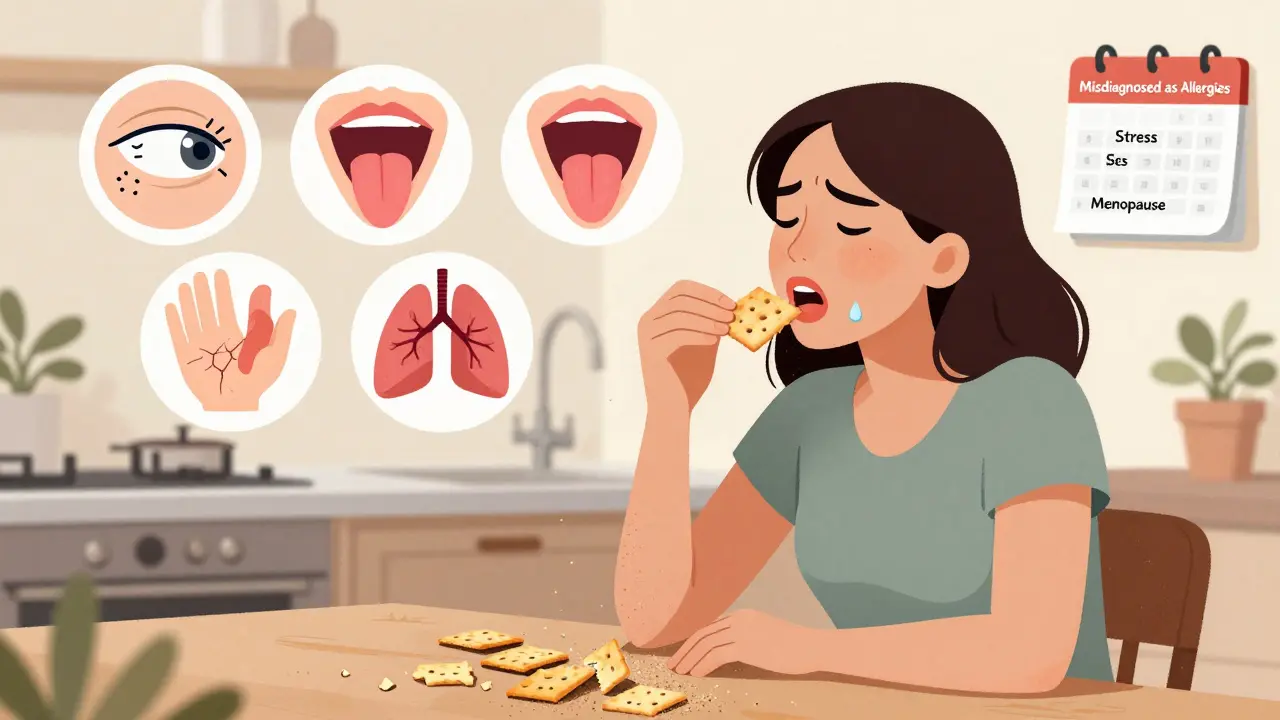
Most people first notice dry eyes and dry mouth. You blink more. You sip water constantly. Eating a cracker feels like swallowing sand. But this isn’t just discomfort. It’s a sign your body’s moisture factories are under siege. The tear glands (lacrimal glands) and salivary glands are the main targets. When they’re damaged, you get xerophthalmia (dry eyes) and xerostomia (dry mouth). Dry eyes aren’t just annoying-they can scratch your cornea. Dry mouth doesn’t just make talking hard; it turns your mouth into a breeding ground for cavities, infections, and tooth loss. Studies show people with Sjögren’s have 5 to 10 times the risk of dental decay compared to others their age. But here’s what most don’t tell you: Sjögren’s doesn’t stop at your mouth and eyes. About 70% of patients fight constant, crushing fatigue that doesn’t improve with sleep. Around 50% of women experience vaginal dryness, which is rarely discussed but deeply impacts relationships and mental health. Up to 25% develop a persistent dry cough from lung involvement. One in five get numbness or tingling in hands and feet from nerve damage. And skin? Dry, itchy, flaky patches-sometimes rashes on the feet or hands-are common.Why Does This Happen? It’s Not Just Bad Luck
Your immune system is supposed to fight germs. In Sjögren’s, it mistakes your own moisture-producing cells for invaders. Why? No one knows exactly. But science points to a mix of genetics and triggers. Certain genes make you more vulnerable. If you have a close relative with an autoimmune disease-like rheumatoid arthritis or lupus-your risk goes up. Then comes the trigger. Many patients recall a viral infection before symptoms started: a bad flu, Epstein-Barr, even a lingering cold. Environmental factors like stress or exposure to chemicals might play a role too. The disease doesn’t hit everyone the same. Some have mild dryness. Others develop serious complications like lung scarring, kidney problems, or even lymphoma. That’s right-Sjögren’s raises your lifetime risk of non-Hodgkin lymphoma from 0.5% in the general population to 4-5%. That’s why monitoring matters.Diagnosis Takes Time-And a Lot of Visits
The average person waits 2.8 years to get diagnosed. Why? Because doctors often miss it. Dry eyes? Allergies. Dry mouth? Not drinking enough. Fatigue? Stress. Vaginal dryness? Menopause. To confirm Sjögren’s, doctors look for three things: symptoms, tests, and antibodies.- Symptoms: At least three months of persistent dry eyes or mouth.
- Tests: The Schirmer’s test measures tear production-if you produce less than 5mm of tears in 5 minutes, that’s a red flag. A salivary flow test checks if you make less than 1.5mL of saliva in 15 minutes. A lip biopsy looks for immune cells clustering around salivary glands.
- Antibodies: Anti-SSA/Ro and anti-SSB/La antibodies show up in 60-70% of cases. If you have them, your risk of systemic complications jumps.
Primary vs. Secondary: What’s the Difference?
There are two types:- Primary Sjögren’s: It stands alone. No other autoimmune disease is present.
- Secondary Sjögren’s: It shows up alongside another condition-most often rheumatoid arthritis or lupus. About 30-50% of cases fall here.
What Treatments Actually Work?
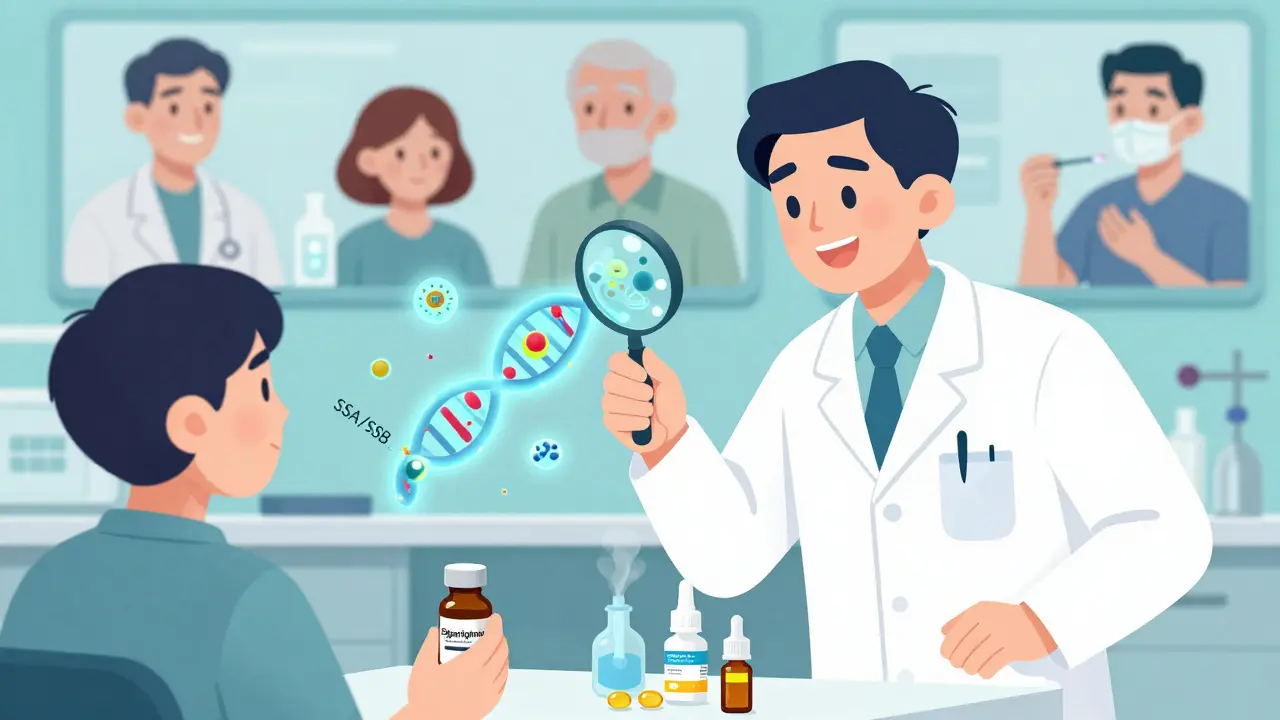
There’s no cure. But you can manage it. For dry eyes: Preservative-free artificial tears. Use them 8-10 times a day. Some people need tiny plugs inserted in the tear ducts to keep tears from draining too fast. Cyclosporine eye drops (Restasis) help reduce inflammation over time. For dry mouth: Sugar-free gum or lozenges to stimulate saliva. Saliva substitutes like Biotène. Drink water constantly. Avoid alcohol, caffeine, and mouthwashes with alcohol-they dry you out more. Prescription drugs like pilocarpine (5mg three times daily) or cevimeline (30mg three times daily) can boost saliva and tear production. About 60-70% of patients report noticeable improvement. Side effects? Sweating, nausea, headaches-but many say it’s worth it. For systemic symptoms:- Hydroxychloroquine (Plaquenil) helps joint pain and fatigue in 30-40% of patients.
- New FDA-approved drug Efgartigimod (Vyvgart Hytrulo), approved in June 2023, showed a 35% improvement in dry mouth in clinical trials.
- For severe cases, biologics like rituximab (used off-label) are being tested in Phase 3 trials.
Lifestyle Changes That Make a Real Difference
You can’t cure Sjögren’s with diet alone-but you can ease the burden.- Humidify your home. Keep indoor humidity between 40-60%. Dry air makes everything worse.
- Choose soft, moist foods. Avoid crackers, toast, dried fruit. Add sauces, broths, yogurt. Eat slowly.
- Use lubricants. Vaginal moisturizers like Replens or hyaluronic acid gels help with intimate dryness. Talk to your gynecologist-it’s part of this disease.
- Protect your skin. Use fragrance-free moisturizers. Avoid long, hot showers.
- Supplements? Omega-3s (fish oil) help reduce inflammation. Many patients report less eye irritation. Vitamin D deficiency is common-get tested.
The Hidden Toll: Mental Health and Isolation
No one sees your fatigue. No one notices when you can’t swallow your lunch. That’s why 61% of patients say doctors dismiss them. And 42% report symptoms of depression. The brain fog is real. Memory slips. Words vanish mid-sentence. People think you’re distracted-or lazy. On Reddit, one user wrote: “I lost a promotion because my boss thought I wasn’t paying attention. I was just trying to remember my own name.” Support groups help. The Sjögren’s Syndrome Foundation has online communities with over 35,000 members. Sharing stories-like the woman who found relief with pilocarpine after three years of misdiagnosis-gives hope.What’s Next? Hope on the Horizon
Research is accelerating. In 2023, the NIH launched the Sjögren’s Precision Medicine Network, enrolling 5,000 patients to match treatments to individual biomarkers. A $15 million initiative called TARGET is hunting for genetic clues to predict who’ll get severe disease. New drugs are coming. Three biologics targeting B-cells are in late-stage trials. The goal isn’t just symptom relief-it’s stopping the immune attack before it destroys glands. But awareness still lags. Sjögren’s affects 4 million Americans-more than multiple sclerosis-but gets less than 20% of the research funding of lupus. That’s changing. Medical schools now teach it. More rheumatologists screen for it.What You Can Do Today
If you have persistent dry eyes and mouth, especially with fatigue or joint pain:- Track your symptoms: When do they start? What makes them better or worse?
- See a rheumatologist-not just your dentist or eye doctor.
- Ask for anti-SSA/SSB blood tests and a Schirmer’s test.
- Start using preservative-free artificial tears and sugar-free gum now.
- Don’t wait for a perfect diagnosis. Manage what you can while you wait.
Rob Sims
January 20, 2026 AT 17:19Oh wow, another ‘it’s not just dry eyes’ article. Let me guess-you also cry into your coffee because your tear ducts are on strike? Newsflash: if you’re sipping water like a camel in the desert, maybe you’re just dehydrated. Or maybe you’re a hypochondriac who googled ‘dry mouth’ and now thinks you have an autoimmune war going on inside you. Chill. Your body isn’t a battlefield. It’s just tired. And you’re not special.
Also, 4 million Americans? That’s like the population of Florida. If it were that common, your dentist would’ve mentioned it while drilling your 17th cavity. But nope. You’re just another person who thinks ‘fatigue’ is a diagnosis and not a symptom of scrolling TikTok at 3 a.m.
And don’t get me started on the ‘lymphoma risk’ scare tactics. You’re more likely to die from a rogue emoji than from Sjögren’s. But hey, keep buying those $50 saliva gels. I’m sure your insurance loves it.
TL;DR: Stop treating normal aging like a medical emergency. Your body isn’t broken. You’re just lazy and scared of the word ‘normal’.
arun mehta
January 20, 2026 AT 19:50Thank you for this comprehensive and deeply informative article. 🙏 The clarity with which you've explained the physiological mechanisms behind Sjögren’s Syndrome is truly commendable. As someone from India, where awareness of autoimmune conditions remains limited, this piece serves as a vital resource. The statistics on dental decay, fatigue, and lymphoma risk are sobering yet necessary. I especially appreciate the emphasis on lifestyle modifications-humidifiers, omega-3s, and vaginal moisturizers are often overlooked in clinical settings here. May more medical professionals adopt this holistic perspective. 🌿💧
Oren Prettyman
January 22, 2026 AT 19:49While the article presents a superficially coherent narrative, it is fundamentally flawed in its causal attribution and evidentiary framing. The assertion that Sjögren’s is an autoimmune attack on exocrine glands is, in fact, a heuristic model, not a mechanistic certainty. The immune system’s involvement is correlative, not necessarily causative; alternative hypotheses-such as chronic viral persistence, epithelial cell senescence, or microbiome dysbiosis-are systematically marginalized in favor of the dominant autoimmune paradigm. Furthermore, the claim that ‘70% of patients fight crushing fatigue’ lacks stratification: is this fatigue measured via validated instruments like the FIS-20? Or is it self-reported, confounded by comorbid depression, sleep apnea, or medication side effects? The diagnostic criteria, particularly the Schirmer’s test, have a sensitivity of only 65% and are heavily influenced by ambient humidity, tear film stability, and patient anxiety. The lip biopsy, while gold-standard, has inter-observer variability exceeding 20%. And yet, we are told to ‘trust the antibodies.’ Anti-SSA/Ro appears in 30% of healthy elderly women. Is that pathology-or population noise?
The FDA approval of Efgartigimod is presented as a breakthrough, yet the phase 3 trial’s primary endpoint was a 35% improvement in patient-reported dry mouth-on a 100-point scale. That’s a 3.5-point difference. Statistically significant? Yes. Clinically meaningful? Debatable. And the ‘new T-cell signature’? Published in one journal, replicated nowhere. We are being sold a narrative dressed in scientific garb. The real tragedy is not Sjögren’s-it’s the medicalization of normal human variation.
Tatiana Bandurina
January 24, 2026 AT 19:41So you’re telling me I’ve been suffering from this for years and no one ever connected the dots? My dry skin, my constant throat clearing, the fact that I couldn’t wear lipstick without it cracking, the way my eyes burned after five minutes of screen time-none of that mattered until I cried in front of a rheumatologist and she said, ‘That’s not just menopause.’
I’m 41. I’ve been told I’m ‘too young’ for this. I’ve been told to ‘drink more water.’ I’ve been told my marriage is failing because I ‘don’t want intimacy.’
Now I’m supposed to be grateful because there’s a new drug that might help my mouth? What about the 10 years I lost being called ‘dramatic’? What about the jobs I lost because I couldn’t focus? What about the fact that I still have to explain to my mom why I don’t ‘just take a pill’?
This isn’t science. This is survival. And you wrote a whole article and never once said: ‘I’m sorry you were ignored.’
Philip House
January 25, 2026 AT 02:22Look, I get it. You’re trying to sound smart. But let’s be real-this whole autoimmune thing is just another way for Big Pharma to sell you stuff. You know who else had dry mouth? My grandpa. He smoked, drank coffee, didn’t brush his teeth. He lived to 92. You think he had Sjögren’s? Nah. He just lived in the real world.
And now you’re telling me I need to buy $40 eye drops and take pills that make me sweat like I’m in a sauna? What’s next? A subscription box for ‘Sjögren’s wellness’? They’ll sell you a humidifier with a Bluetooth app that tracks your tear production.
Also, lymphoma? Yeah, right. You’re more likely to get hit by lightning than develop lymphoma from this. But hey, scare people enough and they’ll pay for anything. I’ve seen this script before. It’s the same one they used for fibromyalgia, chronic Lyme, and ‘adrenal fatigue.’
Bottom line: stop letting doctors sell you fear. Your body’s fine. You just need to stop obsessing over it.
Ryan Riesterer
January 26, 2026 AT 19:27Per the 2023 EULAR/ACR classification criteria, the diagnostic algorithm for primary Sjögren’s requires a combination of objective findings: ocular staining score ≥5 (or van Bijsterveld score ≥4), Schirmer’s ≤5 mm/5 min, unstimulated salivary flow ≤0.1 mL/min, positive anti-SSA/Ro, and focal lymphocytic sialadenitis on lip biopsy (focus score ≥1).
Notably, the presence of anti-SSB/La confers higher specificity for systemic involvement, particularly interstitial lung disease and vasculitis. The recent identification of a CD4+ T-cell signature expressing CXCR5+PD-1+ICOS+ markers in peripheral blood, as reported by Liu et al. (Nature Immunology, 2023), may soon enable non-invasive stratification-potentially replacing biopsy in low-risk phenotypes.
However, the 35% improvement in dry mouth with Efgartigimod, while statistically significant (p=0.012), must be contextualized against the placebo effect observed in 22% of patients in the same trial. The clinical relevance remains marginal for patients with mild mucosal involvement.
Akriti Jain
January 27, 2026 AT 14:33Wait… so this ‘autoimmune disease’ just happened to appear right after you got the COVID shot? Coincidence? Or did the government’s nanotech vaccine reprogram your immune system to attack your own saliva glands? 🤔
And why is it mostly women? Hmm… maybe because they’re more ‘emotional’ and their bodies ‘react’ to stress? Or maybe Big Pharma is targeting women because they’re easier to scare into buying $200 moisturizers?
Also, why do they say ‘vaginal dryness’ but never mention how many women are being pressured into ‘hormone therapy’? Who benefits? Who owns the patents? Who funds the ‘research’?
And why is this only ‘4 million Americans’? What about the rest of the world? Are we all just… invisible? 🤔👁️
Ask yourself: Who controls the narrative? And why are you so quick to believe the ‘experts’?
Mike P
January 29, 2026 AT 12:13Man, I’ve had this for 12 years and no one believed me until I started screaming in the ER because I couldn’t swallow my own spit. You think this is about ‘dry eyes’? Nah. It’s about being ignored until you’re on the verge of losing your teeth, your job, your dignity.
I took pilocarpine for six months. Sweated like a pig. But I could finally eat a damn cookie without choking. Worth it.
And yeah, the lymphoma risk is real. My buddy had it. Got it. Survived. But he had to go through hell. So don’t just ‘track your symptoms.’ Get tested. Now.
And if you’re a doctor reading this-stop calling it ‘just aging.’ We’re not old. We’re sick. And we’re tired of being polite about it.
Sarvesh CK
January 31, 2026 AT 06:26It is a profound and sobering realization that Sjögren’s Syndrome, despite its prevalence and systemic implications, remains one of the most underrecognized autoimmune conditions in modern medicine. The psychological burden borne by patients-often dismissed as psychosomatic or exaggerated-is not merely a clinical oversight but a moral failure of the healthcare paradigm. The reduction of a multisystem autoimmune disorder to the mere symptom of ‘dryness’ reflects a broader epistemic limitation: the tendency to prioritize visible, quantifiable phenomena over the invisible, subjective suffering that defines chronic illness.
Moreover, the disparity in research funding, when juxtaposed with the disease’s prevalence, raises urgent questions regarding health equity. Why is Sjögren’s, affecting more individuals than multiple sclerosis, afforded less than one-fifth of the research investment? Is it because it predominantly affects women? Because it lacks the dramatic visual markers of lupus or the acute lethality of ALS? The answer, I fear, lies not in science, but in sociology.
Yet, the emergence of precision medicine initiatives, such as the NIH’s Sjögren’s Precision Medicine Network, offers a glimmer of hope. If we can move beyond symptom management toward immune modulation and biomarker-guided therapy, we may finally transcend the era of diagnostic neglect.
For the patient reading this: your suffering is real. Your voice matters. And you are not alone.
Alec Amiri
February 2, 2026 AT 01:10So you’re telling me I’ve been drinking 10 liters of water a day for no reason? I thought I was just thirsty. Turns out I was just… broken.
And I’ve been using Biotène like it’s holy water. Now I know why. 😔
Also, my dog started licking my face more. I thought he was being sweet. Turns out he smelled the dryness. He’s a better doctor than my rheumatologist.
Lana Kabulova
February 3, 2026 AT 00:26Why is no one talking about how this affects your ability to kiss? I mean, really. You can’t even kiss someone without feeling like you’re licking a sandpaper pillow. And no one ever says that. Ever. Not even in the support groups. It’s like the whole thing is sanitized. Like we’re supposed to just… accept it. Like dry lips are a fashion statement. I miss being able to kiss someone without a 10-minute prep routine. And no one gets that. Not even my husband. He says ‘it’s not that bad.’
It’s not that bad? Try kissing someone when your tongue feels like it’s been dipped in salt and left in the sun for three days.
Chiraghuddin Qureshi
February 4, 2026 AT 11:44From India, I just want to say: this article brought tears to my eyes (literally 😅). My aunt has this, and we thought it was just ‘old age’ until we saw the lip biopsy results. We’re sharing this with every family doctor we know. Thank you for giving us the words to explain what’s happening. 🙏❤️
Patrick Roth
February 5, 2026 AT 09:15Wait, so the reason I can’t drink whiskey anymore is because my immune system hates me? That’s it? That’s the diagnosis? I thought I was just getting old.
Also, why is this only a US problem? I’ve been in Ireland for 20 years and no one’s ever heard of it. Are we all just… immune to this? Or are we just too Irish to care?