
One in seven new mothers experiences postpartum depression. That’s not rare. It’s common. And yet, too many still believe it’s just the ‘baby blues’-a few tears, some exhaustion, and a bad day. But postpartum depression isn’t about sleepless nights or feeling overwhelmed. It’s a clinical condition that can steal your joy, your energy, and your connection to your baby. And while hormones play a big part, they’re not the whole story.
What’s Really Going On With Your Hormones?
Right after birth, your body goes through one of the most dramatic hormonal shifts in human biology. Estrogen and progesterone, which soared during pregnancy, drop faster than a rock off a cliff. Within 48 to 72 hours, they crash back to pre-pregnancy levels. That’s not a slow fade-it’s a freefall. And your brain, which got used to high levels of these hormones, doesn’t know how to react. One key player is allopregnanolone, a metabolite of progesterone. It acts like a natural calming agent in your brain, reducing anxiety and helping you feel grounded. When allopregnanolone plummets after birth, that calming effect vanishes. Some women’s brains just can’t adjust fast enough. That’s why researchers now think it’s not the drop itself, but how your brain responds to it. But here’s the twist: not every woman with a huge hormonal shift gets postpartum depression. And some women with PPD have hormone levels that look totally normal. So hormones aren’t the cause-they’re more like a trigger. Think of them as lighting a match in a room full of gasoline. The gasoline? Stress, lack of sleep, past depression, isolation, financial pressure, or a traumatic birth. If those are already there, the hormonal crash can push you over the edge. Oxytocin, the bonding hormone, also plays a role. Lower levels during late pregnancy have been linked to higher depression risk. And while breastfeeding boosts oxytocin-which can help lift mood-not everyone can or chooses to breastfeed. That doesn’t mean they’re doomed. It just means other supports become even more important.It’s Not Just Moms
Postpartum depression doesn’t care about gender. Around 1 in 10 new fathers experience it. Transgender and nonbinary parents report similar rates to cisgender women. Even adoptive parents face a 6-8% risk. The triggers? Sleep deprivation, relationship strain, financial stress, feeling unprepared, or a history of mental health issues. If you’re a new parent and you’re feeling numb, irritable, or hopeless-don’t assume it’s just ‘dad guilt’ or ‘not being a real mom.’ It’s real. And it needs real help.What Treatments Actually Work?
There are two main paths: therapy and medication. Both work. Often, they work best together. Cognitive Behavioral Therapy (CBT) is the most studied non-medication option. A 2020 meta-analysis found that over half of women with PPD saw meaningful improvement after CBT. It helps you spot negative thought patterns-like ‘I’m a terrible parent’ or ‘My baby would be better off without me’-and replace them with more realistic, kinder ones. It’s not about positive thinking. It’s about accurate thinking. SSRIs like sertraline are the go-to antidepressants for postpartum depression. Why sertraline? Because it’s one of the safest options if you’re breastfeeding. Hale’s Medication and Mothers’ Milk rates it as L2-‘safer.’ It passes into breast milk in tiny amounts, and studies show no major side effects in babies. Other SSRIs like escitalopram and fluoxetine also work, but sertraline has the most data supporting its use during lactation.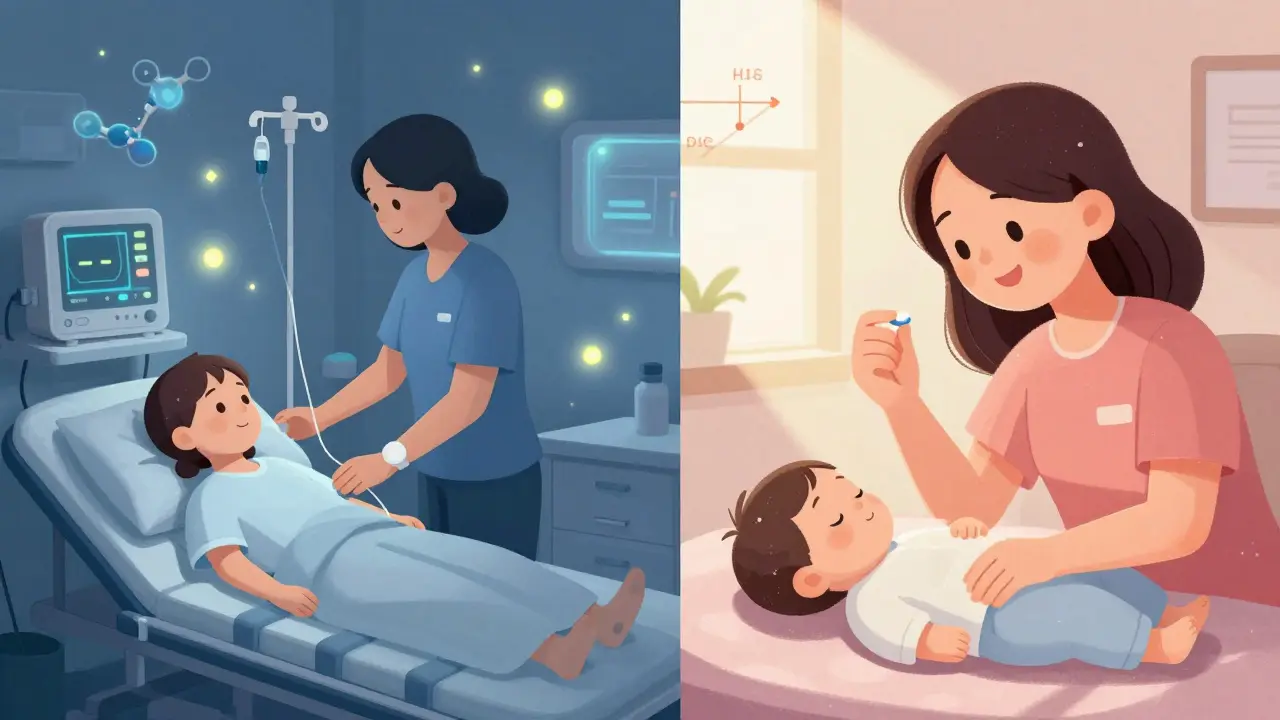
Breakthrough Medications: Brexanolone and Zuranolone
For severe cases, two new drugs have changed the game. In 2019, the FDA approved brexanolone (Zulresso), an IV infusion of allopregnanolone. It’s the first drug made specifically for PPD. You get it over 60 hours in a clinic, with constant monitoring because it can cause drowsiness or fainting. It works fast-many women feel better within hours. But it’s expensive, hard to access, and requires you to be off work for three days. Then in August 2023, the FDA approved zuranolone (Zurzuvae). This one’s oral. You take it for just 14 days. No IV. No clinic stay. It works by targeting the same brain receptors as brexanolone but in pill form. Early studies show symptom improvement within three days. It’s a huge step forward-especially for mothers who can’t leave their babies for days. Both drugs are still new. They’re not for everyone. But for women with severe PPD who haven’t responded to other treatments, they offer real hope.What Doesn’t Work (And Why)
Some people think hormone therapy-like estrogen pills-can fix PPD. Early studies showed promise. One small trial in 2001 found 82% of women improved with sublingual estrogen. But here’s the catch: estrogen increases the risk of blood clots, stroke, and can interfere with milk supply. The FDA and major medical groups don’t recommend it outside of research settings. Similarly, supplements like omega-3s or St. John’s Wort might help mild low mood, but they’re not proven for clinical PPD. And while acupuncture or yoga can help with stress, they’re not enough on their own if you’re clinically depressed.
Screening Is the First Step
If you’re not being asked about your mood after birth, you’re not getting proper care. The Edinburgh Postnatal Depression Scale (EPDS) is used worldwide. It’s a simple 10-question test. A score of 10 or higher signals possible depression. Massachusetts was the first U.S. state to make screening mandatory in 2012. Now, more hospitals are following. But screening only works if someone follows up. Too many OB-GYNs say they feel unprepared to treat PPD. If your provider brushes off your feelings, ask for a referral. You deserve better.What You Can Do Right Now
If you’re struggling:- Don’t wait for it to get worse. Reach out today.
- Call Postpartum Support International at 1-800-944-4773. They’re available 24/7. 87% of callers say the support helped.
- Ask your doctor about sertraline or CBT. Both are proven, safe, and effective.
- If you’re having thoughts of harming yourself or your baby, go to the ER. You are not alone. Help is immediate.
- Find one person you can talk to-partner, friend, relative. Even one conversation can start the healing.
It’s Not Your Fault
You didn’t cause this. You didn’t fail. Your body went through a massive biological change, and your brain is still catching up. Hormones aren’t the villain-they’re just part of the story. What matters is that you’re not alone, and help exists. The goal isn’t to be a perfect parent. It’s to be a present one. And that starts with taking care of yourself.Is postpartum depression the same as baby blues?
No. Baby blues affect up to 80% of new mothers and usually last just a few days to two weeks. Symptoms include mood swings, crying spells, and feeling overwhelmed-but they’re mild and go away on their own. Postpartum depression is more severe, lasts longer (often weeks or months), and interferes with daily life. It doesn’t just fade. It needs treatment.
Can I take antidepressants while breastfeeding?
Yes, many are safe. Sertraline is the most recommended because it passes into breast milk in very low amounts and has no known harm to babies. Other SSRIs like escitalopram are also considered low-risk. Always talk to your doctor before starting any medication, but don’t avoid treatment out of fear-untreated depression can be more harmful to your baby than medication.
How long does postpartum depression last?
With treatment, most people start feeling better within 4 to 8 weeks. Without treatment, it can last for months or even years. Some women experience symptoms for over a year. The earlier you get help, the faster you recover. There’s no shame in needing time to heal-your brain needs it just like a broken bone does.
Are hormonal treatments like estrogen pills recommended?
No. While early studies showed estrogen could help, the risks-like blood clots, stroke, and reduced milk supply-outweigh the benefits. Hormone therapy is not a standard treatment for PPD. The only FDA-approved hormonal treatments are brexanolone (IV) and zuranolone (oral), which are specifically designed for PPD and have been tested for safety.
Can postpartum depression affect my baby?
Yes, untreated PPD can impact your baby’s development. It may lead to delays in language, emotional regulation, and attachment. But treatment helps. When mothers feel better, their babies thrive. Even small improvements in your mood can make a big difference in how you interact with your child. Getting help isn’t just for you-it’s for your whole family.
What if I don’t feel like bonding with my baby?
That’s a common symptom of PPD, not a sign you’re a bad parent. Depression makes it hard to feel joy, even with the people you love. You might feel detached, guilty, or numb. That’s the illness talking, not your heart. With treatment, bonding returns. You’re not broken-you’re sick. And sickness can be healed.
Is it normal to feel angry or irritable with PPD?
Yes. While sadness is the most talked-about symptom, many people with PPD feel intense anger, frustration, or irritability. You might snap at your partner, cry over small things, or feel like you’re losing control. These are signs of depression too. You don’t have to feel ‘down’ to be depressed. Anger is a valid symptom.
Can postpartum depression happen months after birth?
Absolutely. While symptoms often start within the first few weeks, PPD can appear up to a year after giving birth. Many women don’t realize what’s happening until months later, especially if they’ve been told ‘you should be happy by now.’ If you’re feeling persistently low, exhausted, or hopeless-even six months in-it’s still PPD, and it’s still treatable.
vivek kumar
January 17, 2026 AT 01:37Finally, someone broke down the hormone math properly. Estrogen and progesterone don’t just drop-they implode. And allopregnanolone? That’s the real silent killer. Most docs still treat PPD like a mood swing with a prescription pad. But the brain’s GABA receptors don’t care about your Instagram feed. They need neurosteroid support, not platitudes. If your doctor hasn’t heard of zuranolone, they’re operating on 2010 data.
waneta rozwan
January 18, 2026 AT 00:19Oh my GOD. I thought I was just broken. I cried every night for 11 months. My husband thought I was being dramatic. I was told to ‘just breathe’ and ‘get more sleep.’ Sleep? I was sleeping 3 hours a night with a screaming infant. I didn’t know it was PPD until I Googled ‘why do I hate my baby’ and found this. I’m on sertraline now. It didn’t fix me overnight-but it gave me back the person I was before the baby. I’m not a bad mom. I was sick. And I’m getting better.
swarnima singh
January 18, 2026 AT 09:56you know what really kills me? people act like its some new thing. my grandma had 7 kids and never had 'ppd' cause she just sucked it up. now everyone wants a pill for everything. i mean, come on. its just biology. you birth a human, you deal. no one held your hand in the 70s. why now? its weak.
Isabella Reid
January 19, 2026 AT 06:13Swarnima, I hear you-but ‘sucking it up’ killed a lot of women before we had the science to understand what was happening. I lost a friend to PPD in 2018. She didn’t ask for help because she thought she’d be judged. We’ve got better tools now. Using them isn’t weakness-it’s wisdom. And zuranolone? It’s not a luxury. It’s a lifeline for moms who can’t leave their babies for 3 days of IV therapy. Let’s stop shaming people for wanting to survive.
Jody Fahrenkrug
January 21, 2026 AT 03:58I took sertraline while breastfeeding. My baby’s 2 now. No issues. No weird behavior. Just a happy kid who loves to hug. I also did CBT-like, actual homework assignments. It felt silly at first, but writing down ‘I’m a terrible mom’ and then listing 5 things I actually did right that day? Changed everything. Don’t wait. Just start.
Kasey Summerer
January 21, 2026 AT 10:48So let me get this straight: we’ve got a $10k IV drug that works in hours, but you need to take a 3-day sabbatical from parenting… and a $12k 14-day pill that works in 3 days? 😂 Meanwhile, my cousin’s on Prozac from 2012 and she’s fine. Maybe the real problem isn’t PPD-it’s the pharmaceutical industry’s marketing team.
Allen Davidson
January 22, 2026 AT 22:46Look, I’m not here to judge. But if you’re a new dad and you’re feeling numb, don’t wait for your wife to ‘fix’ you. Talk to someone. Go to a support group. I didn’t know I had PPD until I screamed at my kid for spitting up on my shirt. That’s when I realized-I’m not angry at him. I’m angry at myself for feeling nothing. Therapy saved me. Sertraline helped. And now I’m the dad who changes diapers with a smile. It’s not magic. It’s medicine.
john Mccoskey
January 24, 2026 AT 11:06Let’s be brutally honest here. The entire PPD industry is built on the assumption that modern women are fragile, overstimulated, and emotionally incompetent. We’ve replaced resilience with pharmacology. Estrogen therapy was banned not because it was dangerous-but because it couldn’t be patented. SSRIs? Profitable. Brexanolone? Patent-protected. Zuranolone? A billion-dollar market. Meanwhile, the real solutions-community support, paid parental leave, affordable childcare, sleep-deprivation relief-are politically inconvenient. We’re treating symptoms while ignoring the structural violence that makes motherhood unbearable for so many.
Chelsea Harton
January 26, 2026 AT 08:24zuranolone is a game changer. no iv. no clinic. just pills. i took it. felt better in 48 hours. my baby didn’t even know i was gone.
Travis Craw
January 27, 2026 AT 09:43my wife had ppd after our second. she didn't want to talk about it. i just started making coffee every morning and leaving it on the nightstand with a note: 'you're not alone'. didn't fix it. but she said it was the first time she felt seen. sometimes you don't need solutions. just presence.
brooke wright
January 28, 2026 AT 05:19Wait, so if I’m adoptive and got PPD, does that mean my hormones are still to blame? I never carried a baby. I didn’t even have a pregnancy. So why am I crying every night? Is this even real? I feel like I’m faking it because I didn’t ‘earn’ it. But I’m so tired. And I hate my own thoughts. Can someone tell me I’m not crazy?