
When a chemical splash hits your eye, you have seconds to act. One wrong move - rubbing, delaying, or using too little water - can cost you your vision. It’s not a matter of if it happens, but when. In workplaces, labs, and even homes, chemicals like cleaners, fertilizers, and industrial solvents are everywhere. And when they meet your eye, the damage begins in seconds.
Why Speed Is Everything
The clock starts the moment a chemical touches your eye. Alkali substances - like drain cleaners, ammonia, or lime - are especially dangerous because they don’t just burn the surface. They seep deep into the cornea and can dissolve tissue from the inside out. Acid burns, like from battery fluid or sulfuric acid, are serious too, but they tend to stay on the surface longer, giving you a slightly better window to act. Research from the British Journal of Ophthalmology shows that starting irrigation within 10 seconds of exposure cuts the risk of permanent vision loss by 76%. That’s not a guess. That’s data from a 2017 meta-analysis of over 1,200 real cases. Every second you wait, the chemical keeps eating away at your eye. By the time you reach a hospital, the damage may already be done.What to Do Right Away
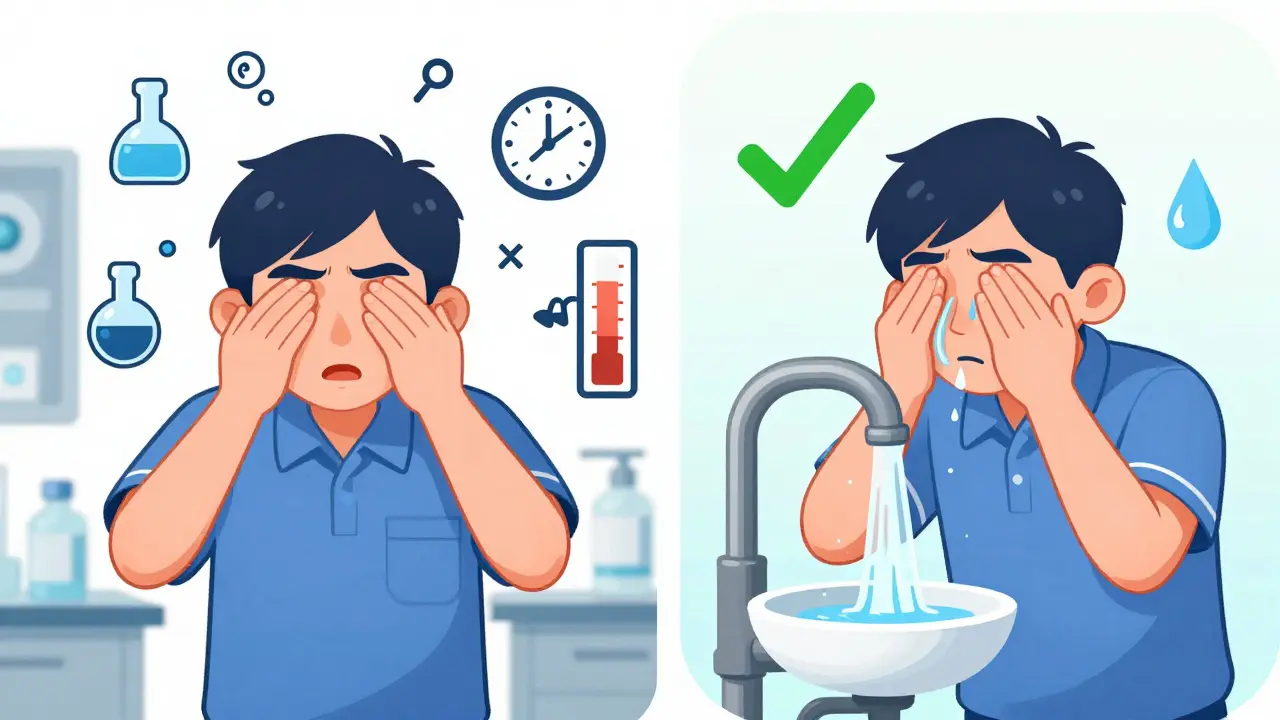
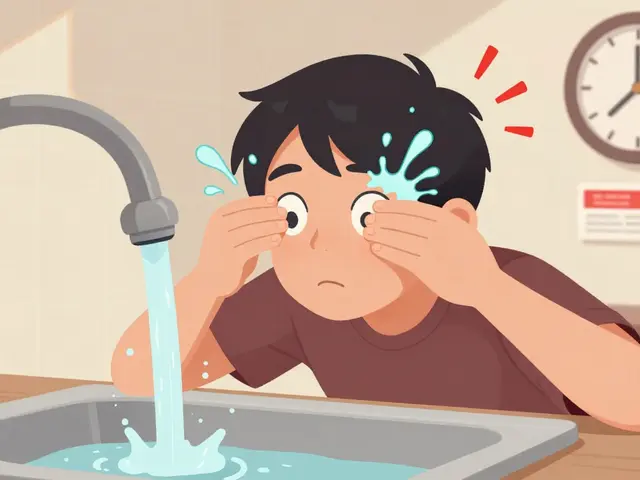
There’s only one rule that matters: flush immediately with water. Not a little splash. Not a quick rinse. Not waiting to find saline. You need a steady, continuous flow for at least 15-20 minutes. Here’s exactly how to do it:- Get to running water - a sink, shower, or eyewash station. Tap water is fine. Saline is better if it’s right there, but don’t waste time looking for it.
- Hold your head under the stream. Tilt your head back and turn it slightly toward the injured side. This stops the chemical from washing into your good eye.
- Use your fingers to gently pull your eyelids apart. You need to see the whole surface. Don’t squeeze. Don’t press. Just hold the lids open.
- Let the water flow. Don’t stop. Even if it hurts. Even if you think it’s done. Keep going for the full time.
- If you wear contact lenses, try to remove them only if you can do it without touching the eye surface. If the eye is too swollen or painful, leave them in - the water will flush them out.
What Not to Do
People make the same mistakes over and over. And each one makes things worse.- Don’t rub. That’s instinctive. But rubbing grinds the chemical deeper into your eye. In 68% of cases, people rub - and that’s one of the top reasons for severe damage.
- Don’t stop early. Many stop after 5 minutes because it hurts. But the CDC and NIOSH say pH levels can stay acidic or alkaline for much longer. You need to flush until the eye’s pH returns to normal (7.0-7.4). That often takes longer than most people think.
- Don’t use eye drops or ointments. They trap chemicals. They delay flushing. They’re not treatment - they’re interference.
- Don’t cover the eye. Covering it doesn’t help. It just hides the damage. You need to get to a doctor after flushing, not hide the injury.
Workplace vs. Home: Different Rules
If you’re at work, you should have an ANSI Z358.1-compliant eyewash station. That means it delivers water at 0.4 gallons per minute, within 10 seconds of activation, and at a tepid temperature (60-100°F). Cold water makes people stop flushing early. Warm water keeps them going. But most homes don’t have these. And that’s a problem. A 2022 CDC survey found that 78.4% of households had no emergency eye rinse solution ready. Only 12.3% knew how long to flush. In the home, use the sink. Let the water run for 20 minutes. Use your hands to keep your eyelids open. If you’re alone, call 911 while flushing. Don’t wait until you’re done.What Happens After
Even if you flush perfectly, you still need medical care. The eye can look okay on the outside but be destroyed inside. Corneal ulcers, scarring, and even perforation can develop hours later. Doctors will check your eye’s pH, look for tissue damage, and may use special dyes to see where the burn is deepest. In severe cases, you might need a corneal transplant. According to Medicare data, those transplants cost an average of $27,700. But they’re often avoidable - if you flush fast enough.Why Most People Fail
A 2022 study of 1,247 workplace chemical eye injuries found that only 43.7% of people started flushing within 60 seconds. The average delay? Two minutes and 17 seconds. That’s long enough for permanent damage. Why? Because no one teaches you how to do it right. Most first aid courses show you how to treat a cut or a burn. But eye injuries? They’re rarely covered. And when they are, they’re oversimplified. The American Red Cross says: “Flush until EMS arrives.” That’s vague. Healthdirect Australia says: “20 minutes, head tilted back, eyelids pulled open.” That’s specific. And it works.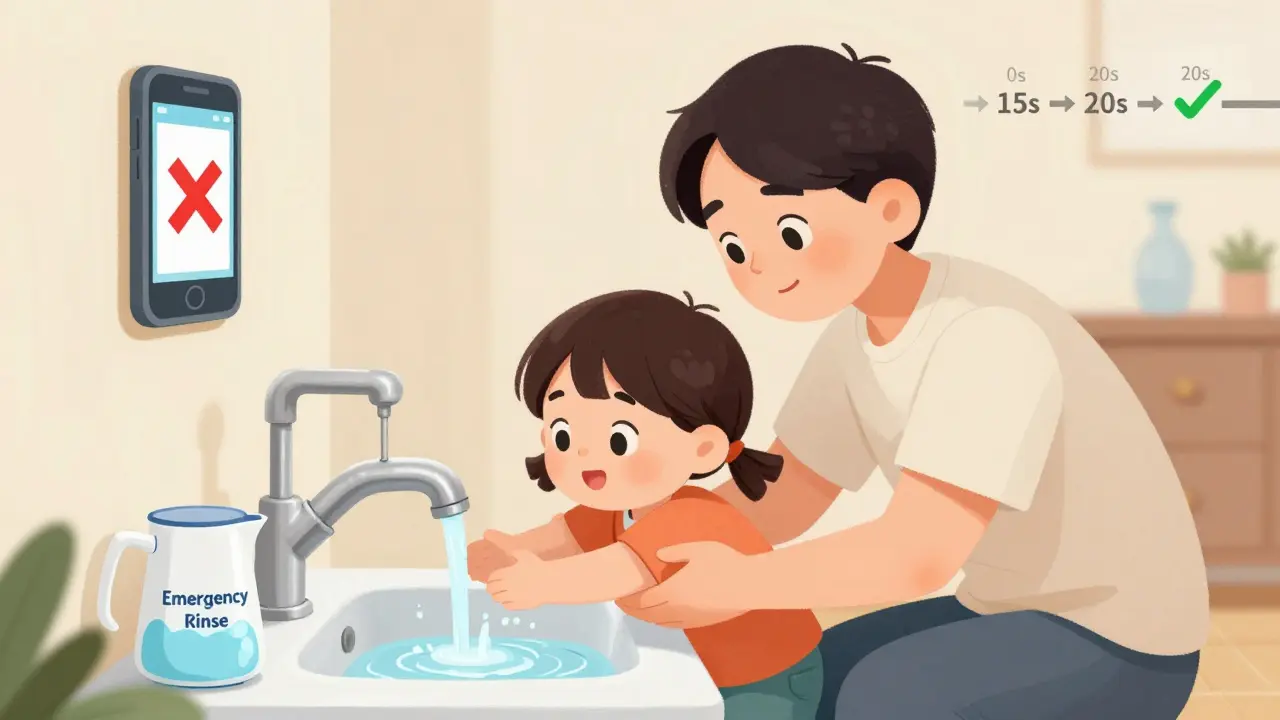
The Truth About Saline and Special Solutions
You’ve probably heard that saline is better than tap water. But here’s the truth: Dr. Reay Brown from Bascom Palmer Eye Institute published in JAMA Ophthalmology in 2020 that saline offers no advantage over tap water for initial flushing. The key isn’t what you use - it’s how much and how long. There’s a new product called Diphoterine, approved by the FDA in 2022. It’s a special solution that binds to chemicals instead of just washing them away. It can reduce flushing time by 40%. But it’s expensive and mostly used in hospitals and labs. For 99% of people, tap water is still your best option.How to Prepare
Don’t wait for an accident. Be ready.- If you work with chemicals, know where the eyewash station is. Test it. Make sure it works.
- At home, keep a bottle of saline or a small pitcher of water near the kitchen or bathroom sink.
- Teach your kids. Show them how to open their eyes and let water run over them. Practice it like a fire drill.
- Don’t rely on smartphone apps. A 2023 study found 63.2% of them give wrong or conflicting advice.
- Take a certified first aid course. People who’ve had hands-on training are 3.2 times more likely to do it right.
The Bigger Picture
Chemical eye injuries cost U.S. employers $327 million a year. That’s not just medical bills. It’s lost workdays, lawsuits, and permanent disability. But the numbers are falling. Since 2015, workplace injuries have dropped 22.4% - thanks to better training and stricter OSHA rules. The World Health Organization is now investing $47.8 million to improve eye safety in developing countries by 2027. Because this isn’t just a rich-world problem. It’s a global one. The solution is simple: water. Speed. Persistence. You don’t need fancy gear. You don’t need a doctor. You need to act - fast and without hesitation.What should I do if a chemical gets in my eye?
Immediately flush your eye with cool running water for at least 15-20 minutes. Tilt your head back and turn it toward the injured side to prevent the chemical from spreading to your other eye. Use your fingers to gently hold your eyelids open. Don’t rub, don’t stop early, and don’t wait for help - start flushing right away.
Is saline better than tap water for flushing the eye?
No. Multiple studies, including one published in JAMA Ophthalmology in 2020, show that tap water works just as well as saline for initial irrigation. The critical factor is the volume and duration of flushing, not the type of liquid. Don’t waste time looking for saline - use whatever running water is available.
How long should I flush my eye after a chemical splash?
Flush for a minimum of 15 minutes, but aim for 20 minutes if possible. Some guidelines, like those from Healthdirect Australia, recommend 20 minutes as the standard. The CDC and NIOSH suggest continuing until the eye’s pH returns to neutral (7.0-7.4), which may take longer than 20 minutes in severe cases. Never stop early just because it feels better.
Should I remove my contact lenses during a chemical splash?
Try to remove them only if you can do so without touching the eye surface. If the eye is swollen, painful, or the lens is stuck, leave it in. Water will flush the lens out during irrigation. Forcing removal can cause more damage. The priority is continuous flushing - not lens removal.
Do I still need to see a doctor after flushing my eye?
Yes. Even if your eye feels fine after flushing, you must see a doctor. Chemical injuries can cause hidden damage to the cornea or inner eye structures. Symptoms like pain, blurred vision, or light sensitivity may appear hours later. A professional exam is essential to prevent long-term vision loss.
Are there signs I’m not flushing enough?
Yes. If you stop before 15 minutes, use small amounts of water, or don’t hold your eyelids open, you’re not flushing enough. Other signs include continuing pain, redness, or swelling after flushing. If you’re unsure, keep going. More water is always better than less. The goal is to dilute and remove every trace of the chemical.
Can chemical eye injuries be prevented?
Yes. Wear protective eyewear when handling chemicals. Ensure eyewash stations are accessible and functional in workplaces. Train yourself and others on proper flushing techniques. Keep a water source near areas where chemicals are stored. Prevention isn’t about luck - it’s about preparation.
Sam Pearlman
February 16, 2026 AT 23:18Linda Franchock
February 18, 2026 AT 16:07Haley DeWitt
February 19, 2026 AT 01:55Adam Short
February 19, 2026 AT 08:17Prateek Nalwaya
February 20, 2026 AT 00:41Dennis Santarinala
February 21, 2026 AT 22:08Steph Carr
February 22, 2026 AT 22:41Geoff Forbes
February 23, 2026 AT 19:39Brenda K. Wolfgram Moore
February 25, 2026 AT 08:25Agnes Miller
February 26, 2026 AT 08:10