
Every year, millions of people with high blood pressure, diabetes, asthma, or thyroid disease face a hard choice: pay for their meds or pay for groceries. The truth is, generic medications aren’t just cheaper-they’re the single biggest tool we have to stop lifelong medical bills from swallowing your income. For someone managing a chronic condition, switching to generics isn’t a small tweak-it’s a financial reset that can save tens of thousands over a lifetime.
What Exactly Are Generic Medications?
Generic drugs are exact copies of brand-name medicines. They contain the same active ingredients, work the same way in your body, and are held to the same strict safety standards. The FDA requires them to match brand-name drugs in strength, dosage, safety, and effectiveness. The only differences? The color, shape, or inactive ingredients like fillers-and those don’t affect how the drug works. You might think generics are like knock-offs. They’re not. They’re the same medicine, just sold without the marketing budget. A pill of generic lisinopril for high blood pressure has the exact same molecule as Prinivil. A generic metformin tablet treats diabetes just like Glucophage. The science doesn’t change. Only the price does.How Much Can You Really Save?
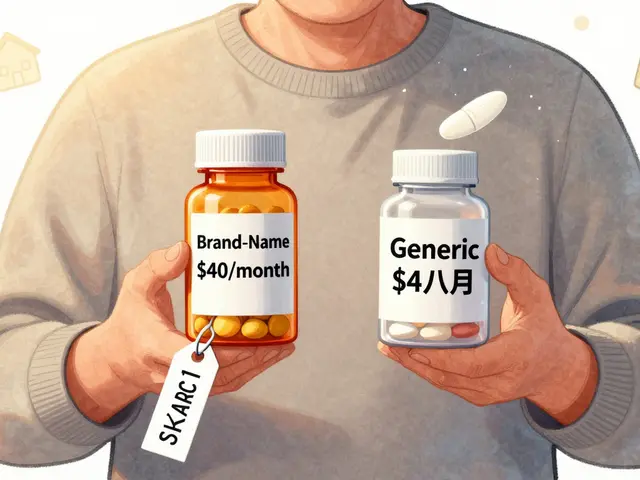
The numbers are staggering. On average, generic drugs cost 80-85% less than their brand-name equivalents. That’s not a guess-it’s backed by data from the USC Schaeffer Center and the FDA. Take a common example: someone with hypertension. Brand-name lisinopril (Prinivil) might cost $40-$50 a month. The generic? Around $4. That’s $1,200-$2,000 saved per year. Do the math over 20 years: $24,000 to $40,000 in your pocket, not spent on pills. For diabetes, brand-name metformin ER can run $150 a month. Generic metformin? $15-$25. That’s $1,500-$1,800 saved annually. Over 30 years? More than $50,000. And it’s not just one drug. Most people with chronic conditions take multiple meds. A person managing diabetes, high cholesterol, and arthritis could be spending $500-$800 a month on brand-name drugs. Switch to generics, and that drops to $80-$120. That’s $5,000+ saved every year.Why Do Generics Cost So Much Less?
Brand-name drug companies spend billions developing a new drug-testing, clinical trials, FDA applications, advertising. Once the patent expires (usually after 20 years), other companies can make the same drug without those upfront costs. They don’t need to run new trials. They just prove their version works the same way. That’s called bioequivalence. The FDA requires generics to deliver the same amount of active ingredient into your bloodstream within a narrow range (80-125%) compared to the brand. That’s not a loophole-it’s a strict scientific standard. If a generic doesn’t meet it, it’s rejected. With multiple manufacturers competing to sell the same drug, prices drop fast. One company starts at $10 a month. Another drops to $7. Then $5. Then $3. That’s how you get a 97% market share for generics in the U.S.-not because people are forced to use them, but because they’re the obvious choice.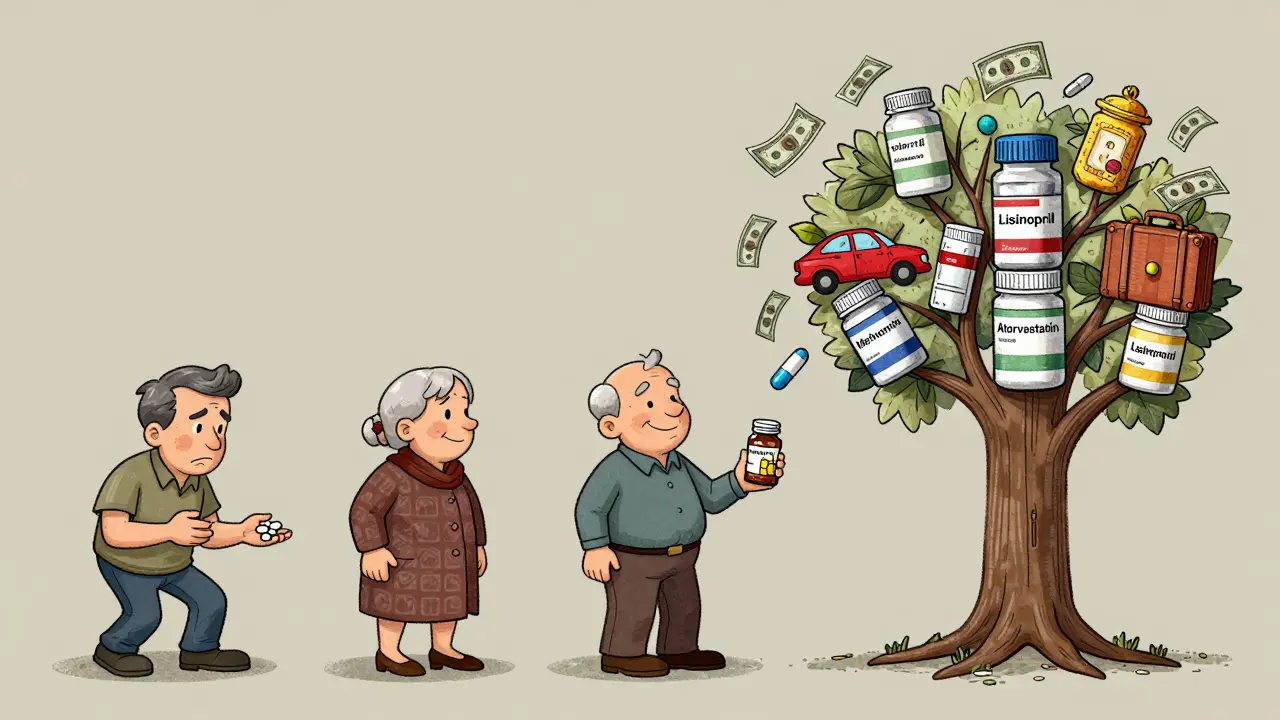
Generics Improve Adherence-And That Saves Lives
Cost isn’t just about money. It’s about whether you take your medicine every day. The CDC found that 1 in 4 Americans skip doses because they can’t afford their prescriptions. That’s not just risky-it’s deadly. Missed doses of blood pressure or diabetes meds lead to strokes, heart attacks, kidney failure, and amputations. Those events cost hospitals thousands per visit. Studies show patients on generics are 18-22% more likely to stick with their treatment. Why? Because they can afford to. When your pill costs $4 instead of $40, you don’t have to choose between meds and rent. Medication Therapy Management (MTM) programs-often covered by Medicare Part D-help patients switch to generics and avoid dangerous interactions. Pharmacists in these programs have reduced medication-related hospitalizations by 30-40% by simply optimizing drug regimens with cost-effective generics.Real-World Impact: Brazil, India, and the U.S.
It’s not theoretical. In Brazil, government policies pushed generics for hypertension and diabetes. Within five years, medication access rose 35%, and annual healthcare costs dropped by $1.2 billion. In India, generic HIV drugs brought treatment to millions who couldn’t afford the brand versions. Between 2005 and 2015, adherence jumped 40%, and death rates fell 25%. Here in the U.S., generics saved $338 billion in 2020 alone. Over the past decade, they’ve saved the system nearly $2.4 trillion. That’s not just corporate profit-it’s families keeping their homes, avoiding bankruptcy, and living longer.Myths About Generics-Busted
Some people still believe generics are “weaker” or “lower quality.” That’s not true. - Myth: Generics don’t work as well.Fact: The FDA requires them to be bioequivalent. Thousands of studies confirm they work the same. - Myth: The fillers cause side effects.
Fact: Inactive ingredients can rarely cause allergic reactions (like lactose or dyes), but that’s true for brand-name drugs too. If you have a sensitivity, your pharmacist can help you find a version without it. - Myth: Only big pharma makes good drugs.
Fact: Many generics are made by the same factories that produce brand-name drugs. The FDA inspects them all the same way.
How to Switch to Generics-Step by Step
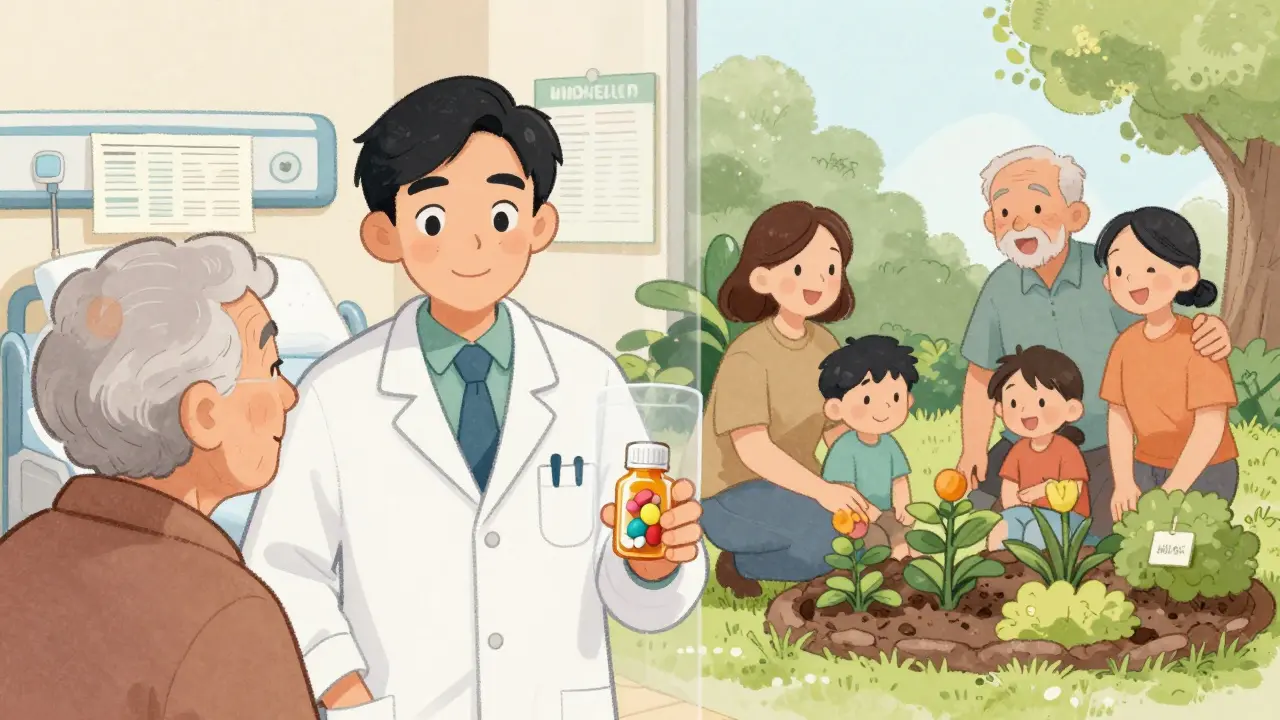
1. Check your prescriptions. Ask your pharmacist: “Is there a generic version of this?” If they say no, ask why. Sometimes it’s just a matter of insurance formulary. 2. Use the FDA’s Orange Book. It lists approved generics and their brand equivalents. You can search it online for free. 3. Ask about patient assistance programs. Some manufacturers offer discounts-even for brand-name drugs-if you qualify based on income. 4. Use mail-order pharmacies. Many offer 90-day supplies of generics at lower prices than local pharmacies. 5. Enroll in MTM. If you’re on Medicare Part D, you’re eligible for free pharmacist consultations to review all your meds and cut unnecessary costs. 6. Don’t assume your insurance won’t cover it. Some plans still push brand-name drugs. But if you appeal with evidence of cost savings, they often change their minds.What’s Next? Biosimilars and Complex Generics
The next wave isn’t just simple pills. Biologic drugs-like those for rheumatoid arthritis, cancer, or psoriasis-are expensive because they’re made from living cells, not chemicals. But now, biosimilars are hitting the market. These are generic-like versions of biologics, and they’re already saving patients thousands. The Inflation Reduction Act of 2022 capped insulin costs at $35 a month for Medicare users-and many of those are now generics. By 2027, the FDA’s new GDUFA III rules will speed up approvals for complex generics, meaning even more affordable options for chronic conditions.Bottom Line: Your Health, Your Wallet
If you’re on long-term medication, you’re not just paying for pills. You’re paying for your future. Generics turn a financial burden into a manageable cost. They don’t compromise your health-they protect it. The savings aren’t hypothetical. They’re real. For a 60-year-old with diabetes and high blood pressure, switching to generics could mean $1,500 saved this year, $15,000 over ten years, and $50,000+ over a lifetime. That’s a vacation. A new car. Emergency savings. Peace of mind. Talk to your pharmacist. Ask your doctor. Check your prescriptions. You don’t need to suffer financially to stay healthy. Generics make that possible.Are generic drugs as safe as brand-name drugs?
Yes. The FDA requires generic drugs to meet the same strict standards for safety, strength, quality, and performance as brand-name drugs. They contain the same active ingredients and are tested to ensure they work the same way in your body. The only differences are in inactive ingredients like fillers or dyes, which rarely affect how the drug works.
Why do some people say generics don’t work as well?
This usually comes from the placebo effect or confusion with inactive ingredients. Some people notice a different color or shape and assume it’s less effective. In rare cases, someone might react to a filler (like lactose) in one version but not another. But the active ingredient-the part that treats your condition-is identical. Studies consistently show no difference in outcomes between generics and brand-name drugs.
Can I switch from a brand-name drug to a generic without asking my doctor?
In most cases, yes. Pharmacists are trained to substitute generics when allowed by law and your prescription. But if your doctor specifically wrote “dispense as written” or “no substitutions,” you’ll need to check with them first. Always inform your doctor if you switch, especially if you have multiple conditions or take complex drug combinations.
Are all chronic condition drugs available as generics?
Most are. For common conditions like high blood pressure, diabetes, high cholesterol, asthma, and thyroid disease, generics are widely available and make up over 90% of prescriptions. For newer or complex biologic drugs-like those for rheumatoid arthritis or cancer-generics (called biosimilars) are still emerging, but they’re growing fast. By 2027, more than $150 billion in brand-name drug sales will face generic competition.
How do I know if my insurance covers generics?
Check your plan’s formulary-this is the list of drugs your insurance covers. Generics are almost always on the lowest cost tier. If your prescription isn’t covered, ask your pharmacist to request a prior authorization or switch to a covered generic. Many insurers will approve the switch if you show it’s medically equivalent and cheaper.
Do generics take longer to work than brand-name drugs?
No. Generic drugs are required to be absorbed into your bloodstream at the same rate and to the same extent as the brand-name version. If your blood pressure drops or your blood sugar stabilizes on a brand-name drug, it will do the same on the generic. There’s no delay in effectiveness.
Can I save money by buying generics in bulk?
Yes. Many pharmacies offer 90-day supplies of generics at lower prices than 30-day fills. Mail-order pharmacies often have the best deals. For example, a 90-day supply of generic metformin might cost $25 instead of $15 for a 30-day supply. That’s not just convenience-it’s real savings.
Are there any situations where I shouldn’t use a generic?
Very few. For most people, generics are safe and effective. In rare cases-like epilepsy or thyroid disorders-some doctors prefer brand-name drugs because the therapeutic window is narrow. But even then, many patients switch successfully. Always talk to your doctor or pharmacist if you’re unsure. Don’t assume you need the brand name.
Phil Hillson
January 19, 2026 AT 00:59Jacob Hill
January 19, 2026 AT 12:35Aman Kumar
January 20, 2026 AT 01:29Astha Jain
January 20, 2026 AT 08:31Lewis Yeaple
January 21, 2026 AT 05:56Jackson Doughart
January 22, 2026 AT 18:33Malikah Rajap
January 23, 2026 AT 09:42Josh Kenna
January 25, 2026 AT 02:51Erwin Kodiat
January 25, 2026 AT 13:52Valerie DeLoach
January 27, 2026 AT 12:48Christi Steinbeck
January 27, 2026 AT 19:46sujit paul
January 29, 2026 AT 00:01Tracy Howard
January 30, 2026 AT 01:24Jake Rudin
January 31, 2026 AT 21:43Lydia H.
February 1, 2026 AT 05:20