
For people living with type 1 diabetes, managing blood sugar has long meant constant calculations: carb counting, checking glucose levels, injecting insulin, adjusting for exercise, stress, sleep, and meals. It’s exhausting. And for decades, that’s all there was - until now. Closed-loop systems are changing everything. These aren’t science fiction anymore. They’re real, FDA-approved devices that automatically adjust insulin based on real-time glucose data, day and night. No more waking up at 3 a.m. to check your meter. No more guessing how much insulin to give before pizza. This isn’t just convenience - it’s a fundamental shift in how diabetes is managed.
How Closed-Loop Systems Actually Work
A closed-loop system isn’t one device. It’s three parts working together: a continuous glucose monitor (CGM), an insulin pump, and a smart algorithm. The CGM checks your glucose every 5 minutes and sends that data wirelessly to the pump. The algorithm - the brain of the system - looks at the numbers, sees the trend (rising, falling, steady), and decides: Should I give more insulin? Less? Or hold off? It does this automatically, 24/7, without you lifting a finger.
This is different from older systems. Back in 2009, the first step was low-glucose suspend - a pump that would stop insulin if your blood sugar dropped too low. That helped, but it was reactive. Modern hybrid closed-loop (HCL) systems are proactive. They don’t just stop insulin when you’re low. They also increase insulin when you’re rising, even before you hit a high. That’s why time-in-range (70-180 mg/dL) jumps from around 55% with traditional pumps to 70-75% with HCL systems. That’s a 15-point gain. And it’s not just numbers - it’s fewer lows, fewer highs, and far less mental load.
The Big Players: Tandem, Insulet, and Beta Bionics
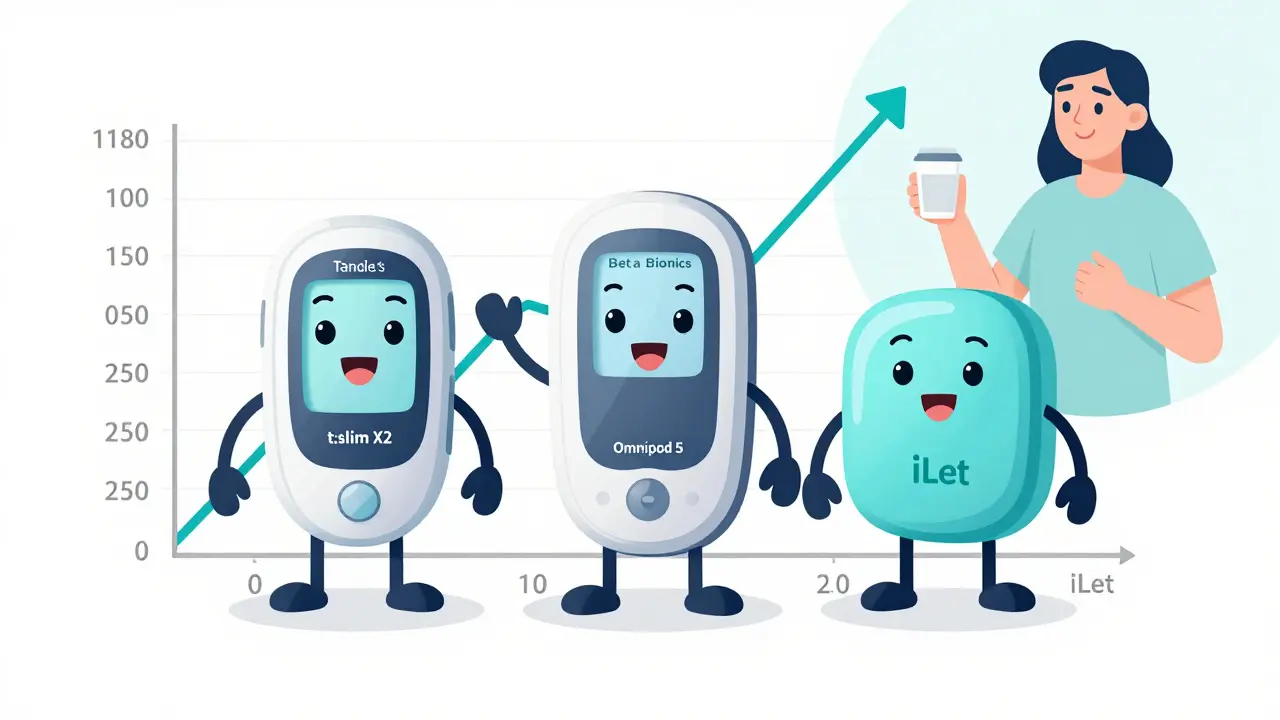
Three systems dominate the U.S. market today. Each has its own strengths.
- Tandem’s t:slim X2 with Control-IQ - Launched in 2019 and updated in 2022, this system automatically delivers correction boluses. If your glucose spikes after a meal, it doesn’t wait for you to act. It adjusts insulin on its own. It requires a smartphone (iOS or Android) and works with most CGMs. The pump itself costs around $6,500, with a $299 annual software fee.
- Insulet’s Omnipod 5 - This one’s all-in-one. No separate pump. The pod sticks to your skin, holds up to 150 units of insulin, and runs for three days. It doesn’t need a separate device - just your phone. It was FDA-approved in January 2022. Originally, it required you to announce meals, but as of early 2024, its new "Autonomous" mode (in beta) removes that step. Each pod costs $320.
- Beta Bionics’ iLet - This is the closest thing to a true artificial pancreas. You don’t need to enter insulin-to-carb ratios or correction factors. Just input your weight. The system learns your body’s needs over time. FDA-approved in 2021, it’s designed for people who find traditional insulin settings overwhelming. It’s still new, but early data shows it matches or beats other systems in time-in-range.
Each system has trade-offs. Control-IQ handles corrections well but still needs meal boluses. Omnipod 5 is sleek and wearable but requires more frequent pod changes. iLet is simple to set up but doesn’t yet handle all meal types perfectly. The right choice depends on your lifestyle, tech comfort, and how much you want to manage versus automate.
Real Results: What the Numbers Don’t Tell You
Studies show HCL systems increase time-in-range by 10-15 percentage points. That’s impressive. But real life tells a deeper story.
A 2023 survey of over 1,200 users on the T1D Exchange Forum found that 78% said their sleep improved dramatically. Overnight hypoglycemia - the silent danger - dropped by over 50%. One user wrote: "I haven’t had a severe low in 8 months. Before Control-IQ, it was once a month. I didn’t realize how much I was dreading bedtime until I stopped fearing it."
On Reddit’s r/insulinpumps, 68% of 3,400+ threads were positive. Common themes: "My morning blood sugar is stable for the first time ever," and "I forgot I had diabetes today - in a good way."
But it’s not perfect. A 2023 DiabetesMine review found that 42% of negative experiences centered on post-meal spikes. If you eat a high-fat meal - pizza, pasta with cream sauce, or a burger with cheese - the algorithm often underestimates how long glucose will keep rising. That’s because most systems still rely on carbs as the main trigger. You still need to bolus manually for meals. And if you forget, or guess wrong, your glucose can climb.
Another issue: sensor lag. Glucose readings are accurate, but they’re delayed by 5-15 minutes. If your sugar spikes fast - say, after a sugary drink - the system might not respond quickly enough. Users report this most often during sports, parties, or eating out. And when sensors fail - which happens to 15% of users - the whole system shuts down. No backup. No manual override built in.
The Hidden Costs and Challenges
There’s more to these systems than the tech. The cost is steep. Even with insurance, many users pay $1,200-$1,500 extra per year. Medicare covers only 80% of pump costs. For low-income families, that’s a barrier. In 2023, only 28% of insulin pump users in the U.S. had adopted HCL systems. Among children, it’s higher - 35% - because parents are more willing to manage the setup.
Training is another hurdle. Setting up the system takes 3-5 hours. You need to understand carb ratios, correction factors, and how to troubleshoot a CGM error. A 2023 Diabetes UK survey found that 45% of users felt they didn’t get enough training from their clinic. That’s risky. Misuse can lead to high glucose, then ketoacidosis. A 2025 study in The Lancet Diabetes & Endocrinology found HCL users had a 1.2x higher rate of DKA than those on manual pumps. Why? Because people assume the system will fix everything - and forget to check for ketones when glucose is high for hours.
Then there’s "algorithm fatigue." About 15% of users eventually turn off automation. Why? Because it’s too rigid. One shift worker on Reddit said: "I work nights. My eating schedule is chaos. The system kept overcorrecting. I had to disable it for two weeks."
Adhesion is another problem. Thirty-eight percent of users reported pumps or sensors falling off - especially during exercise or in hot weather. Skin Tac or medical tape helps. But it’s another thing to carry, remember, and apply.
What’s Next: The Road to Fully Closed-Loop
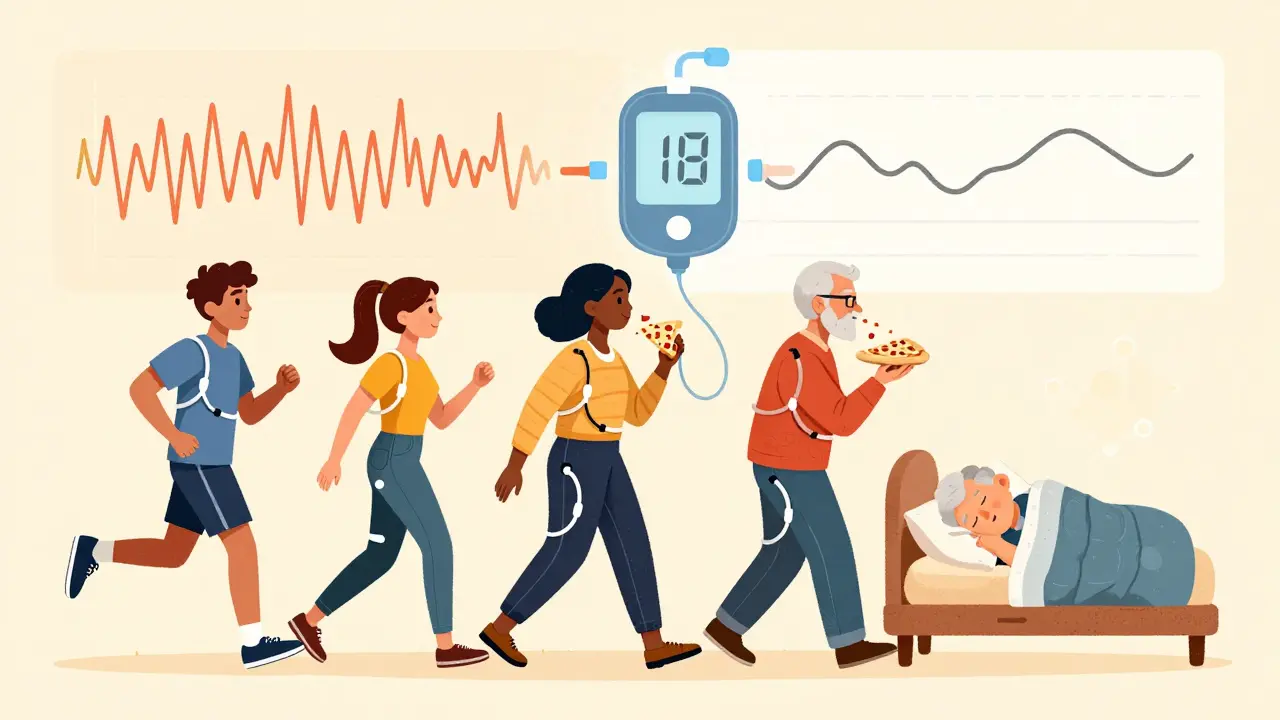
The next big leap is fully closed-loop - no meal announcements, no manual boluses. That’s coming. Tandem’s Control-IQ 3.0 (released late 2023) already reduces hypoglycemia by another 1.8%. Omnipod 5’s "Autonomous" mode (in beta as of early 2024) removes meal boluses entirely. Beta Bionics’ iLet is already close - it just recommends, doesn’t require, meal inputs.
By 2025, we’ll see interoperable systems. That means you can pair any CGM with any pump. No more being locked into one brand. The FDA is pushing for this. And by 2026, systems like Beta Bionics’ Project Eiger will start using activity trackers and stress biomarkers - not just glucose - to adjust insulin. Imagine your pump knowing you’re stressed from work, or that you ran 5 miles this morning, and adjusting automatically.
But the biggest change won’t be tech. It’ll be mindset. Right now, HCL systems are tools. In five years, they’ll be standard. Endocrinologists surveyed by the Endocrine Society in 2023 said 92% expect fully closed-loop systems to become routine care by 2030. That’s not hype. That’s where the data is leading.
Is It Right for You?
Ask yourself:
- Do you get anxious about lows, especially overnight?
- Do you forget boluses or guess wrong on carbs?
- Are you tired of constant calculations?
- Can you afford the upfront cost and ongoing supplies?
- Are you willing to learn the system and troubleshoot when it glitches?
If you answered yes to the first three, and you can handle the cost and learning curve - this is the biggest leap in diabetes care since insulin itself. It doesn’t cure diabetes. But it gives you back your life.
For many, it’s not about perfection. It’s about peace. One parent wrote: "My daughter used to cry before bed because she was scared of lows. Now she sleeps. We both sleep. That’s worth every dollar."
Are closed-loop systems only for type 1 diabetes?
Currently, all FDA-approved closed-loop systems are designed for type 1 diabetes. They’re not approved for type 2, gestational diabetes, or other forms. However, early trials are underway for type 2 users with insulin dependence, especially those with high variability or frequent lows. But as of 2026, these systems are only officially recommended for type 1.
Do I still need to count carbs with a closed-loop system?
Yes - for now. Hybrid closed-loop systems like Control-IQ and Omnipod 5 (before its Autonomous mode) still require you to enter meal carbs so the system can deliver a bolus. Even iLet recommends meal announcements for better control. Fully closed-loop systems that eliminate carb counting are in testing and expected to be available by 2025-2026. Until then, you’ll still need to estimate carbs and bolus manually.
Can I use a closed-loop system if I’m active or exercise often?
Yes, but you’ll need to adjust settings. Most systems have an "exercise mode" that temporarily reduces basal insulin. Some users lower their target glucose range before workouts. Others pre-bolus less or disconnect temporarily. The system can’t yet predict how your body will respond to a sprint or a long hike. You still need to monitor and adapt. Many users report better stability during exercise with HCL than with manual methods, but it’s not automatic.
What happens if my CGM fails or the algorithm makes a mistake?
The system will pause automation and alert you. You’ll need to switch to manual insulin delivery using your CGM reading and your usual calculation methods. Always keep backup supplies - insulin pens, test strips, and your old pump settings. Never rely on automation alone. If your glucose is high for more than 2 hours, check for ketones. Mistakes happen - especially with sensor errors or rapid glucose swings - so staying informed is part of using the system safely.
Is it safe to use a closed-loop system long-term?
Yes, based on current data. The CLEAR study followed users for two years and found sustained improvements in time-in-range with no increase in serious complications. However, there’s a small increase in DKA risk - about 1.2 times higher than with manual systems. This is why education matters. You must know how to recognize high glucose + ketones, and how to respond. Regular check-ins with your diabetes team, good hygiene, and consistent sensor use reduce this risk significantly.
Sonja Stoces
February 12, 2026 AT 10:41Annie Joyce
February 13, 2026 AT 16:25Kristin Jarecki
February 14, 2026 AT 19:57Joanne Tan
February 15, 2026 AT 22:27Ojus Save
February 17, 2026 AT 03:14Stacie Willhite
February 18, 2026 AT 22:06Jason Pascoe
February 20, 2026 AT 03:24Rob Turner
February 20, 2026 AT 23:37Luke Trouten
February 21, 2026 AT 10:46