
When antibiotics disappear from hospital shelves, it’s not just a supply chain problem-it’s a life-or-death emergency. By 2025, antibiotic shortages have become one of the most urgent threats to modern medicine. In the UK, the number of drug shortages more than doubled between 2020 and 2023. In the US, it’s the worst it’s been in a decade. And in low-income countries, many patients simply don’t get treated at all. This isn’t a future scenario. It’s happening right now.
Why Antibiotics Are Different
Most drug shortages are frustrating, but manageable. If your blood pressure medication runs out, there are usually other pills you can take. But antibiotics? That’s not the case. When amoxicillin or penicillin G benzathine disappears, doctors don’t have a backup that works just as well. Many infections-like ear infections, urinary tract infections, or pneumonia-only respond to a narrow set of drugs. When those are gone, clinicians are forced to use stronger, more toxic alternatives like colistin or carbapenems. These aren’t just last-resort options-they’re dangerous. And using them unnecessarily speeds up the rise of superbugs.The Global Picture
The World Health Organization tracks antibiotic resistance across 104 countries. The data is alarming: one in three urinary tract infections can’t be treated with first-line antibiotics. In parts of South Asia and the Eastern Mediterranean, that number is even higher. Meanwhile, in Africa, one in five infections is already resistant. But resistance isn’t the only problem-it’s the lack of access. In low- and middle-income countries, 70% of antibiotics are simply unavailable. That means a child with pneumonia might go home without any treatment because the clinic ran out of azithromycin. A nurse in rural Kenya told the WHO: “We send patients home knowing they might die from something that should be easy to fix.”Why Are Antibiotics Running Out?
It’s not because we’re running out of science. We have plenty of antibiotics. The problem is economics. Generic antibiotics make up 85% of global use, but they’re cheap. Prices have dropped 27% since 2015. Meanwhile, the cost to meet safety and manufacturing standards has gone up 34%. Factories that make sterile injectables need expensive equipment and strict controls. No company wants to invest in a product that barely turns a profit. So they stop making them. Brexit made things worse in the UK. Between 2020 and 2023, the number of reported drug shortages jumped from 648 to 1,634. Many of those were antibiotics shipped from Europe. When supply chains broke down, hospitals scrambled. In the US, the FDA recorded 147 active antibiotic shortages by the end of 2024. Penicillin G benzathine has been in short supply since 2015. Amoxicillin with clavulanate? After a major shortage in early 2023, use dropped by 69% in 16 databases because doctors had no choice but to avoid prescribing it.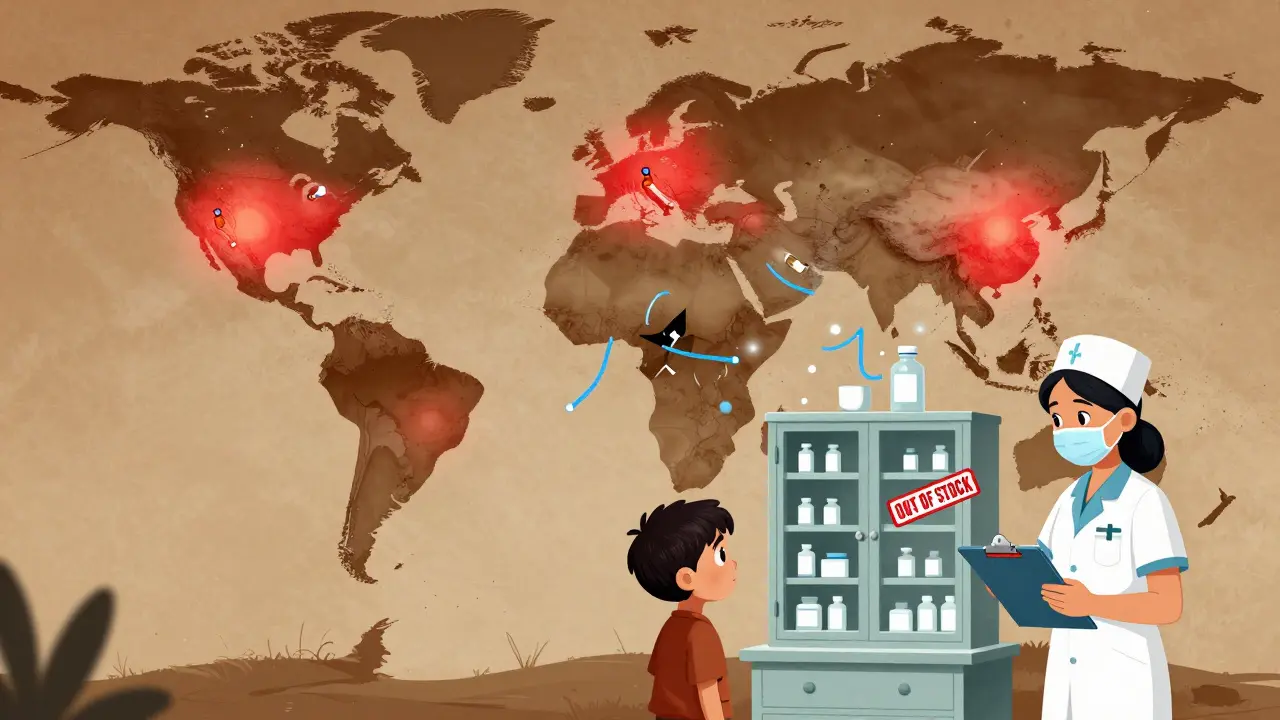
What Happens When Antibiotics Are Gone
Hospitals are forced to improvise. A 2025 survey of US hospital pharmacists found that 78% had to change treatment plans because of shortages. Sixty-two percent saw more patients get sicker as a result. One doctor in California told the American Public Health Association she had to use colistin-a toxic drug reserved for the most desperate cases-for a routine urinary tract infection. In the UK, a physician on Reddit wrote about rationing amoxicillin, forcing staff to prescribe broader-spectrum antibiotics that increase resistance risk. In Mumbai, a mother waited 72 hours for azithromycin to arrive. Her child’s pneumonia worsened. She ended up in intensive care. These aren’t rare stories. They’re becoming the norm.The Domino Effect: Resistance Gets Worse
When doctors can’t use the right antibiotic, they use the next best thing-even if it’s too strong. That’s how resistance spreads. For example, when third-generation cephalosporins vanish, doctors turn to carbapenems. But over 40% of E. coli and 55% of K. pneumoniae are already resistant to those. So now, carbapenems are being overused. That pushes resistance even higher. The WHO says resistance is rising 5-15% every year in over 40% of monitored pathogen-antibiotic combinations. We’re treating infections with weapons that are already losing their power.Who’s Trying to Fix This?
Some hospitals are getting smarter. Johns Hopkins Hospital cut unnecessary broad-spectrum antibiotic use by 37% during shortages by using rapid diagnostic tests. These tests tell doctors within hours what bacteria they’re dealing with-so they can pick the right drug, even if it’s not the first-line one. California launched a regional antibiotic-sharing network in 2024. Participating hospitals saw critical shortages drop by 43%. The WHO announced a five-point plan in October 2025, including a $500 million Global Antibiotic Supply Security Initiative to be launched by 2027. The European Commission is pushing new rules to guarantee production of essential antibiotics. The US FDA approved two new manufacturing facilities in January 2025, which could ease 15% of current shortages by late 2025. But these are band-aids. The real fix? Making antibiotic production financially sustainable.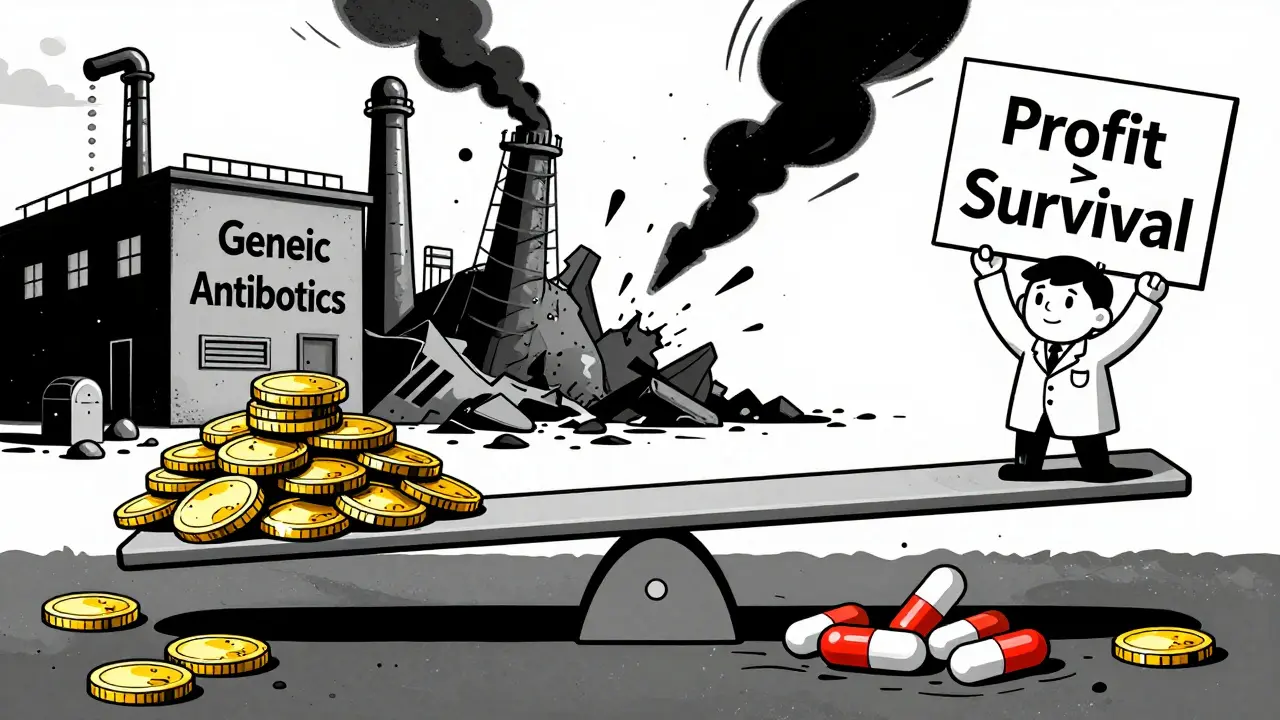
What Needs to Change
The market for antibiotics is broken. The global market was worth $38.7 billion in 2024, but growth was just 1.2%-far below the 5.7% average for all pharmaceuticals. Companies won’t invest in making cheap drugs unless they’re paid fairly. Governments need to guarantee minimum purchase volumes. They need to offer subsidies or prizes for manufacturers who keep producing essential antibiotics. Right now, the system punishes the companies that make the drugs we need most. Antibiotic stewardship programs are now in 82% of US hospitals, but only 37% meet WHO standards. That means most are still not doing enough to track usage, prevent waste, or avoid overuse. We need better training, better data, and better accountability.What You Can Do
You can’t fix the supply chain. But you can help stop resistance. Never pressure your doctor for antibiotics. Don’t take them unless you need them. Finish the full course-even if you feel better. Don’t save leftover pills for next time. And never share them. Each misuse chips away at the effectiveness of these drugs for everyone.The Road Ahead
Without major changes, the Review on Antimicrobial Resistance predicts antibiotic shortages will grow by 40% by 2030. That could lead to 1.2 million extra deaths every year from infections we used to treat easily. The WHO’s goal is for 70% of antibiotic use to come from the safest, most targeted drugs by 2030. Right now, we’re at 58%. We’re falling behind. This isn’t just about medicine. It’s about justice. People in rich countries are scrambling to get the right drugs. People in poor countries are dying because they never had a chance. Antibiotic shortages aren’t an accident. They’re a system failure. And if we don’t fix it now, the next generation will inherit a world where even a scraped knee could kill you.Why are antibiotics more likely to be in short supply than other drugs?
Antibiotics are 42% more likely to face shortages than other medications because they’re mostly cheap generics with low profit margins. Manufacturers avoid making them because the cost to meet strict safety standards outweighs the revenue. Unlike cancer drugs or diabetes medications, there’s little financial incentive to produce antibiotics, even though they’re essential.
What happens when hospitals run out of first-line antibiotics?
Doctors are forced to use broader-spectrum or last-resort antibiotics like carbapenems or colistin. These drugs are more toxic, have more side effects, and speed up antibiotic resistance. In some cases, patients get no treatment at all. A 2025 survey found 62% of US hospitals saw increased patient complications because of antibiotic shortages.
Is antibiotic resistance getting worse because of shortages?
Yes. When the right antibiotic isn’t available, doctors use stronger ones out of necessity. This overuse pushes bacteria to evolve faster. The WHO reports that resistance has increased in over 40% of monitored pathogen-antibiotic combinations since 2018, rising 5-15% annually. Shortages aren’t the only cause-but they’re a major driver.
Are there any alternatives to traditional antibiotics?
There are no direct replacements yet. Phage therapy and monoclonal antibodies are being researched, but they’re still experimental and not widely available. Rapid diagnostics help doctors choose better antibiotics faster, but they don’t replace the drugs themselves. For now, the only real solution is ensuring the existing antibiotics stay in supply.
What’s being done to prevent future shortages?
The WHO is launching a $500 million Global Antibiotic Supply Security Initiative by 2027. The EU and US are pushing for guaranteed government purchases and financial incentives for manufacturers. Some regions, like California, have created hospital networks that share antibiotic stockpiles. But progress is slow. Without major policy changes and funding, shortages will keep rising.
sam abas
January 14, 2026 AT 04:52ok so let me get this straight-antibiotics are cheap so no one makes them? like, wow. who knew capitalism could be this stupid. i mean, we spend billions on crypto nonsense and space tourism but a kid in kenya can’t get amoxicillin because some pharma exec decided ‘profit margins’ are more important than life? yeah. that’s the american dream right there. and dont even get me started on how the fda approves new factories but they’re still 18 months away. meanwhile, my cousin’s baby got sepsis from an ear infection last year because the hospital was out of penicillin. and the dr just shrugged and said ‘try azithromycin.’ guess what? it didn’t work. now she’s on colistin. and yeah, i know it’s toxic. but what choice did we have? the system is broken. and nobody cares until it’s their kid.
Milla Masliy
January 15, 2026 AT 01:59thank you for writing this. as someone who works in a community clinic in rural texas, i see this every week. we had to switch a patient from amoxicillin to cephalexin last month because the first ran out-and then cephalexin ran out too. we started calling other clinics just to borrow a few doses. it’s not just about resistance-it’s about dignity. no one should have to beg for medicine that’s been around since the 1940s. i’m glad california’s sharing network is working. we need that everywhere. and yes, we need government guarantees. but also, let’s stop pretending this is just a ‘supply chain’ issue. it’s a moral failure.
Damario Brown
January 16, 2026 AT 19:50lol the real problem is that people take antibiotics for colds. you think this is bad? try being a pharmacist in a rural town where grandpa takes his kid’s amoxicillin for his ‘sinus thing’ and then complains when it doesn’t work. also, phage therapy is literally a thing and you’re all acting like it’s sci-fi. it’s been used in georgia since the 1920s. we’re not inventing new tech-we’re ignoring proven stuff because it’s not patentable. also, why is everyone acting surprised? this has been predicted since 2010. the only surprise is that people still act shocked when the system collapses. also, the fda’s new factories? they’re not gonna fix anything. the supply chain’s broken because no one wants to make $0.10 pills. fix the pricing model or shut up.
Avneet Singh
January 16, 2026 AT 21:35the structural inefficiencies inherent in the commodification of essential therapeutics are, frankly, a grotesque manifestation of neoliberal bioeconomic precarity. one cannot help but observe the grotesque asymmetry between the capitalization of luxury pharmaceuticals (e.g., GLP-1 agonists at $1,000/month) and the systemic neglect of low-margin, high-utility antimicrobials. the WHO’s $500M initiative is a performative gesture-without binding global procurement mandates, it’s merely symbolic. furthermore, the overreliance on empirical prescribing in LMICs exacerbates resistance dynamics, yet diagnostic infrastructure remains woefully underfunded. we are not facing a shortage of drugs-we are facing a shortage of political will. and frankly, the discourse here is dangerously reductive.
Adam Vella
January 17, 2026 AT 05:26It is imperative to recognize that the antibiotic crisis is not merely an economic or logistical phenomenon, but a profound epistemological failure of modern medicine’s reductionist paradigm. We have engineered a system that treats biological entities-microorganisms-as if they were mere mechanical components to be replaced, rather than dynamic, evolving systems deserving of ecological respect. The overuse of broad-spectrum agents, the commodification of life-saving compounds, and the institutionalized neglect of stewardship reflect a deeper philosophical malaise: the belief that technological progress alone can resolve biological complexity. Until we embrace a more holistic, planetary health framework-one that integrates ethics, ecology, and equity-we will continue to treat symptoms while ignoring the disease of our own hubris.
Nelly Oruko
January 17, 2026 AT 10:51My grandma used to say, ‘Don’t waste medicine.’ She was right. I’ve seen people save leftover antibiotics for next time. Don’t. It kills more than it helps. Just finish the course. Even if you feel better. It’s that simple.
vishnu priyanka
January 19, 2026 AT 02:42in mumbai, we call it ‘pharmacy roulette’-you show up, they’re out of azithromycin, you wait, they say ‘try this one,’ you take it, it doesn’t work, you go back. it’s like playing slots with your kid’s life. but you know what? we still laugh. we make chai and joke about how ‘the system is a drama queen.’ but deep down? we’re scared. my neighbor’s daughter almost died last year. now i keep a small stash of amoxicillin at home. i know it’s dumb. but what else can you do when the clinic is 20 km away and the van’s out of gas?
Alan Lin
January 20, 2026 AT 22:14This is not a crisis of supply-it is a crisis of values. We have allowed profit to dictate the distribution of life-saving medicines. The fact that a child in Nairobi dies because a factory in Ohio shut down its penicillin line because the margin was 3% is not an accident. It is a choice. And those of us in positions of influence-clinicians, policymakers, citizens-must stop treating this as a technical problem and start treating it as a moral emergency. The WHO’s initiative is a start, but without binding international agreements, mandatory stockpiling, and financial guarantees for manufacturers of essential antibiotics, we are merely rearranging deck chairs on the Titanic. We must act now-not in 2027, not in 2030. Today. Because tomorrow, it will be too late. And if you’re reading this and thinking ‘it won’t happen to me,’ you’re already part of the problem.