
When you’re in severe pain-after surgery, a broken bone, or a flare-up of chronic back pain-it’s tempting to reach for the strongest relief possible. Opioids can deliver that. But they’re not a simple fix. They come with real, measurable risks that can change your life in ways you didn’t expect. The question isn’t just whether opioids work. It’s when they should be used, and how to avoid the trap of dependence.
When Opioids Are Actually Needed
Opioids aren’t the first tool doctors should reach for. In fact, most guidelines say they shouldn’t be used at all for long-term pain like arthritis, fibromyalgia, or chronic lower back pain unless everything else has failed. The CDC’s 2022 guidelines make this clear: non-opioid treatments-physical therapy, exercise, cognitive behavioral therapy, acetaminophen, or NSAIDs-should come first. That’s because the evidence for opioids helping with chronic pain over months or years is weak. Studies show they might reduce pain by less than 2 points on a 10-point scale in the first few weeks, and that benefit fades over time. So when are opioids appropriate? For short-term, severe pain: after major surgery, a serious injury, or during cancer treatment. Even then, the goal is to use the lowest dose for the shortest time possible. A typical prescription for acute pain should be no more than a 3- to 7-day supply. Many patients end up with way more pills than they need-76% of unused opioids sit in medicine cabinets, where they can be stolen, misused, or accidentally taken by kids or elderly relatives. For chronic pain, opioids are only considered if:- Non-opioid treatments didn’t help enough
- Pain is severely limiting daily function
- The patient understands the risks and agrees to strict monitoring
The Hidden Danger: Dependence Isn’t Just Addiction
People often confuse dependence with addiction. They’re not the same. Dependence means your body has adapted to the drug. If you stop suddenly, you get withdrawal-sweating, nausea, muscle aches, anxiety. That’s a physical response, not a moral failing. Addiction is when you keep using despite harm: lying to doctors, stealing, neglecting family, risking your job. It’s a brain disorder. But here’s the scary part: dependence can happen fast. Even if you take opioids exactly as prescribed, your body can become dependent within a few weeks. About 8-12% of people prescribed opioids for chronic pain develop opioid use disorder (OUD). That number jumps to 26% if the daily dose is over 100 MME. And it’s not just about dose. Certain factors make dependence much more likely:- Using opioids with benzodiazepines (like Xanax or Valium)-this increases overdose risk by 3.8 times
- Having a history of substance abuse, even if it’s in the past
- Being over 65-your body clears drugs slower, so even normal doses can build up
- Having depression, anxiety, or untreated PTSD
How Doctors Are Supposed to Monitor You
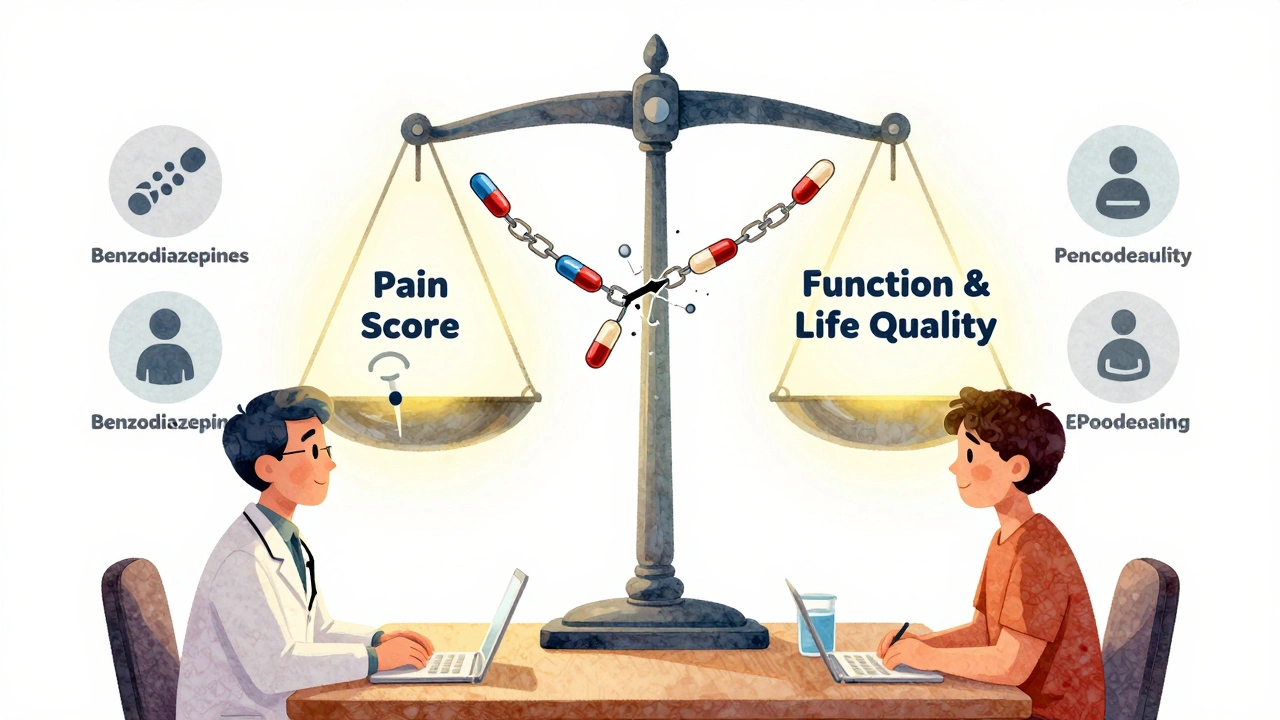
If you’re on opioids long-term, you shouldn’t just get a refill every month. There should be a plan. The VA/DoD and CDC guidelines say doctors should check in regularly:- At least every 3 months for stable patients
- Every month if you’re high-risk
- Pain score (0-10 scale)
- How well you’re functioning-can you walk, sleep, work?
- Urine drug tests to check for other substances
- Screening tools like the Current Opioid Misuse Measure (COMM)
- Checking prescription drug monitoring programs (PDMPs) to see if you’re getting opioids from other doctors
When It’s Time to Taper Off
Sometimes, the risks start outweighing the benefits. Maybe your pain hasn’t improved. Maybe you’re feeling foggy all day. Maybe you’ve started needing higher doses just to feel the same relief. That’s when tapering becomes necessary. Tapering doesn’t mean quitting cold turkey. Abruptly stopping opioids can trigger severe withdrawal-and in some cases, push people back to street drugs like heroin. A safe taper is slow and personalized:- Slow taper: 2-5% reduction every 4-8 weeks. Best for patients doing okay but on long-term therapy.
- Moderate taper: 5-10% every 4-8 weeks. For those with no functional improvement or signs of tolerance.
- Rapid taper: 10% per week. Only if you’re on over 90 MME/day or having dangerous side effects.
What’s Being Done to Fix This
The tide is turning. Since 2012, opioid prescriptions in the U.S. have dropped by over 40%. More hospitals now have naloxone (the overdose reversal drug) on hand-51% of U.S. hospitals do, up from just 18% in 2016. All but one state now has a real-time prescription monitoring system that doctors must check before prescribing opioids. Research is also shifting. The NIH has poured $1.5 billion into finding non-addictive pain treatments. Right now, 37 new drugs are in late-stage trials-some targeting nerve pain without touching opioid receptors at all. These could change everything. But the problem isn’t solved. In 2021, over 80,000 people in the U.S. died from opioid overdoses. That’s more than car crashes or gun violence. And while fewer prescriptions are being written, the death toll is still rising-largely because of synthetic opioids like fentanyl, which are now mixed into illegal drugs.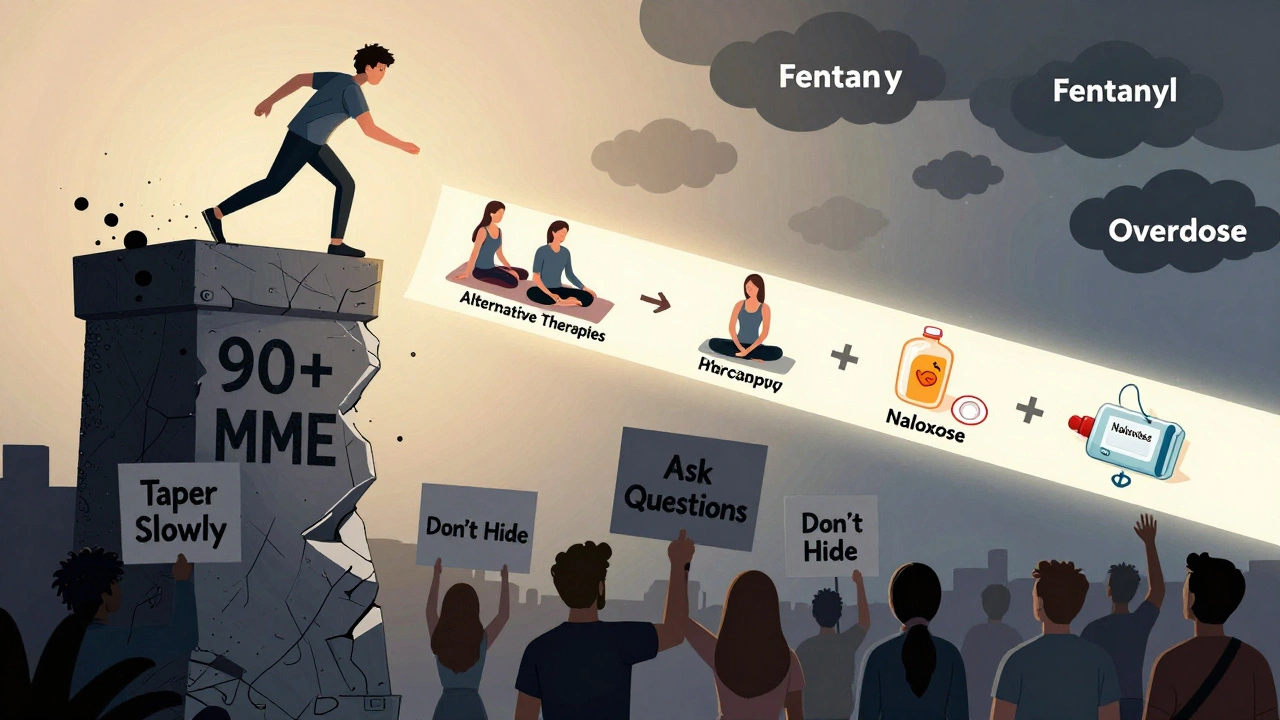
What You Should Do If You’re on Opioids
If you’re taking opioids for pain:- Ask your doctor: “Is this still helping me function, or am I just taking it to avoid feeling bad?”
- Keep all medications locked up. Never leave them on the counter.
- Ask for naloxone if you’re on 50+ MME/day or use benzodiazepines. It’s safe, easy to use, and can save your life-or someone else’s.
- Don’t skip follow-ups. Your pain level and function matter more than how many pills you’re taking.
- If you feel like you can’t stop, or you’re craving them, say something. Dependence isn’t weakness. It’s biology. Help exists.
- Watch for changes in behavior-withdrawal, secrecy, mood swings.
- Know where the pills are. Count them sometimes.
- Keep naloxone in the house. It’s not just for addicts-it’s for anyone on opioids.
It’s Not About Fear. It’s About Balance.
Opioids aren’t evil. For someone in unbearable pain after trauma or surgery, they can be a lifeline. But they’re not magic. They don’t fix the root cause of pain. They mask it. And that mask can become a cage. The goal isn’t to deny people relief. It’s to make sure relief doesn’t cost more than it gives. That means smarter prescribing, better monitoring, and more alternatives. It means treating pain as a whole-person issue-not just a number on a scale. If you’re on opioids, you deserve care that’s honest, careful, and respectful. You also deserve to know the truth: that the safest path forward isn’t always the fastest one.Are opioids ever safe for long-term pain?
Yes-but only in specific cases. Opioids may be considered for chronic non-cancer pain if non-opioid treatments have failed, pain is severely limiting daily life, and the patient agrees to strict monitoring. Even then, doctors should start low (under 50 MME/day) and avoid doses over 90 MME/day unless absolutely necessary. The goal is always to improve function, not just reduce pain numbers.
How quickly can someone become dependent on opioids?
Dependence can develop in as little as 3 to 7 days, even with proper use. That’s why guidelines recommend limiting prescriptions for acute pain to no more than a week. Long-term dependence is more common after 30+ days of continuous use. The risk increases sharply with higher doses and with concurrent use of other sedatives like benzodiazepines.
What’s the difference between tolerance, dependence, and addiction?
Tolerance means you need more of the drug to get the same effect. Dependence means your body has adapted to the drug and will cause withdrawal if you stop. Addiction is a brain disorder where you continue using despite harm-lying, stealing, neglecting responsibilities. You can be dependent without being addicted. But addiction almost always includes dependence.
Can I just stop taking opioids if I’ve been on them for a while?
No. Stopping abruptly can cause severe withdrawal-nausea, sweating, muscle pain, anxiety, insomnia-and may trigger relapse to illegal opioids. Tapering must be done slowly and with medical supervision. A typical taper reduces dose by 5-10% every 4-8 weeks. The plan should be made with your doctor, not forced on you.
What should I do if I think I’m becoming dependent?
Talk to your doctor immediately. Don’t wait until you’re struggling to get refills or hiding use. Dependence is a medical issue, not a moral failure. Ask about tapering options, naloxone, or referral to a pain specialist or addiction medicine provider. Medication-assisted treatments like buprenorphine or methadone are proven, safe, and effective for opioid use disorder.
Is naloxone only for people who use drugs illegally?
No. Naloxone is for anyone on opioids-prescribed or not. People on high-dose therapy, those taking opioids with benzodiazepines, or anyone over 65 are at risk for accidental overdose. Keeping naloxone at home is like having a fire extinguisher: you hope you never need it, but if you do, it saves lives. Many pharmacies now offer it without a prescription.
Are there better alternatives to opioids for chronic pain?
Yes. Physical therapy, exercise, cognitive behavioral therapy, acupuncture, and certain non-opioid medications (like gabapentin or duloxetine) have strong evidence for managing chronic pain. Studies show these approaches often improve function better than opioids over time. New non-addictive pain drugs are also in clinical trials. The goal isn’t to eliminate pain entirely-it’s to help you live better without risking dependence.

Aileen Ferris
December 9, 2025 AT 21:46Rebecca Dong
December 11, 2025 AT 15:31Sarah Clifford
December 11, 2025 AT 19:00Regan Mears
December 12, 2025 AT 18:01Queenie Chan
December 13, 2025 AT 06:54Kaitlynn nail
December 15, 2025 AT 01:02Jack Appleby
December 15, 2025 AT 04:53Ben Greening
December 17, 2025 AT 02:02Nikki Smellie
December 17, 2025 AT 08:22David Palmer
December 19, 2025 AT 01:18Doris Lee
December 19, 2025 AT 10:10Michaux Hyatt
December 20, 2025 AT 22:40