
When your child has a fever, the last thing you want is to guess which medicine is safe-or worse, give too much. Acetaminophen and ibuprofen are the two go-to options for parents, but they’re not the same. One works faster. The other lasts longer. One might be better for teething. The other might be safer if your baby is under six months. And mixing them? That’s where things get risky.
What’s the Difference Between Acetaminophen and Ibuprofen?
Acetaminophen (also called paracetamol) and ibuprofen both lower fever and ease pain, but they work in different ways. Acetaminophen affects the brain’s temperature control center. Ibuprofen reduces inflammation, which is why it’s also used for swelling or sore muscles.
For fever, ibuprofen wins in effectiveness. A 2021 review of 85 studies found that kids given ibuprofen were more likely to be fever-free at 4 hours than those given acetaminophen. The odds? Nearly double. At 6 hours, the difference was still clear. That’s not just a small edge-it’s the kind of gap that matters when your child is miserable and you’re up all night.
But acetaminophen isn’t useless. It’s gentler on the stomach. If your child has vomiting or a sensitive tummy, it’s often the better first choice. It also kicks in faster-about 30 to 60 minutes after giving it. Ibuprofen takes 1 to 2 hours to peak, but it lasts longer: up to 8 hours versus 4 to 6 for acetaminophen.
When Can You Start Using These Medicines?
Age matters. The American Academy of Pediatrics says acetaminophen can be used for babies as young as 2 months, but only after checking with a doctor if your child is under 3 months. For ibuprofen, the cutoff is 6 months. That’s not because it’s dangerous-it’s because there’s less research on very young infants. Their kidneys are still learning how to handle meds.
Many parents assume if it’s sold over the counter, it’s automatically safe for newborns. That’s a dangerous myth. A 2022 study from Children’s Hospital of Orange County found that 68% of dosing errors in kids under 2 happened because parents used age-based charts instead of weight. Your baby’s weight is the only number that counts.
Dosing: How Much Is Too Much?
Both medicines come in liquid form, and both come with a syringe or cup. Use only what’s in the box. Never use a kitchen spoon. A teaspoon is not a measuring spoon. A tablespoon is not a dose.
For acetaminophen: 7 to 15 mg per kilogram of body weight, every 4 to 6 hours. Max daily dose: 75 mg/kg. For ibuprofen: 4 to 10 mg/kg, every 6 to 8 hours. Max daily dose: 40 mg/kg.
Example: A 10-pound (4.5 kg) baby would get 32 to 68 mg of acetaminophen per dose. That’s about 1.25 mL of the infant concentration (160 mg/5 mL). For ibuprofen, it’s 18 to 45 mg per dose-about 0.6 to 1.4 mL of the same concentration.
Here’s the hard truth: you don’t need to alternate. Many parents do it because they think it works better. But the American Academy of Pediatrics doesn’t recommend it unless a doctor says so. Why? Because it’s easy to lose track. One parent gives acetaminophen at 8 a.m., then ibuprofen at noon, then acetaminophen again at 4 p.m.-and by 8 p.m., they’ve given both meds three times. That’s how liver damage happens.

Safety: What Are the Real Risks?
Both medicines are safe when used correctly. But both can hurt if misused.
Acetaminophen overdose is the leading cause of acute liver failure in children in the U.S. It doesn’t take much-just 2 to 3 times the recommended dose over a day. And it’s silent. No vomiting. No crying. Just a slow, invisible damage to the liver. That’s why you must never give more than 5 doses in 24 hours.
Ibuprofen can stress the kidneys, especially if your child is dehydrated. That’s why it’s not recommended for babies under 6 months. It can also cause stomach upset. In one Reddit thread with over 1,200 parent responses, 32% said their child got nauseous or had loose stools after ibuprofen. Only 15% had that with acetaminophen.
There’s also a newer concern: asthma. A 2022 meta-analysis found kids who got acetaminophen in their first year were 1.6 times more likely to develop asthma by age 6. The link isn’t proven, but it’s strong enough that the FDA is reviewing it in 2025. Ibuprofen doesn’t show the same risk.
What About Brand Names and Generic Drugs?
Children’s Tylenol and Children’s Motrin are the names you see on shelves. But generics are just as good-and cheaper. In 2023, 76% of sales were generic. A 4-ounce bottle of generic acetaminophen costs $6.99 at CVS. The brand? $8.49. Ibuprofen? $9.29 for brand, $6.50 for generic.
Here’s the catch: the concentration changed in 2011. Older bottles said 80 mg per 0.8 mL. New ones say 160 mg per 5 mL. If you’re using an old bottle or someone gave you an old one, you could give 3 times too much. Always check the label. If it says “Infant Drops,” it’s the old formula. Don’t use it.

How to Give Medicine Safely
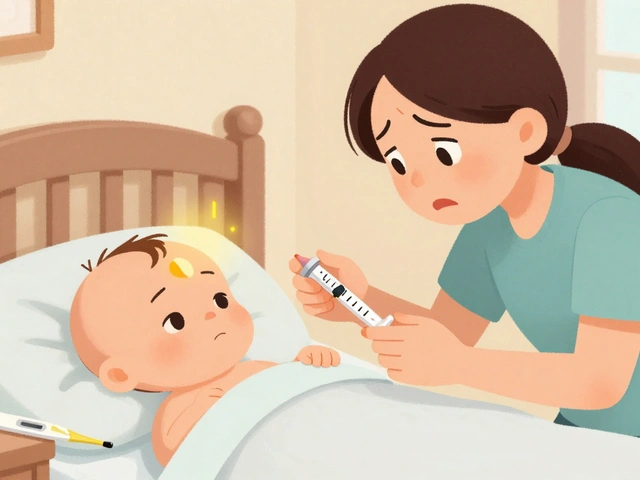
Don’t just squirt it in. Hold your child upright. Use the syringe that came with the bottle. Slowly drip it along the inside of the cheek. Don’t squirt it down the throat-that can cause choking.
Keep the dosing tool with the medicine. Don’t leave it on the counter. Don’t use it for anything else. One parent in a BabyCenter survey said they used the syringe to feed their baby applesauce. They later gave the wrong dose because they didn’t clean it properly.
Store both medicines out of reach. Even a teaspoon of ibuprofen can land a toddler in the ER. The American Association of Poison Control Centers says 17% of pediatric poisonings come from adult formulations. That’s right-someone gave their child adult Tylenol because it was “just one pill.”
When to Call the Doctor
Medicines help, but they don’t fix the cause. If your child is under 3 months and has a fever of 100.4°F or higher, call the doctor immediately. No waiting. No giving medicine first.
For older kids, call if:
- The fever lasts more than 72 hours
- Your child won’t drink, is lethargic, or won’t wake up
- They have a rash, stiff neck, or trouble breathing
- You’ve given the maximum dose for 2 days and the fever hasn’t dropped
And if you’re ever unsure about the dose-call. Don’t Google it. Don’t ask a friend. Call your pediatrician or a poison control center. They’ve seen it all.
What’s Coming Next?
The American Academy of Pediatrics is updating its fever guidelines in January 2025. They’re looking at new data on acetaminophen and asthma, and whether ibuprofen should be recommended earlier for babies under 6 months.
Right now, the evidence says: ibuprofen works better for fever. Acetaminophen is gentler on the stomach. Both are safe if you dose by weight, use the right tool, and never mix them without a doctor’s okay.
The best medicine isn’t the one with the fanciest bottle. It’s the one you give correctly.
Ethan McIvor
December 3, 2025 AT 13:28Just wanted to say thanks for this. I’ve been panic-dosing my 8-month-old every 3 hours thinking I had to alternate… turns out I was just exhausting myself. 😅 This cleared up so much. Feels like someone finally spoke plain English instead of medical jargon.
Mindy Bilotta
December 4, 2025 AT 04:50OMG the 2011 concentration change?? I had an old bottle in the back of my cabinet and just checked-yep, it’s the 80mg/0.8mL one. I’m tossing it rn. Also, never knew a kitchen spoon could be that dangerous… my toddler once got a whole tsp of syrup from my coffee spoon. Yikes.
Michael Bene
December 6, 2025 AT 00:38Let me just say-this whole post is a masterclass in not being an idiot. Acetaminophen = silent liver assassin. Ibuprofen = kidney stressor with a side of diarrhea. And yet, we treat these like candy because they’re ‘over the counter.’
Meanwhile, the FDA’s sitting on a 2025 review like it’s a Netflix season drop. Meanwhile, moms are eyeballing syringes while their kid screams like they’re being tortured by a vacuum cleaner. And you think ‘it’s just a fever’? Nah. It’s a minefield wrapped in a pink bottle labeled ‘Children’s Tylenol.’
Also, generics? Yes. Brand names? You’re paying for the cartoon bear. Not the medicine. The medicine is the same. Stop being a sucker.
Brian Perry
December 7, 2025 AT 17:26Wait so if my kid is 10lbs and I give 1.25ml of Tylenol… that’s like… a drop? How do you even measure that without a microscope?? I swear I’ve given doses based on how much ‘looks right.’ And now I’m terrified. 😭
Gavin Boyne
December 8, 2025 AT 19:58Canada’s got it right with the 6-month ibuprofen cutoff. In the US, we treat babies like lab rats with insurance. ‘Oh, it’s not FDA-approved for under 6? Cool, I’ll just do it anyway.’
Meanwhile, the real problem isn’t the meds-it’s the fact that pediatricians are booked out for 6 weeks and parents are left Googling like it’s a dating app. ‘Is this fever normal?’ ‘Should I give Motrin?’ ‘Will my kid turn into a zombie?’
Stop the panic. Measure by weight. Use the syringe. Don’t be a hero. Call the doctor. It’s not rocket science. It’s just… common sense. And apparently, that’s the rarest thing in parenting right now.
Ignacio Pacheco
December 9, 2025 AT 01:55Interesting that the asthma link with acetaminophen isn’t proven but still gets flagged. Reminds me of the whole ‘vaccines cause autism’ panic-correlation isn’t causation. But the FDA reviewing it? That’s a signal. Not a verdict. Still, I’d lean toward ibuprofen for fever unless stomach’s upset. Less mystery, less risk.
Jim Schultz
December 9, 2025 AT 10:26Wow. Just… wow. You actually wrote a 2,000-word essay on fever meds and didn’t once say ‘trust your gut.’ That’s practically a miracle in parenting culture. Most posts end with ‘if you’re unsure, just call your doc’-but you actually told people HOW to call, WHAT to say, and WHY it matters. That’s not advice. That’s a public service.
Also, the ‘adult Tylenol = one pill’ thing? I’ve seen it. A mom gave her 18-month-old a 500mg tablet because ‘it was just one.’ Kid ended up in ICU. That’s not negligence. That’s a horror movie. And you’re the narrator who didn’t sugarcoat it. Thank you.
Kidar Saleh
December 10, 2025 AT 22:53This is the kind of post that should be printed and laminated. Taped to the fridge. Given to every new parent at the hospital. The dosing charts? The syringe warnings? The 2011 concentration change? These are life-or-death details buried in the fine print-and you pulled them into the light.
And the bit about not alternating unless directed? That’s the golden nugget. So many parents think they’re being proactive by alternating-they’re just playing Russian roulette with their child’s liver.
Well done. This isn’t just informative. It’s heroic.