
When you hear about a new cancer drug in the news, it’s easy to think it’s just another pill that might help. But behind every successful treatment is a much more precise story - one shaped by biomarkers and carefully defined inclusion criteria. These aren’t just buzzwords. They’re the gatekeepers that decide who gets access to life-changing therapies - and who doesn’t. For patients with cancer, understanding how these systems work can mean the difference between joining a trial that could extend their life and being turned away because their tumor doesn’t match the profile.
What Exactly Are Biomarkers in Cancer Trials?
A biomarker is any measurable sign in your body that tells doctors something about your disease. It could be a gene mutation, a protein level in your blood, or even the shape of a tumor on a scan. In cancer, biomarkers help identify which patients are most likely to respond to a specific drug. The FDA defines them as objective measures of biological processes, and they’re now used in nearly 60% of cancer drugs approved since 2017.Think of it like this: not all breast cancers are the same. Some have too much HER2 protein. Others have BRCA mutations. A drug that works wonders for HER2-positive tumors might do nothing for a HER2-negative one. Biomarkers help match the right drug to the right patient. This is precision medicine in action - no more guessing.
How Inclusion Criteria Are Built Around Biomarkers
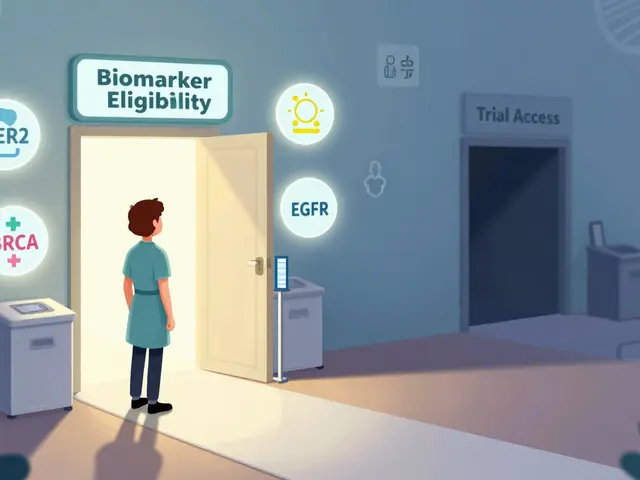
Inclusion criteria are the rules that determine who can join a clinical trial. Traditional trials used broad criteria: age, cancer stage, previous treatments. Now, biomarkers have become the most important filter. For example, a trial might require:- Presence of a specific EGFR mutation in non-small cell lung cancer
- High tumor mutational burden (TMB) in melanoma
- Microsatellite instability (MSI-H) in colorectal cancer
- BRCA1 or BRCA2 germline mutation in ovarian cancer
These aren’t arbitrary. Each one has been validated through years of research. If a patient doesn’t meet the biomarker requirement, they’re excluded - not because they’re not sick enough, but because the drug is designed to target a specific biological flaw. This sounds strict, but it’s actually more effective. Trials using biomarker-based inclusion criteria have a nearly 50% success rate in Phase 2, compared to under 30% for trials that don’t use them.
Why Biomarker Trials Work Better
The old way of running trials was like throwing a net into the ocean hoping to catch fish. You’d enroll hundreds of patients with the same cancer type, hoping a few would respond. Most didn’t. The drug failed, and everyone lost time.Now, it’s like using sonar. You find the exact patch of water where the fish you want are swimming. Trials that select patients based on biomarkers recruit faster, have higher response rates, and are more likely to get approved. A 2021 analysis of over 9,700 drug development programs found that biomarker-driven trials were twice as likely to reach regulatory approval. That’s not luck - it’s science.
Take the case of neratinib, a drug for HER2-mutant breast cancer. In unselected patients, response rates were around 12%. When researchers used HER2 mutation as an eligibility criterion, that jumped to 32%. That’s not a small improvement - it’s the difference between a drug being shelved and becoming a standard treatment.
The Hidden Challenges of Using Biomarkers
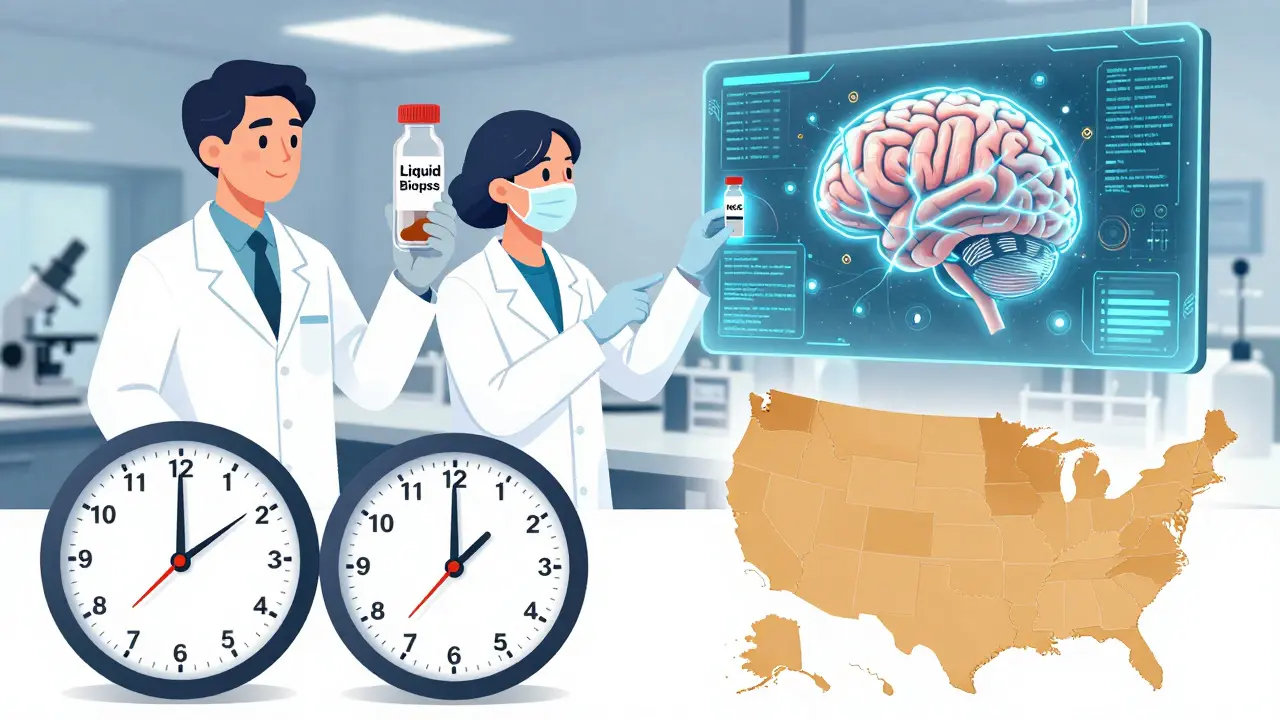
It’s not all smooth sailing. Even though biomarkers improve outcomes, they add layers of complexity.First, testing takes time. Specialized biomarker tests - like next-generation sequencing or liquid biopsies - can take 7 to 14 days to process. That’s a long wait for someone whose cancer is progressing. Some sites don’t have the lab equipment, so samples have to be shipped across states or even countries. Delays like this can cause patients to lose eligibility.
Second, biomarkers aren’t evenly distributed. A mutation common in one population might be rare in another. For example, the HLA-A*02:01 biomarker, used in some cell therapies, appears in over 50% of Europeans but under 20% in parts of North America. This means global trials have to adjust site locations, or risk not enrolling enough patients.
Third, not all tests are created equal. A study found that 68% of biomarkers used in early trials lacked proper validation. If the test isn’t accurate, you might exclude someone who could benefit - or worse, include someone who won’t respond. That’s why labs must be CLIA-certified and methods must be standardized across all trial sites.
What Happens Behind the Scenes
Before a biomarker can be used in a trial, it goes through a rigorous qualification process. The FDA requires a Context of Use statement that answers five key questions:- What medical need does it address?
- What exactly is the biomarker?
- How will it be used in the trial?
- How is it measured?
- What evidence supports it?
This process can take 18 to 24 months. That’s why many trials still use biomarkers that haven’t been fully approved - they’re considered exploratory. But if the test result directly affects treatment decisions, the FDA requires full validation. This creates tension between innovation and safety.
Site staff also need serious training. A typical biomarker trial requires 120 to 160 hours of staff education - more than triple what’s needed for traditional trials. Nurses have to learn how to handle tissue samples correctly, when to draw blood, and how to explain complex results to patients. Without proper training, errors creep in - and patients get left out.

The Future: Liquid Biopsies, AI, and Real-World Data
The next wave of innovation is already here. Liquid biopsies - blood tests that detect tumor DNA - are now used in 31% of Phase 2+ cancer trials, up from just 9% in 2020. These tests are faster, less invasive, and can be repeated over time. Instead of waiting for a tissue biopsy, doctors can track how a tumor evolves during treatment.Some trials are even using dynamic eligibility. If a patient’s biomarker changes after starting treatment, they might be reclassified - allowing them to switch to a new drug mid-trial. This flexibility was unthinkable a decade ago.
Artificial intelligence is also helping. Companies are using AI to scan millions of genetic records and find new biomarker patterns. By 2025, over 65% of new trials are expected to use multi-omic panels - combining DNA, RNA, protein, and metabolic data to build a full picture of a patient’s cancer.
And soon, real-world data from electronic health records will help validate biomarkers faster. Instead of waiting for a trial to prove a biomarker works, regulators might use data from thousands of real patients. This could cut years off the approval timeline.
Who Benefits - and Who Gets Left Behind?
The biggest win is clear: patients with rare mutations finally have a fighting chance. A decade ago, someone with a ROS1 fusion in lung cancer had no targeted therapy. Now, they do - because a biomarker made it possible.But equity remains a problem. Biomarker testing isn’t equally available everywhere. Rural clinics, low-income countries, and underserved communities often lack access to genetic testing. A patient in Sydney might get tested within days. A patient in rural Queensland might wait months - if they get tested at all.
That’s why the future of clinical trials isn’t just about science. It’s about logistics, funding, and fairness. The goal isn’t just to find better drugs - it’s to make sure the right patients, no matter where they live, can get them.
What You Can Do
If you or someone you know is considering a cancer clinical trial:- Ask: “What biomarkers are being tested?”
- Find out if your hospital has a molecular tumor board - they help interpret complex results.
- Request a copy of your biomarker test report. Don’t assume the trial team has it - sometimes records get lost.
- Ask about alternative sites. If your local hospital doesn’t offer the test, another center might - and they might cover travel costs.
Knowledge is power. Understanding biomarkers doesn’t just help you qualify - it helps you advocate for the best possible care.
What’s the difference between a biomarker and a genetic mutation?
A genetic mutation is a change in your DNA - like a typo in a book. A biomarker is any measurable sign that tells doctors something about your disease. A mutation can be a biomarker - for example, a BRCA1 mutation is both a genetic change and a biomarker used to identify patients who may respond to PARP inhibitors. But not all biomarkers are genetic. Some are proteins, tumor shapes, or blood markers. So, all mutations used in trials are biomarkers, but not all biomarkers are mutations.
Can I be turned away from a trial just because I don’t have a biomarker?
Yes - but only if the trial is designed to test a targeted therapy. If a drug is meant to block a specific protein or gene, it won’t work on patients whose tumors don’t have that target. This isn’t rejection - it’s precision. However, there are always other trials available. Many trials now include biomarker screening as part of enrollment, so even if you don’t qualify for one, you might qualify for another. Always ask about alternative options.
How long does biomarker testing usually take?
It varies. Simple tests like IHC for HER2 can take 3-5 days. Complex tests like whole-exome sequencing or liquid biopsy panels often take 7-14 days. Some specialized labs in major cities can deliver results in 5 days. If you’re on a tight timeline, ask if the trial site has a fast-track lab or if samples can be sent to a centralized testing center - many do, especially in oncology trials.
Are biomarker tests covered by insurance?
In Australia, Medicare covers many biomarker tests when they’re part of approved cancer treatment pathways - especially for lung, melanoma, and colorectal cancers. In the U.S., most private insurers cover FDA-approved companion diagnostics. But off-label or exploratory tests may not be covered. Always check with your insurance provider and the trial coordinator. Some trials cover testing costs entirely - this should be clearly stated in the consent form.
Can I get retested if my biomarker status changes?
Yes - and increasingly, trials are designed to allow this. Tumors evolve. A biomarker that was negative at diagnosis might become positive after treatment. Some trials now use “dynamic eligibility,” where retesting is built into the protocol. If you’re already in a trial and your cancer progresses, ask if you can be retested. You might qualify for a new arm of the study or a different drug entirely.
John Smith
February 25, 2026 AT 23:39Gwen Vincent
February 27, 2026 AT 22:56Lillian Knezek
March 1, 2026 AT 01:40Maranda Najar
March 1, 2026 AT 12:44Christina VanOsdol
March 2, 2026 AT 19:42Matthew Brooker
March 3, 2026 AT 22:56Joseph Cantu
March 4, 2026 AT 22:31Jacob Carthy
March 6, 2026 AT 07:50Lisandra Lautert
March 7, 2026 AT 23:55Cory L
March 8, 2026 AT 01:32Bhaskar Anand
March 8, 2026 AT 03:47Dinesh Dawn
March 8, 2026 AT 14:53Vanessa Drummond
March 8, 2026 AT 18:56Nick Hamby
March 10, 2026 AT 11:14